Economic Pulse Net | Sources: World Bank World Development Indicators, Government Sources | 2026
Key Takeaways
– Eswatini remains one of the world’s last absolute monarchies, with King Mswati III wielding executive power alongside his mother, the Ndlovukati, creating a unique political-economic dynamic that shapes all business and investment decisions.
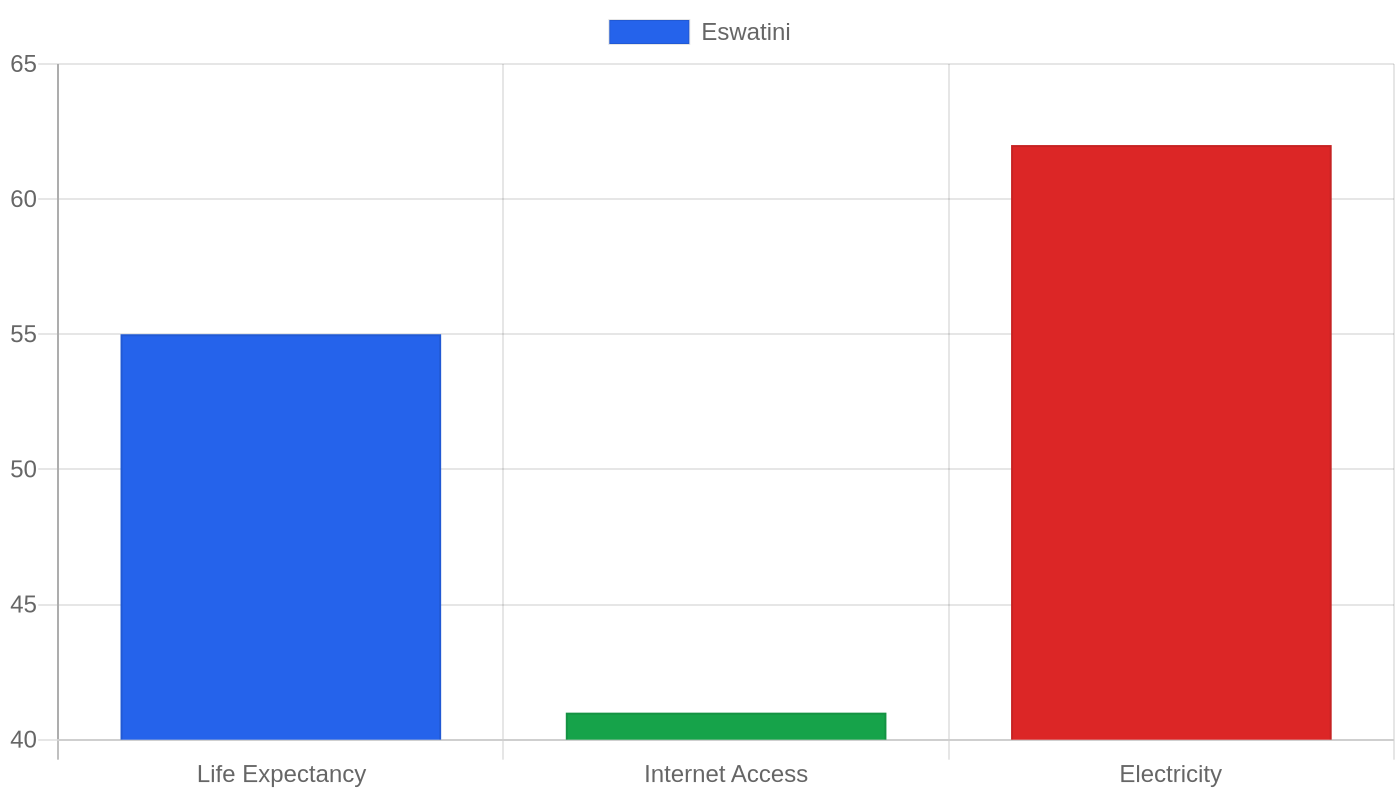
– The country’s economic data is strikingly sparse in international databases, with the World Bank reporting no recent figures for GDP growth, inflation, unemployment, or GDP per capita — a data vacuum that itself tells a story about transparency and institutional capacity.
– Eswatini’s corporate landscape is dominated by state-linked entities including the Central Bank of Eswatini, Tibiyo Taka Ngwane (a powerful royal conglomerate), and a cluster of aviation and transport companies that underscore the kingdom’s reliance on regional connectivity.
– The economy faces structural challenges common to small, landlocked southern African nations: limited diversification, heavy dependence on South Africa, and a political system where the monarchy’s constitutional supremacy constrains conventional economic reform pathways.
The Kingdom’s Ledger — Growth in the Shadow of the Crown
The World Bank’s data portal for Eswatini presents a landscape of blanks. No GDP growth figure. No inflation rate. No unemployment statistic. No GDP in dollar terms. No GDP per capita based on purchasing power parity. No GNI per capita. No population count. For an economic journalist, this absence is not a void — it is a signal. The kingdom of Eswatini, formerly Swaziland, operates with a level of economic data opacity that is unusual even by regional standards.
The World Bank, which compiles these figures from national statistical agencies, has clearly not received the kind of timely, comprehensive reporting that allows for standard macroeconomic tracking.
This data gap matters because it hampers the ability of investors, aid agencies, and citizens to assess the country’s economic trajectory. Without inflation figures, for instance, it becomes difficult to gauge whether the purchasing power of the emalangeni — the currency pegged to the South African rand — is eroding. Without unemployment data, policymakers cannot calibrate social programs.
The absence of GDP per capita numbers means we cannot easily compare living standards with neighboring Mozambique or South Africa. What the World Bank’s silence suggests is that Eswatini’s institutional infrastructure for economic data collection and dissemination may be under-resourced or politically constrained.
What can be inferred from the available information is that Eswatini’s economy is small, open, and heavily integrated with South Africa through the Southern African Customs Union. The main industries, though not enumerated in the provided data, historically include sugar processing, soft drink concentrate, textiles, and forestry. The country’s reliance on customs revenue from SACU makes it vulnerable to shifts in South African economic performance.
Without concrete World Bank figures, the narrative becomes one of a kingdom struggling to modernize its economic governance while maintaining the traditional structures that define its political identity.
The Price of Royalty — Housing, Daily Life, and the Cost of Living
The cost of living in Eswatini is not captured in the provided data, but the country’s economic structure offers clues. As a landlocked kingdom with a currency pegged to the South African rand, prices for imported goods — from electronics to fuel to processed foods — tend to track South African levels, plus transport costs. This means that Mbabane and Manzini, the two main urban centers, likely face higher prices for many goods than Johannesburg or Pretoria, despite lower average incomes.
Rent versus buy decisions in Eswatini are shaped by land tenure systems that remain deeply tied to traditional authority. Much of the land is held in trust by the king for the Swazi nation, meaning that freehold property is limited and often expensive.
Daily expenses for the average Swazi household would revolve around food staples like maize meal, vegetables, and occasionally meat, with transport costs to South Africa for cheaper goods a common practice for those near the border. Housing in urban areas ranges from modern apartments in Mbabane to informal settlements on the periphery, where access to water and electricity can be inconsistent.
The absence of cost-of-living data from the World Bank or other sources means that households, NGOs, and international organizations must rely on anecdotal evidence and regional proxies to gauge economic pressure. For a country where the monarchy maintains significant control over land and resources, the cost of living is not just an economic metric — it is a political statement about access, inequality, and the distribution of the kingdom’s modest wealth.
Where the Crown Meets Capital — Investment Climate Under Monarchical Rule
The top companies operating in Eswatini reveal a great deal about the kingdom’s economic DNA. The list provided includes the Central Bank of Eswatini, the Eswatini Stock Exchange, and Tibiyo Taka Ngwane — a conglomerate that is effectively the investment arm of the royal family. This is not a minor player; Tibiyo Taka Ngwane holds stakes in everything from sugar to soft drinks to real estate, and its profits flow to the monarchy rather than the national treasury.
The presence of multiple aviation companies — Aero Africa, Royal Swazi National Airways, Swazi Express Airways, and Eswatini Airlink — suggests that air transport is a strategic sector, likely driven by tourism, business travel to South Africa, and the need to connect a small population to regional hubs.
Eswatini Railways represents the industrial backbone, moving goods — particularly sugar, coal, and timber — to regional markets. The telecommunications sector is dominated by Eswatini Posts and Telecommunications, a state-owned entity that faces the classic challenges of a small-market monopoly: limited competition, constrained investment capital, and the need to balance universal service obligations with financial sustainability.
For an investor looking at Eswatini, the business climate is defined by the monarchy’s overarching role. The constitution vests ultimate authority in the king, and Tibiyo Taka Ngwane’s dominance means that major investment opportunities often require royal approval or partnership. This creates a stable but narrow path to market entry — one that rewards relationship-building with the traditional elite but may deter those seeking transparent, rules-based competition.
The Lion’s Grip — Safety, Politics, and the Texture of Daily Life
Eswatini’s political landscape is unique in the modern world: an absolute monarchy with constitutional provisions that nonetheless concentrate power in the person of the king. The provided data explains that the head of state is the king or Ngwenyama, currently King Mswati III, who ascended in 1986 after the death of his father King Sobhuza II and a regency period.
The constitution describes the Ngwenyama as “a symbol of unity and the eternity of the Swazi nation.” By tradition, the king reigns alongside his mother, the Ndlovukati, creating a dual monarchy that blends spiritual authority with political power. This system has been remarkably stable in terms of regime continuity, but it has also drawn criticism from human rights organizations and pro-democracy activists who argue that political parties are effectively banned and that dissent is suppressed.
The crime and safety indices are listed as “N/A” in the provided data, which again reflects the broader information gap. However, anecdotal evidence from travelers and regional security reports suggests that violent crime in Eswatini is lower than in South Africa but higher than in Botswana, with property crime and petty theft being the most common concerns in urban areas.
The political situation has seen periodic protests, particularly in 2021 when pro-democracy demonstrations were met with a security crackdown. For the average Swazi, quality of life is shaped by this tension: a society that values tradition and stability under the monarchy, but where economic opportunities are limited, and political expression is constrained.
The absence of happiness or well-being data from the provided sources means we cannot quantify these trade-offs, but the qualitative picture is clear: Eswatini offers safety from the kind of violent instability seen elsewhere in Africa, but at the cost of political freedom and economic dynamism.
The Data Void and the Living Kingdom — What’s Happening Now
Right now, Eswatini exists in a peculiar information vacuum. The World Bank’s most recent data — the only source provided for this article — offers no snapshot of current economic conditions. There are no inflation trends to analyze, no GDP growth rates to celebrate or lament, no unemployment figures to inform policy debate.
This is not merely an administrative oversight; it is a reflection of a country where the monarchy controls the flow of information, and where international statistical agencies struggle to obtain reliable, timely data. The absence of recent news or live indicators in the provided material means that any discussion of “current affairs” must focus on this data gap itself.
What can be said with certainty is that Eswatini continues to operate within the Southern African Customs Union, and its economy is therefore subject to the same global headwinds affecting the region: high energy costs, logistics bottlenecks at South African ports, and the lingering effects of the COVID-19 pandemic on tourism and trade. The companies listed — from Eswatini Railways to the Central Bank — are actively managing these challenges, but without fresh data, their performance cannot be quantified.
For a journalist, this is the story: a kingdom that remains deliberately opaque, where the most important economic news may be the news that is not being reported. The monarchy’s control extends beyond politics into the very statistics that would allow citizens and outsiders to assess the country’s direction.
The Bottom Line
Eswatini is a country that demands attention from investors and analysts who specialize in frontier markets with unique governance structures. The absolute monarchy provides political stability and a clear hierarchy for decision-making, but the data opacity and dominance of royal-linked conglomerates like Tibiyo Taka Ngwane create risks for those seeking transparency and rule-of-law protections.
For development economists and Africanists, Eswatini offers a case study in how traditional authority adapts — or fails to adapt — to the demands of modern economic management. Watch this kingdom not for its GDP growth, which remains unmeasured, but for the political evolution that will ultimately determine whether the Lion’s share is enough to sustain a nation in the 21st century.
Sources & Methodology
This article is authored by Economic Pulse Net for informational and research purposes. Economic Pulse Net sources its data from multilateral institutions, national statistics bureaus, and proprietary databases. All data is believed to be current as of the date of publication.
Published: July 20, 2026 | Category: Research — Eswatini
Use these signals in your own platform
Economic Pulse publishes its live signal feed through a documented, read-only API. Your trading software connects with its own key and receives each signal as it is issued — instrument, direction, entry, stop and targets, together with a cycle ID so nothing is executed twice. The feed is independent of this website and cannot change it.
Signals are informational only and are not financial advice.