Economic Pulse Net | Sources: World Bank World Development Indicators, Government Sources | 2026
Key Takeaways
– Eritrea has never held a national election since independence in 1993, with President Isaias Afwerki remaining in power under the country’s single-party system, the People’s Front for Democracy and Justice (PFDJ).
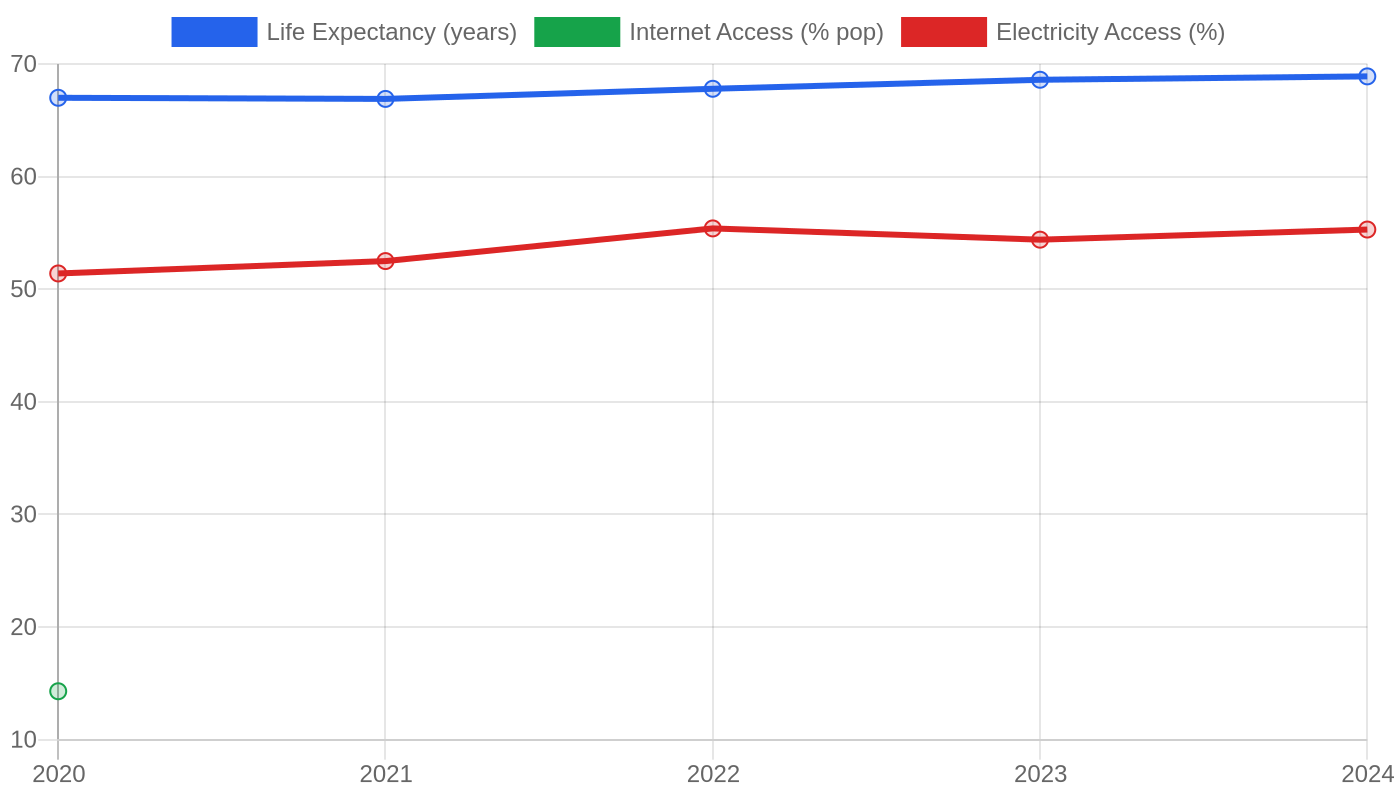
– The World Bank provides no official economic data for Eritrea — no GDP growth, no inflation rate, no unemployment figure, no GDP per capita, and no population estimate — making it one of the most statistically opaque nations on Earth.
– The 1997 constitution, which promised multi-party politics, remains unimplemented, and all scheduled national elections have been cancelled, most recently as of 2025.
– With no major industries, no listed top companies, and no cost-of-living data available, Eritrea’s economy functions largely outside international observation, driven by remittances, a large diaspora, and a state-controlled system of indefinite national service.
The Black Box Economy — When a Country Disappears from the Data
If you search for Eritrea in the World Bank’s economic databases, you will find blank fields. GDP growth: not available. Inflation: not available. Unemployment: not available. GDP per capita: not available. Even the country’s population — one of the most basic metrics for any nation — is listed as “not available” by the World Bank. This is not a data collection oversight. It is a statement about the nature of the Eritrean state.
The absence of numbers is itself the most telling statistic. For a country that has been independent since 1993, the lack of any internationally verified economic indicators suggests either a deliberate refusal to engage with global financial institutions or a state apparatus that does not generate the kind of standardized data modern economies are expected to produce.
The World Bank’s silence on Eritrea means analysts, investors, and journalists must rely on fragmentary reports, diaspora networks, and satellite imagery to piece together what is happening inside one of the world’s most isolated nations.
What we do know comes not from economic spreadsheets but from political reality. Eritrea’s economy is shaped by its political structure: a single-party state under the PFDJ, with President Isaias Afwerki in power since independence. The country’s infamous indefinite national service program — which conscripts citizens for years with no clear end date — has created a massive brain drain, with hundreds of thousands of Eritreans fleeing to Europe and neighboring countries.
Remittances from this diaspora form a critical, if unquantified, pillar of what little economic activity exists. Without formal industries, without foreign investment, without even basic data, Eritrea’s economy operates as a closed system, sustained by a combination of state control, military mobilization, and external support from the Eritrean diaspora.
The Price of Living in a Data Void — Housing, Daily Expenses, and the Informal Economy
There are no official housing costs, no rental indices, no consumer price baskets for Eritrea. The World Bank provides no cost-of-living data, and no international organization tracks what it costs to buy bread in Asmara or rent a room in Massawa. This is not because nothing costs anything — it is because the economy functions so far outside formal channels that standard measurements become meaningless.
In the absence of data, what we know comes from anecdotal reports and the experiences of the Eritrean diaspora. The country operates with a dual currency system: the official nakfa, which is heavily controlled and nearly worthless outside state channels, and the US dollar or Ethiopian birr, which circulate informally. Basic goods are scarce.
The indefinite national service means that a significant portion of the working-age population is either in military camps or engaged in unpaid state projects, removing them from the labor market and suppressing any normal housing or consumer goods economy.
For the small urban middle class in Asmara, housing is often tied to family networks or state allocation. There is no functioning mortgage market, no rental agency system, no property listings. Daily expenses are met through a combination of formal salaries — which are among the lowest in Africa — and remittances from relatives abroad. The cost of living, such as it is, is defined not by market prices but by scarcity, state control, and the informal networks that have developed to circumvent both.
No Companies, No Investment — The Business Climate in a Single-Party State
The data provided lists “Top Companies” as blank. This is not an oversight. Eritrea has no stock exchange, no publicly traded corporations, no internationally recognized private sector of any significant scale. The economy is dominated by state-owned enterprises controlled by the PFDJ, which operates as both political party and economic conglomerate. Mines, construction, transportation, and telecommunications are all under state control or closely allied with the ruling party.
The business environment for foreign investors is among the most challenging in the world. There is no independent judiciary to enforce contracts. The single-party political structure means that any significant economic activity requires approval from a state that has shown little interest in opening its economy to outside scrutiny.
The few international companies that have operated in Eritrea — primarily in mining — have faced unpredictable regulatory environments, disputes over revenue sharing, and the broader instability of a country that remains under UN sanctions related to its involvement in the Somali conflict.
Sectors that might attract investment — mining, agriculture, fisheries, tourism — remain underdeveloped. Eritrea’s Red Sea coastline is pristine and strategically located, but the combination of political isolation, lack of infrastructure, and the absence of any legal framework for foreign ownership has kept investors away. The PFDJ’s control over the economy is not just political; it is financial.
Without independent companies, without a private sector worth measuring, the business climate in Eritrea is not so much difficult as it is nonexistent.
Safety Under Surveillance — Politics, Crime, and Life in a Perpetual State of Emergency
The Crime Index and Safety Index for Eritrea are both listed as “not available.” This is consistent with a country that does not participate in international crime reporting systems. But the absence of data does not mean the absence of control. Eritrea is often described as one of the most militarized societies in the world. The indefinite national service program, which the UN has compared to forced labor, means that the state maintains a pervasive presence in daily life.
The political landscape is unequivocal: the PFDJ is the only legal party. Other political groups are not allowed to organize. The National Assembly has 150 seats, but national elections have been periodically scheduled and cancelled, with none ever held as of 2025. President Isaias Afwerki has been in office since independence in 1993. The 1997 constitution, which promised multi-party politics, remains unimplemented. There is no freedom of the press, no independent civil society, no political opposition.
For ordinary Eritreans, safety is a complex concept. Violent crime rates are believed to be low, due in large part to the state’s extensive surveillance and control mechanisms. But safety from the state itself is another matter. Arbitrary detention, forced conscription, and restrictions on freedom of movement are well-documented by human rights organizations.
Quality of life is shaped not by economic indicators but by the ability to navigate a system that demands indefinite service, limits travel, and punishes dissent. The Eritrean diaspora — estimated at over 500,000 people, a significant portion of the country’s likely population — is itself a statement about the quality of life inside the country.
The Frozen Present — No Elections, No Data, No Change
As of 2025, Eritrea remains in a state of political and economic stasis. National elections have been cancelled yet again. The 1997 constitution remains a document without force. President Isaias Afwerki, now in his fourth decade in power, shows no signs of stepping down or allowing political liberalization. The PFDJ’s monopoly on power is absolute, and the state’s control over the economy is unchallenged.
There are no recent news reports of policy reforms, no inflation trends to track, no business developments to analyze. The country that was once a focal point of international attention during its war of independence and its later border conflict with Ethiopia has receded from global consciousness. Even the 2018 peace deal with Ethiopia, which raised hopes of opening and reform, has not translated into measurable economic change. The border with Ethiopia remains tense. The UN sanctions remain in place.
The diaspora continues to leave.
What is happening right now in Eritrea is, in many ways, what has been happening for decades: nothing visible to the outside world. The country’s leadership has chosen isolation over integration, control over development, and silence over transparency. In an era of global data, Eritrea remains a blank space on the economic map — not because it does not exist, but because it has chosen not to be seen.
The Bottom Line
Eritrea is a country for those who study the edges of the global system — the places where standard economic models fail and political control trumps market forces. For investors, it offers nothing: no data, no legal framework, no exit strategy. For human rights observers and political analysts, it is a case study in how a state can survive for decades without elections, without growth, and without accountability. For the Eritrean diaspora, it remains a homeland they cannot safely return to.
Watch Eritrea not for its economic potential, but for what it reveals about the limits of international data and the endurance of authoritarianism in the modern world.
Sources & Methodology
This article is authored by Economic Pulse Net for informational and research purposes. Economic Pulse Net sources its data from multilateral institutions, national statistics bureaus, and proprietary databases. All data is believed to be current as of the date of publication.
Published: July 20, 2026 | Category: Research — Eritrea
Use these signals in your own platform
Economic Pulse publishes its live signal feed through a documented, read-only API. Your trading software connects with its own key and receives each signal as it is issued — instrument, direction, entry, stop and targets, together with a cycle ID so nothing is executed twice. The feed is independent of this website and cannot change it.
Signals are informational only and are not financial advice.