Economic Pulse Net | Sources: World Bank World Development Indicators, Government Sources | 2026
Key Takeaways
* Resource-Heavy Economy: The nation’s industrial landscape is dominated by oil and gas giants, with EG LNG, GEPetrol, and Sonagas forming the backbone of the commercial sector.
Political Centralization: President Teodoro Obiang holds extensive constitutional powers, allowing him to legislate by decree and control the cabinet, creating a highly centralized unitary state.
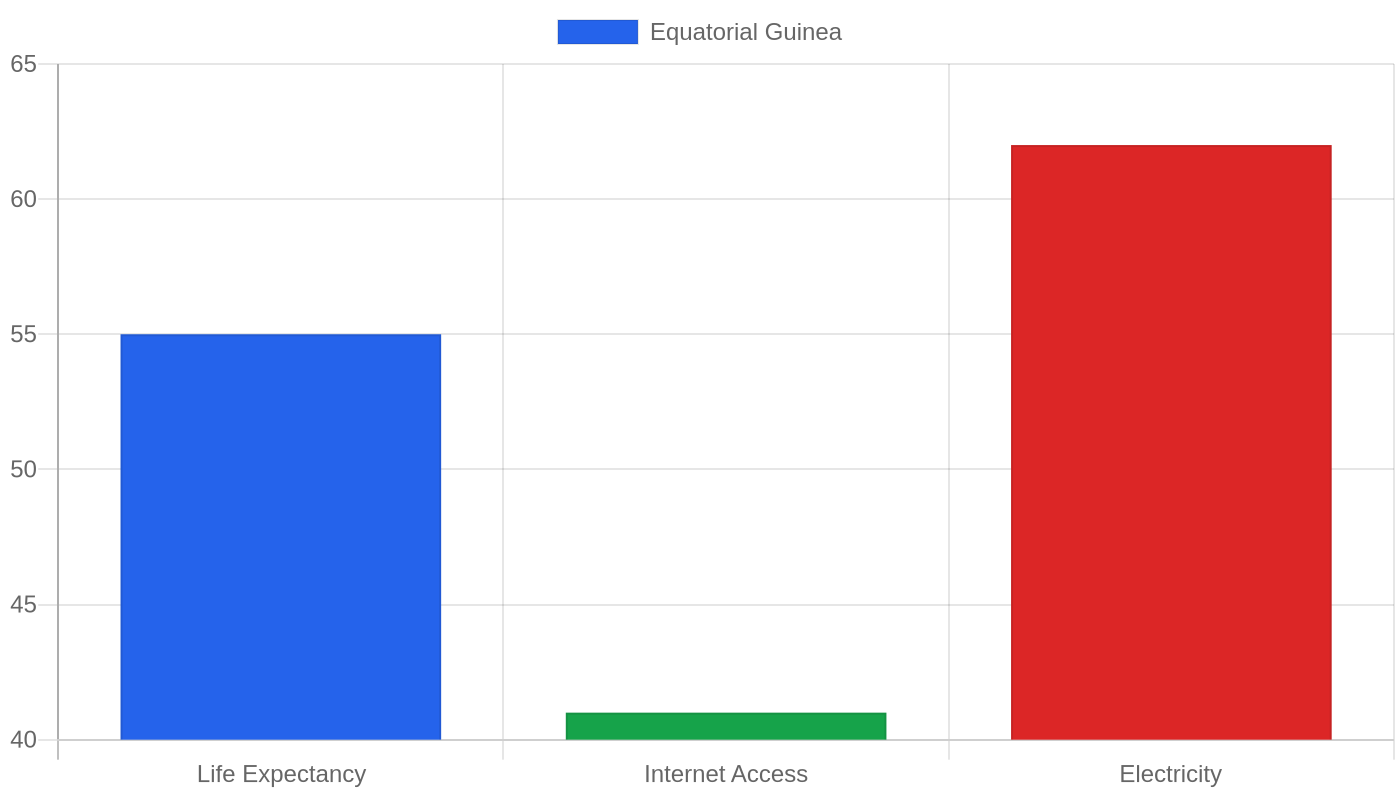
Data Scarcity: Official economic metrics such as GDP growth, inflation, and unemployment are currently listed as N/A by the World Bank, complicating standard macroeconomic analysis.
Service Sector Presence: Beyond energy, consumer services are represented by major airlines including Ceiba Intercontinental, Cronos Airlines, and Guinea Ecuatorial Airlines.
Safety and Rights Concerns: International bodies like Human Rights Watch have raised significant concerns regarding civil liberties and governance under the current administration.
The Invisible Ledger: Navigating an Opaque Economic Landscape
Equatorial Guinea presents a unique challenge for economists and investors alike, primarily due to the stark absence of granular data in public records. According to the World Bank, key indicators such as GDP growth, inflation CPI, unemployment rates, and even total GDP figures are reported as N/A. This lack of transparency creates a fog around the country’s true economic health, forcing analysts to look at structural indicators rather than statistical trends.
Despite this data void, the main industries provide a clear picture of the nation’s reliance on hydrocarbons. The economy is heavily skewed toward the Oil & gas sector, driven by major players like EG LNG, GEPetrol, and Sonagas. These entities are not just contributors; they are likely the primary engines of foreign exchange and state revenue, given the absence of diversified manufacturing or agricultural export data.
While the specific contribution of these sectors to the national income remains unquantified in available reports, their prominence in the top companies list suggests that the fiscal pulse of the nation beats in rhythm with global energy prices. For any observer trying to gauge economic stability, the silence from the World Bank data points is louder than any number could be, indicating either a severe reporting gap or a deliberate opacity that shields the state from international scrutiny.
High Costs in a Hidden Market
For expatriates and businesses operating within Equatorial Guinea, the cost of living remains a critical, albeit poorly documented, variable. With no specific housing indices or daily expense metrics provided in the current dataset, it is impossible to calculate precise rent-to-income ratios or compare local costs against regional averages using standard inflation trackers.
However, the presence of established utility providers like Segesa indicates a functioning infrastructure network that likely commands premium pricing in urban centers. In resource-rich but data-poor economies, the cost of living is often decoupled from local wages, meaning that those earning in hard currency may find basic amenities expensive relative to global standards, while locals face different purchasing power dynamics.
Without concrete figures on the Consumer Price Index (CPI), which is also listed as N/A, we cannot determine if the country is experiencing deflationary pressures or hyperinflation. Consequently, businesses must rely on anecdotal evidence and direct market inquiries rather than published cost-of-living indexes when budgeting for operations. This uncertainty adds a layer of risk premium to any financial planning, as hidden costs can emerge without warning in markets where price transparency is low.
Energy Dominance and Corporate Structure
The corporate landscape of Equatorial Guinea is defined by a dual pillar of energy production and consumer connectivity. At the forefront are the state-linked or dominant private firms in the Oil & gas sector: EG LNG, GEPetrol, and Sonagas. These companies represent the primary avenue for large-scale investment and employment, though the scale of hiring is obscured by the lack of unemployment data.
Parallel to this industrial core is a robust consumer services sector, highlighted by the presence of multiple aviation entities. Ceiba Intercontinental Airlines, Cronos Airlines, Ecuato Guineana, and Guinea Ecuatorial Airlines suggest a competitive, if perhaps fragmented, air transport network essential for both tourism and business travel. The existence of several airlines in a small market implies either intense competition or overlapping service areas catering to different segments of the population.
For investors, the focus remains squarely on the energy value chain, as these firms likely hold the majority of the country’s foreign direct investment (FDI) inflows. The diversification into utilities via Segesa further indicates efforts to maintain essential services, yet the dominance of energy firms underscores the economy’s vulnerability to commodity price shocks.
Understanding the interplay between these state-heavy energy corporations and the consumer-facing airlines is key to grasping the operational reality of doing business in the region.
Governance, Safety, and Social Stability
The political environment in Equatorial Guinea is characterized by extreme centralization and limited checks on executive power. President Teodoro Obiang, who has led the nation since the adoption of the 1982 constitution, wields extensive authority that includes naming and dismissing cabinet members, making laws by decree, and dissolving the Chamber of Representatives. This constitutional framework defines the nation as a unitary state, consolidating decision-making power at the highest levels of government.
Such a structure raises significant questions about policy continuity and responsiveness to public needs, as legislative oversight is effectively neutralized by the president’s decree-making powers. From a safety perspective, crime and safety indices are listed as N/A, leaving a vacuum in our understanding of personal security risks for residents and visitors.
However, broader social stability is complicated by human rights concerns; Human Rights Watch has criticized the dictatorship for its treatment of citizens, suggesting that political repression may undermine social cohesion. The combination of authoritarian governance and opaque security data creates an environment where political risk is high, and the rule of law may be subject to the whims of the executive branch.
For long-term stakeholders, the stability offered by strongman rule is counterbalanced by the potential for sudden policy shifts and international isolation due to rights violations.
Current Affairs and Policy Implications
While specific recent news events are not detailed in the provided text, the ongoing political landscape dictates the current affairs narrative. The persistence of the 1982 constitution’s provisions means that any reform efforts are entirely dependent on the will of President Obiang, who serves as commander in chief of the armed forces and negotiates treaties independently.
This concentration of power suggests that any economic reforms or international agreements are likely to be top-down initiatives rather than results of broad political consensus. The lack of updated World Bank data implies that international institutions may have limited engagement or access to reliable statistics, which could affect future aid or investment flows.
Meanwhile, the continued operation of major airlines and energy firms indicates that despite political controversies, the core economic machinery continues to function. The tension between the country’s resource wealth and its political isolation remains the defining feature of its current affairs. Stakeholders must navigate a landscape where legal frameworks can change by decree and where international criticism, such as that from Human Rights Watch, does little to alter the domestic power structure.
The “now” in Equatorial Guinea is defined by continuity of power and opacity of data, requiring cautious and informed engagement.
The Bottom Line
Equatorial Guinea remains a high-risk, high-opportunity frontier for specialized investors, particularly those in the energy sector. The complete absence of standard economic data necessitates extreme due diligence, as traditional valuation models cannot be applied without significant adjustment. Investors should focus on the entrenched power of EG LNG, GEPetrol, and Sonagas, while remaining vigilant regarding the political risks associated with President Obiang’s absolute authority.
Ultimately, this country demands a strategy built on direct relationships and on-the-ground intelligence rather than reliance on published macroeconomic indicators.
Sources & Methodology
This article is authored by Economic Pulse Net for informational and research purposes. Economic Pulse Net sources its data from multilateral institutions, national statistics bureaus, and proprietary databases. All data is believed to be current as of the date of publication.
Published: October 12, 2026 | Category: Research — Equatorial Guinea
Use these signals in your own platform
Economic Pulse publishes its live signal feed through a documented, read-only API. Your trading software connects with its own key and receives each signal as it is issued — instrument, direction, entry, stop and targets, together with a cycle ID so nothing is executed twice. The feed is independent of this website and cannot change it.
Signals are informational only and are not financial advice.