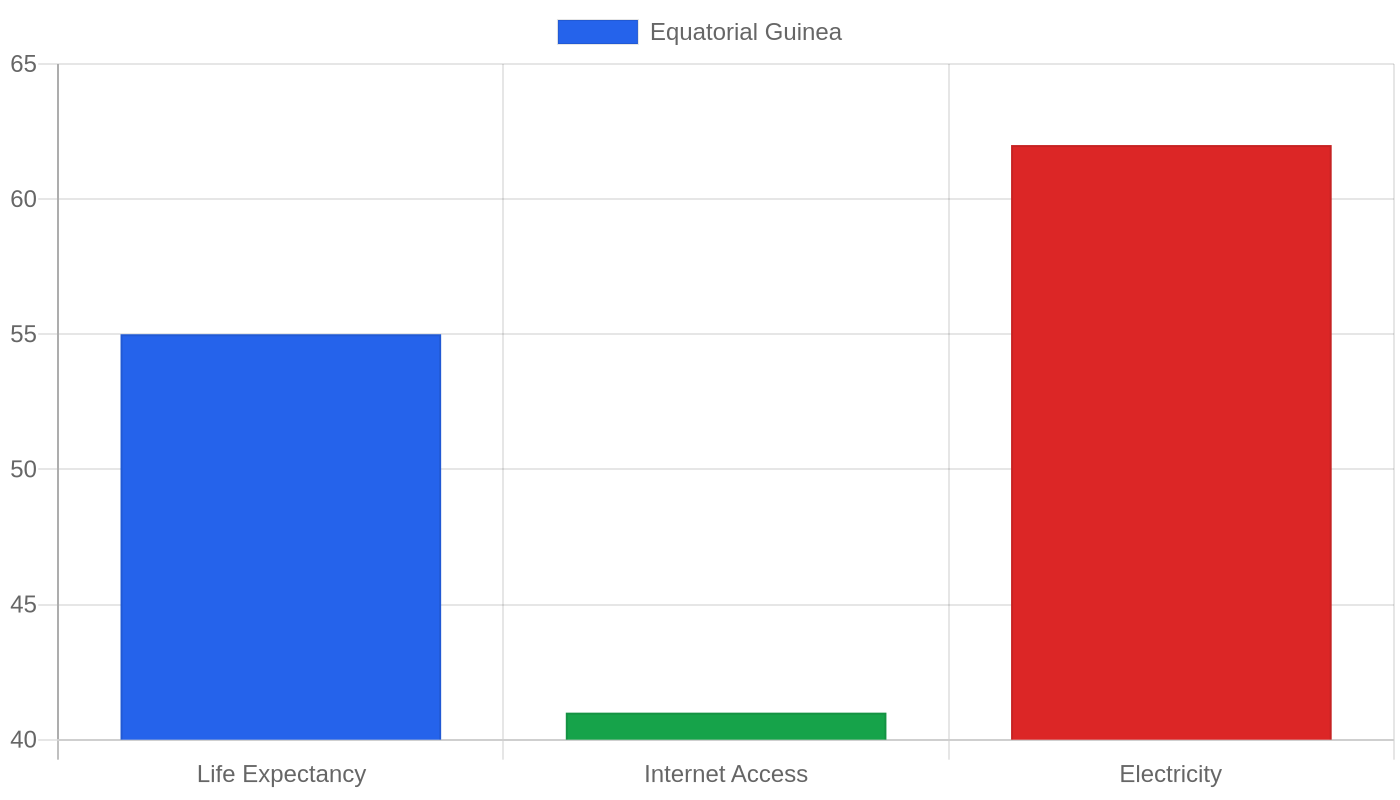
Economic Pulse Net | Sources: World Bank World Development Indicators, Government Sources | 2026
Key Takeaways
* Oil-Dependent Economy: The nation’s industrial backbone is heavily concentrated in the oil and gas sector, dominated by state-linked entities like EG LNG and GEPetrol.
Political Centralization: President Teodoro Obiang retains extensive constitutional powers, including the ability to rule by decree and control the military, creating a stable but authoritarian political environment.
Service Sector Fragmentation: The consumer services landscape is characterized by multiple local airlines, reflecting both connectivity efforts and potential market fragmentation.
Data Transparency Challenges: Official economic metrics such as GDP growth, inflation, and unemployment figures are currently unavailable from standard World Bank reporting, complicating external investment analysis.
Safety and Rights Concerns: International organizations like Human Rights Watch have raised significant concerns regarding civil liberties and governance under the current regime.
The Architecture of an Oil-Driven Economy
Equatorial Guinea presents a unique case study in resource-dependent development, where the macroeconomic narrative is inextricably linked to hydrocarbon extraction. While specific GDP growth rates and per capita income figures remain unreported in the latest World Bank data, the structural composition of the economy offers clear insights into its operational reality.
The country’s industrial output is overwhelmingly driven by the energy sector, with major players such as EG LNG, GEPetrol, and Sonagas forming the core of national revenue generation. This concentration suggests that any fluctuation in global oil prices or production quotas will have immediate and disproportionate effects on the national budget.
Beyond energy, the service sector plays a crucial role in domestic logistics and connectivity, evidenced by the presence of several aviation firms including Ceiba Intercontinental Airlines, Cronos Airlines, Ecuato Guineana, and Guinea Ecuatorial Airlines. These entities indicate an active, albeit potentially saturated, market for consumer services within the region.
The absence of official unemployment statistics does not negate the labor demands of these heavy industries, which likely absorb a significant portion of the skilled workforce. Consequently, the economy functions less as a diversified marketplace and more as a managed ecosystem centered around energy exports and state-directed services.
Navigating the Cost of Living and Housing Market
For expatriates and investors, understanding the cost of living in Equatorial Guinea requires looking beyond aggregate indices, which are currently listed as unavailable. Without a published Crime Index or Safety Index, daily life must be assessed through the lens of infrastructure availability and utility provision. The presence of Segesa, a key utilities provider, highlights the importance of reliable power and water services, which often dictate housing quality and rental premiums in capital cities.
In markets lacking transparent consumer price index (CPI) data, housing costs tend to be bifurcated between luxury accommodations catering to the oil industry and informal settlements with limited amenities. Rent versus buy decisions are heavily influenced by the transient nature of the energy sector workforce, who often prefer short-term leases due to contract durations. Daily expenses for imported goods and services are likely elevated due to logistical challenges and the small size of the domestic market.
Investors should anticipate higher operational costs for businesses requiring consistent utility access, given the critical role played by the single major utility provider mentioned in the corporate landscape.
Investment Opportunities and Business Climate
The business environment in Equatorial Guinea is defined by the dominance of state-affiliated enterprises and a concentrated industrial base. For foreign investors, the most accessible entry points lie within the oil and gas supply chain, where companies like EG LNG and Sonagas operate at scale. GEPetrol serves as the national petroleum company, suggesting that partnerships or joint ventures may require navigating complex regulatory frameworks tied to state interests.
The consumer services sector offers alternative avenues for investment, particularly in aviation, where multiple carriers such as Cronos Airlines and Guinea Ecuatorial Airlines compete for regional routes. However, the proliferation of airlines may also signal market saturation or intense competition among smaller operators. The political stability provided by President Obiang’s long-standing administration offers a predictable, if rigid, regulatory environment.
Businesses must prioritize compliance with local laws, as the constitution grants the president broad authority over economic decrees and cabinet appointments. This centralization can streamline decision-making for large projects but may pose challenges for small-to-medium enterprises seeking independent market access.
Safety, Politics, and Quality of Life
Life in Equatorial Guinea is shaped by a political landscape that prioritizes executive control over democratic checks and balances. According to the 1982 constitution, President Teodoro Obiang holds extensive powers, including the ability to make laws by decree, dissolve the Chamber of Representatives, and serve as commander-in-chief of the armed forces.
This unitary state structure ensures that policy shifts can occur rapidly without legislative gridlock, but it also concentrates risk in the hands of a single leadership tier. International observers, including Human Rights Watch, have documented serious concerns regarding the treatment of political opponents and civil liberties under this system.
The lack of a published Safety Index and Crime Index makes it difficult for residents to gauge everyday risks statistically, relying instead on anecdotal evidence and community reports. Happiness and well-being data are similarly absent, leaving quality-of-life assessments to focus on material conditions and security perceptions. Expatriates often report high levels of personal security in gated communities and business districts, contrasting with broader societal tensions.
The interplay between political stability and human rights critiques creates a complex backdrop for long-term residency and social integration.
What’s Happening Now: Governance and Structural Shifts
Current affairs in Equatorial Guinea are dominated by the enduring influence of President Obiang’s administration and its impact on economic policy. The government continues to leverage its constitutional powers to maintain control over key sectors, ensuring that revenue from oil and gas remains aligned with state objectives. Recent developments highlight a continued reliance on state-owned enterprises like Sonagas and GEPetrol to drive national development goals.
There is no indication of imminent electoral reforms or significant changes to the power dynamics established by the 1982 constitution. Instead, the focus appears to be on maintaining operational efficiency within the energy sector amidst global market fluctuations. The presence of multiple airlines suggests ongoing efforts to improve regional connectivity, possibly to support trade and tourism initiatives.
However, the lack of transparency in economic data raises questions about the accuracy of reported progress and the true extent of fiscal health. International partners continue to engage with the government, balancing economic interests with concerns raised by organizations like Human Rights Watch. The current trajectory points toward incremental adjustments rather than transformative change, preserving the status quo while managing external pressures.
The Bottom Line
Equatorial Guinea remains a niche market best suited for specialized investors with a high risk tolerance and expertise in the energy sector. The country’s primary appeal lies in its hydrocarbon resources, managed by powerful state-linked entities that offer lucrative but regulated opportunities. Prospective residents and businesses must navigate a political environment characterized by strong executive control and limited transparency in social indicators.
Success in this market requires a deep understanding of local regulations and a willingness to engage with state-centric economic structures. Those seeking diversified emerging markets may find Equatorial Guinea too narrow in scope, but for those focused on oil and gas, it remains a critical player.
Sources & Methodology
This article is authored by Economic Pulse Net for informational and research purposes. Economic Pulse Net sources its data from multilateral institutions, national statistics bureaus, and proprietary databases. All data is believed to be current as of the date of publication.
Published: October 04, 2026 | Category: Research — Equatorial Guinea
Use these signals in your own platform
Economic Pulse publishes its live signal feed through a documented, read-only API. Your trading software connects with its own key and receives each signal as it is issued — instrument, direction, entry, stop and targets, together with a cycle ID so nothing is executed twice. The feed is independent of this website and cannot change it.
Signals are informational only and are not financial advice.