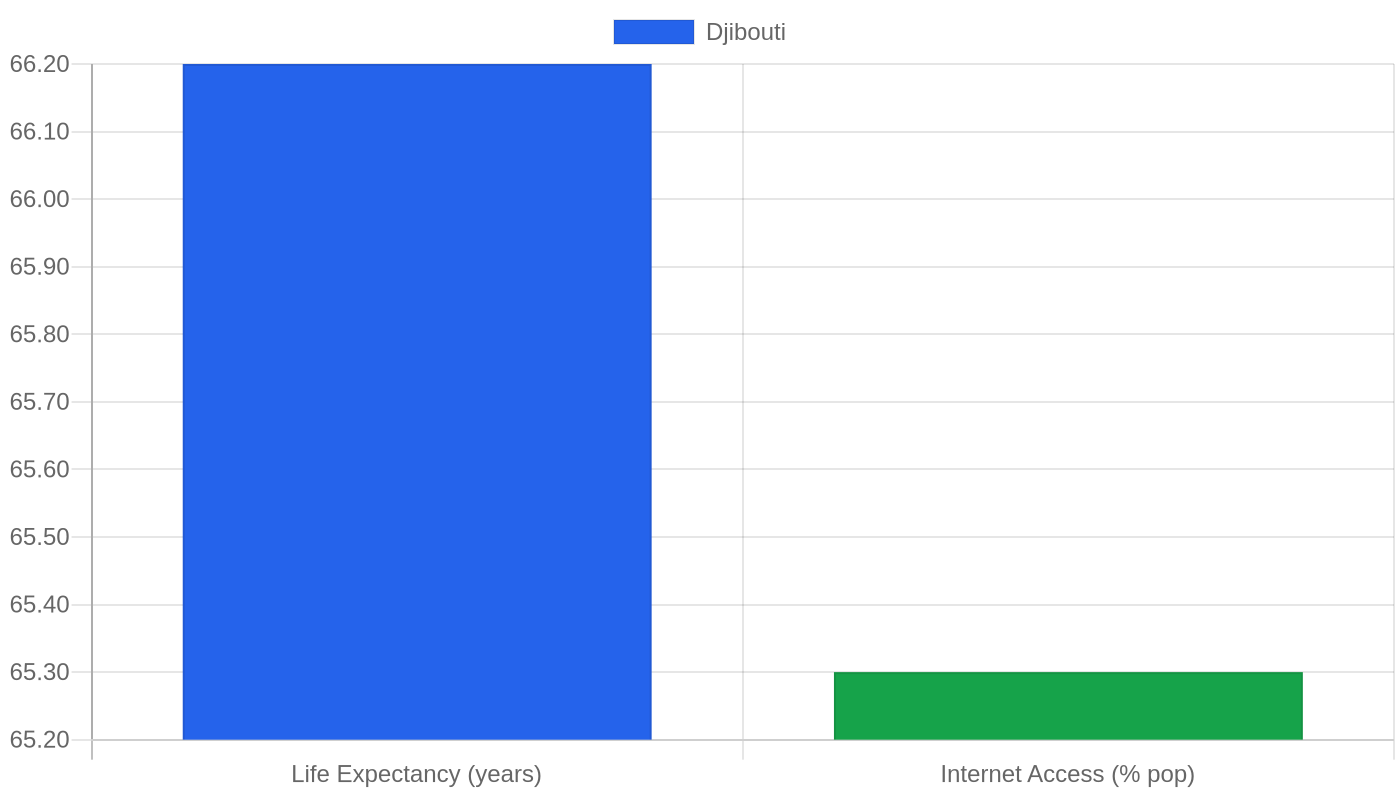
Economic Pulse Net | Sources: World Bank World Development Indicators, Government Sources | 2026
Key Takeaways
– Djibouti’s economy is almost entirely built around its strategic port facilities, serving as the primary maritime gateway for landlocked Ethiopia, yet official economic indicators remain sparse.
– The political landscape is defined by a unitary presidential system that the Economist Democracy Index rated as authoritarian in 2024, with executive power dominating the cabinet and legislature.
– The corporate sector is dominated by state-linked entities and financial institutions, including the Central Bank of Djibouti, Djibouti Telecom, and the newly-formed Ethio-Djibouti Railways.
– Despite its critical role in regional trade, the absence of published World Bank data on GDP growth, inflation, unemployment, and per-capita income makes independent economic assessment unusually difficult.
– For investors and policymakers, Djibouti represents a high-risk, high-reward proposition: a stable security environment in a volatile region, but one with limited political pluralism and opaque economic reporting.
The Numbers Gap: Reading Between the Lines of a Data-Scarce Economy
The World Bank’s latest country profile for Djibouti presents an unusual challenge for economic journalists: the headline indicators — GDP growth, inflation, unemployment, GDP per capita, and GNI per capita — are all listed as unavailable. This absence is itself a story. For a nation that positions itself as the Dubai of the Horn of Africa, the failure to publish timely macroeconomic data undermines the very transparency that foreign investors demand.
What we do know is structural. Djibouti’s economy is not diversified; it is a logistics and services hub. The port of Djibouti handles the overwhelming majority of Ethiopia’s seaborne trade — Ethiopia is landlocked and relies on Djibouti’s docks for nearly all its imports and exports. This relationship is institutionalized through Ethio-Djibouti Railways, a joint venture that represents one of the largest infrastructure projects in the region.
The railway, completed with Chinese financing, connects Addis Ababa to the port of Djibouti, slashing freight times from days to hours.
The corporate landscape reinforces this narrative. The top companies list reads like a who’s who of transport, finance, and communications: Air Djibouti and Djibouti Airlines dominate the skies, Djibouti Telecom holds a monopoly over the digital infrastructure, and the banking sector — including Banque Indosuez Mer Rouge, Banque pour le Commerce et l’Industrie – Mer Rouge, and Dahabshil Bank International — facilitates the remittance flows that underpin the regional economy.
Notably absent are manufacturing, agriculture, or technology firms. This is a country that does not make things; it moves them.
The lack of inflation and employment data is particularly troubling. In a region where food prices are volatile and youth unemployment is a persistent driver of instability, the absence of official statistics leaves policymakers flying blind. The World Bank’s silence on these metrics may reflect data collection challenges, political sensitivity, or simply a lack of capacity. Whatever the cause, it complicates any serious investment analysis.
Cost of Living: The Price of Strategic Geography
Without official cost-of-living indices, we must infer from Djibouti’s economic structure. The country imports nearly all its food, fuel, and manufactured goods — local agriculture is minimal, and the harsh desert climate limits domestic production. This import dependency typically translates into high consumer prices, particularly in the capital city of Djibouti City, where expatriate workers, military personnel, and international organizations drive demand for housing and services.
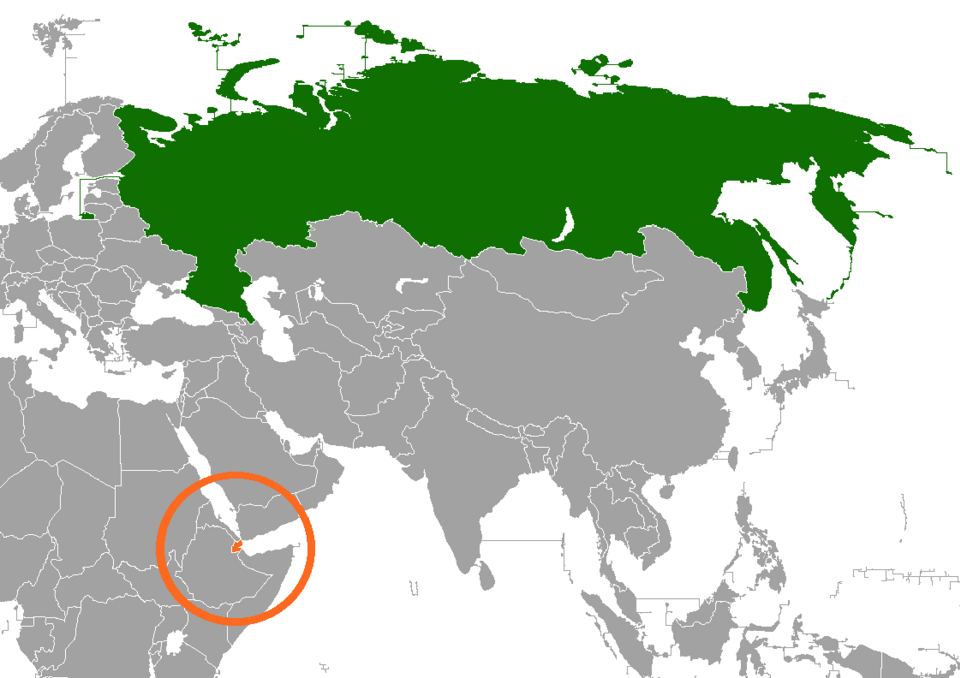
Rent in Djibouti City is notoriously expensive relative to local incomes. The presence of foreign military bases — France, China, Japan, and the United States all maintain a presence — has created a parallel economy where international salaries inflate the cost of prime real estate. For ordinary Djiboutians, housing costs consume a disproportionate share of household income, a situation exacerbated by rapid urbanization and limited construction.
The comparison to regional averages is stark: Djibouti is not a low-cost environment like neighboring Sudan or Yemen; it is a high-cost service economy in a low-income region.
Investment & Business Climate: A Gateway with Strings Attached
For foreign investors, Djibouti offers a unique value proposition: deep-water ports, a stable security environment, and proximity to one of Africa’s fastest-growing economies, Ethiopia. The government has actively courted foreign capital, particularly from China, which has financed ports, railways, and free trade zones. The new Djibouti International Free Trade Area, operated by a Chinese consortium, is designed to attract light manufacturing and logistics companies seeking duty-free access to regional markets.
The financial sector is mature by regional standards. The presence of multiple banks — including the Central Bank of Djibouti as regulator and Dahabshil Bank International as a major remittance player — suggests a functioning monetary system. However, the dominance of state-linked enterprises like Djibouti Telecom and Ethio-Djibouti Railways means that the private sector remains constrained.
The Economist Democracy Index’s 2024 rating of the country as authoritarian signals that the rule of law, while present, is subject to executive discretion. For investors, this means that contracts are only as strong as political relationships.
Safety, Politics & Quality of Life: Stability at a Price
Djibouti is often described as an island of stability in a troubled neighborhood. Crime rates are low, and the security apparatus is effective at maintaining public order. This is not accidental — the government derives significant revenue from hosting foreign military bases, and it ensures that the environment remains safe for international personnel. For expatriates, Djibouti City is a relatively comfortable posting, with modern amenities, international schools, and a growing expat community.
But the political reality is more complex. The Economist Democracy Index’s authoritarian rating reflects a system where the president dominates both the executive and legislative branches. Opposition parties exist but operate under significant constraints. Freedom of expression is limited, and civil society is weak. For the average citizen, quality of life is a trade-off: security and stability in exchange for political voice.
This arrangement has persisted for decades, but it raises long-term questions about succession, generational change, and the sustainability of a model that depends heavily on external rents.
What’s Happening Now: The Railway Diplomacy Era
The most significant development in Djibouti’s recent economic history is the operational maturation of the Ethio-Djibouti Railways. This Chinese-built, standard-gauge line has transformed trade logistics in the Horn of Africa, cutting transport costs and time dramatically. As Ethiopia’s economy grows and its population expands, the railway’s importance will only increase. This is Djibouti’s trump card: it controls the lifeline of a nation of over 120 million people.
Simultaneously, Djibouti is expanding its port capacity. The Doraleh Container Terminal, operated by a Chinese firm, has positioned the country as a transshipment hub for East Africa. The government is betting that its geographic location — at the junction of the Red Sea and the Indian Ocean — will attract more transshipment traffic as global shipping routes evolve. However, there are rising concerns about debt sustainability.
Djibouti has borrowed heavily from Chinese lenders to finance infrastructure, and while terms have been restructured, the long-term fiscal burden remains a risk.
The banking sector is also evolving. Dahabshil Bank International, originally a remittance company serving the Somali diaspora, has expanded into full-service banking, reflecting the broader financialization of the economy. Meanwhile, Djibouti Telecom is exploring new digital services, including mobile money, which could expand financial inclusion in a country where many citizens remain unbanked. These developments suggest that Djibouti, despite its authoritarian politics, is not economically stagnant.
It is adapting to the demands of a digital, logistics-driven future.
The Bottom Line
Djibouti is a country that punches far above its weight in strategic importance but remains fragile beneath the surface. For logistics companies, infrastructure investors, and regional traders, it offers unmatched access to Ethiopian markets and the broader Horn of Africa. For those concerned with governance, transparency, and political freedom, it presents a more troubling picture.
The lack of basic economic data is a red flag — it suggests a government that is not fully accountable to its citizens or the international community. Watch Djibouti not for its domestic market, but for its role as the gateway to a continent’s future.
Sources & Methodology
This article is authored by Economic Pulse Net for informational and research purposes. Economic Pulse Net sources its data from multilateral institutions, national statistics bureaus, and proprietary databases. All data is believed to be current as of the date of publication.
Published: August 10, 2026 | Category: Research — Djibouti
Use these signals in your own platform
Economic Pulse publishes its live signal feed through a documented, read-only API. Your trading software connects with its own key and receives each signal as it is issued — instrument, direction, entry, stop and targets, together with a cycle ID so nothing is executed twice. The feed is independent of this website and cannot change it.
Signals are informational only and are not financial advice.