Economic Pulse Net | Sources: World Bank World Development Indicators, Government Sources | 2026
Key Takeaways
– Djibouti’s economy is overwhelmingly dependent on its role as a regional logistics hub, with the World Bank identifying port services and related industries as the core of its economic activity.
– The financial sector is unusually developed for a country of its size, anchored by a Central Bank and a mix of domestic and international banks operating in the Mer Rouge (Red Sea) corridor.
– Political power remains highly concentrated — the Economist Democracy Index rated Djibouti as “authoritarian” in 2024, a designation that shapes investor perceptions and development strategy.
– State-owned enterprises dominate key infrastructure, including Djibouti Telecom and Ethio-Djibouti Railways, making public-private dynamics central to any business climate assessment.
– The country’s strategic position at the mouth of the Red Sea continues to attract foreign interest, though the data available on domestic living standards remains thin.
A Port Economy in the Horn of Africa
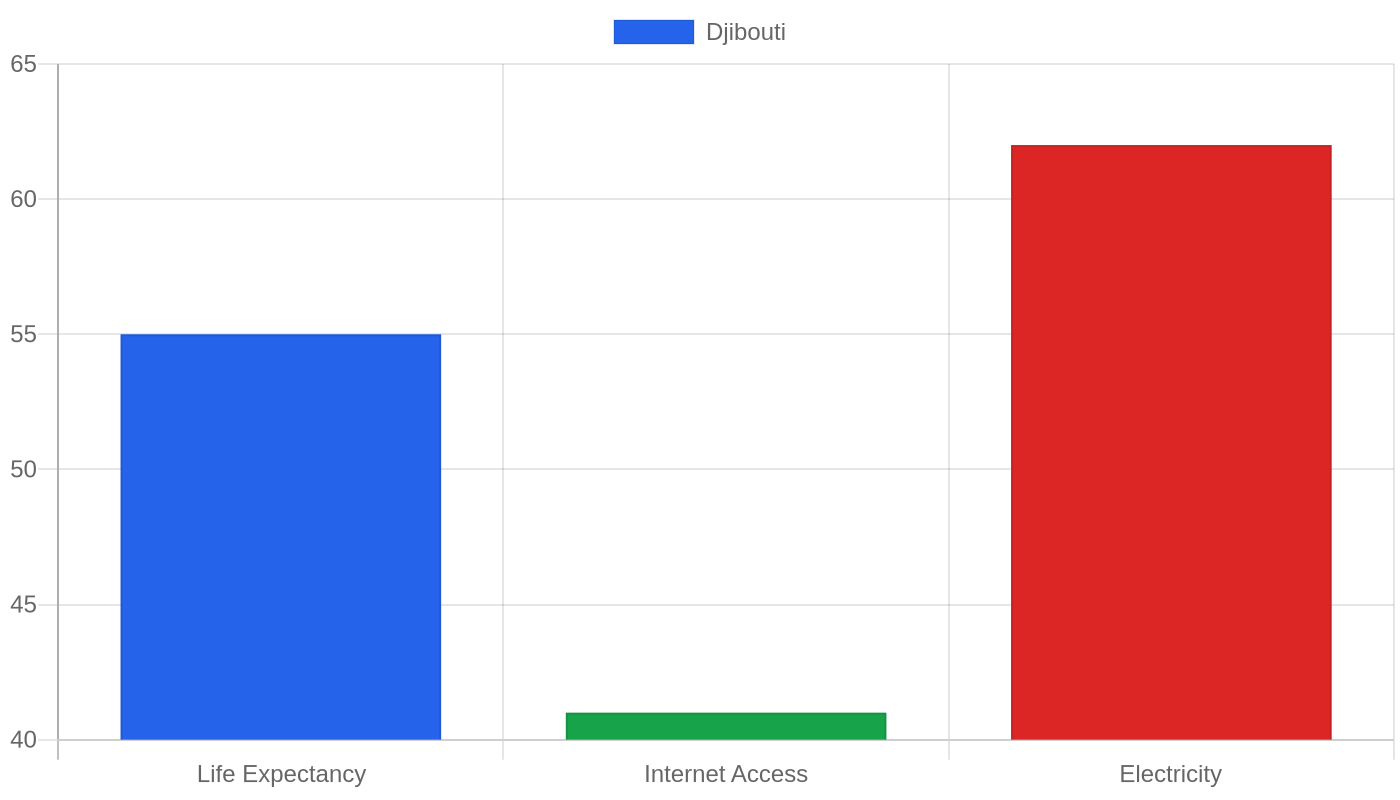
When economists talk about Djibouti, they are not talking about a diversified industrial base or a bustling consumer market. They are talking about geography. The World Bank’s data on Djibouti presents a country where the headline indicators — GDP growth, inflation, unemployment, GDP per capita — remain unpublished in the latest available figures. That absence is itself telling.
Djibouti is a small, arid nation whose economic identity is almost entirely tied to its function as a transit point for goods moving in and out of landlocked Ethiopia and the wider East African region.
The main industries listed for the country confirm this narrative. There is no significant manufacturing sector, no agricultural export engine, no tech hub. Instead, the industrial landscape is dominated by transport and logistics — Ethio-Djibouti Railways, which connects Djibouti’s ports to the Ethiopian hinterland, stands alongside Air Djibouti and Djibouti Airlines as the backbone of the country’s connectivity strategy. This is a nation that moves things, not one that makes things.
What does this mean in practice? It means that Djibouti’s economic fortunes are tied to the health of its neighbors, particularly Ethiopia, and to global shipping patterns through the Red Sea. It also means that the country’s leadership has staked its entire development model on becoming an indispensable link in regional supply chains.
The absence of robust World Bank data on domestic consumption, inflation, or employment suggests that the formal economy — the one measured by statisticians — is only part of the story. A significant share of economic activity likely happens in informal trade, port-adjacent services, and the spending of foreign military personnel stationed in the country.
The financial sector, however, tells a more structured story. Djibouti hosts a Central Bank, alongside institutions like Banque Indosuez Mer Rouge, Banque pour le Commerce et l’Industrie – Mer Rouge, and Dahabshil Bank International. The presence of Dahabshil — a major player in the Somali remittance corridor — underscores Djibouti’s role as a financial intermediary for the Horn of Africa, not just a physical gateway.
For a country with a small population, this banking density suggests that money flows through Djibouti even when goods do.
The High Cost of a Strategic Location
Living in Djibouti is not cheap, and the reason is structural. The country imports nearly everything — food, fuel, construction materials, manufactured goods — because its own resource base is minimal. The World Bank data on cost of living is not specified in the available figures, but the logic of the economy dictates that prices in Djibouti City are heavily influenced by global shipping costs, import tariffs, and the demand generated by a substantial expatriate and military presence.
Housing in Djibouti City is a premium product. The stock of modern, habitable housing is limited relative to the demand created by international organizations, embassies, logistics firms, and foreign military personnel. This pushes rents upward, often beyond the reach of ordinary Djiboutians. For locals, the housing market is a tale of two cities: older, denser neighborhoods where extended families share space, and newer developments aimed at foreigners and the small local elite.
Buying property is a long-term commitment in a country where mortgage financing is limited and land ownership remains tightly controlled by the state.
Daily expenses — food, transport, utilities — are similarly shaped by import dependence. What little local produce exists is limited by the arid climate. The result is a cost of living that is high by regional standards, even if the formal data is not available to quantify it precisely. For the average worker, this means that wages, where they are paid in the formal sector, are stretched thin by the cost of basic goods.
The strategic location that makes Djibouti valuable to the world does not automatically translate into affordable living for its citizens.
Business Climate: State Power and Strategic Assets
For investors, Djibouti is a country where the state is not just a regulator but the primary economic actor. The top companies list is dominated by state-linked entities: Djibouti Telecom, Ethio-Djibouti Railways, and the national carriers. This is not a market where private enterprise leads; it is a market where the government sets the agenda and private firms — often foreign — are invited to participate on specific terms.
The financial sector offers the most obvious entry point. The presence of international banks like Banque Indosuez Mer Rouge and Banque pour le Commerce et l’Industrie – Mer Rouge signals that there is room for foreign financial institutions, particularly those serving trade finance and corporate clients. Dahabshil Bank International bridges the gap between formal banking and the remittance economy that sustains much of the Horn of Africa.
For a financial firm looking to serve the Red Sea trade corridor, Djibouti offers a stable, dollar-pegged environment in a region of volatility.
The industrials sector, anchored by Ethio-Djibouti Railways, is the other key opportunity. The railway is the literal engine of the port economy, and its expansion or modernization will determine whether Djibouti can handle growing volumes of cargo. The country’s bet is that Ethiopia’s growing economy will need more port capacity, and Djibouti intends to be the beneficiary.
However, the authoritarian political landscape — as rated by the Economist Democracy Index in 2024 — means that investors must be comfortable operating in a system where political connections matter as much as business fundamentals, and where the rule of law is subordinate to presidential authority.
Politics, Safety, and the Authoritarian Bargain
The Economist Democracy Index’s 2024 rating of Djibouti as “authoritarian” is not a footnote; it is a central fact of doing business and living in the country. Executive power rests overwhelmingly in the presidency, which dominates the cabinet and the National Assembly. This concentration of power creates stability of a sort — policy direction is clear, and major infrastructure projects can be pushed through without the delays of democratic deliberation.
But it also means that accountability is limited, and that the state’s priorities — ports, railways, foreign military basing — take precedence over social spending or political liberalization.
The crime and safety indices are not available in the World Bank data, but the security situation in Djibouti City is generally considered manageable compared to some regional capitals. The heavy presence of foreign military installations and international agencies creates a protective bubble of sorts, and the country has not experienced the kind of internal conflict seen in some of its neighbors.
However, the lack of data means that perceptions of safety are just that — perceptions, shaped by anecdote and the experiences of expatriates rather than by reliable statistics.
Quality of life is a mixed picture. For the expatriate community, Djibouti offers a comfortable, if isolated, existence with access to international schools, medical facilities, and a social scene centered on the diplomatic and military communities. For the local population, the reality is more constrained.
The absence of published GDP per capita or GNI figures from the World Bank makes it difficult to assess average living standards, but the structure of the economy — heavily service-oriented, with limited formal employment — suggests that many Djiboutians work in informal trade or low-wage service jobs tied to the port and logistics sectors.
The Geopolitical Gambit Intensifies
Right now, Djibouti is doubling down on its role as the region’s logistics linchpin. The country’s leadership continues to court foreign investment in port infrastructure, railways, and telecommunications, betting that the Red Sea will remain a critical global shipping lane and that East Africa’s economies will continue to grow.
The presence of Ethio-Djibouti Railways as a top company underscores the centrality of the Ethiopian connection — as Ethiopia’s population and economy expand, its need for reliable port access grows, and Djibouti is positioned to capture that demand.
The financial sector is also evolving. The Central Bank of Djibouti remains the anchor, but the presence of banks like Dahabshil International signals a push to formalize remittance flows that have traditionally moved through informal channels. There is a quiet effort to make Djibouti not just a port for goods but a hub for financial services in the Horn of Africa.
Meanwhile, Djibouti Telecom’s dominance suggests that the government sees digital connectivity as the next frontier — a way to diversify the economy beyond physical logistics.
None of this happens in a political vacuum. The authoritarian structure that the Economist Democracy Index identified in 2024 remains intact, and the government shows no signs of loosening its grip. For international partners — whether Gulf states, European powers, or Asian investors — this is an acceptable trade-off: stability and strategic access in exchange for turning a blind eye to democratic deficits.
The question is whether this model can deliver rising living standards for ordinary Djiboutians, or whether it will continue to benefit a narrow elite while the majority waits for the benefits of the port economy to trickle down.
The Bottom Line
Djibouti is a country to watch for anyone interested in the geopolitics of trade, the future of East African logistics, or the dynamics of authoritarian development models. It is not a consumer market, nor is it a manufacturing hub — it is a strategic asset with a population attached. Investors should watch Djibouti for opportunities in port infrastructure, financial services, and telecommunications, but they should enter with eyes open to the political realities.
This is a state where the president’s office is the ultimate decision-maker, and where the line between business and government is deliberately blurred. For now, the bet on logistics is working — but the absence of data on living standards, inflation, and employment is a reminder that the country’s economic model has yet to prove it can benefit the people who call it home.
Sources & Methodology
This article is authored by Economic Pulse Net for informational and research purposes. Economic Pulse Net sources its data from multilateral institutions, national statistics bureaus, and proprietary databases. All data is believed to be current as of the date of publication.
Published: August 06, 2026 | Category: Research — Djibouti
Use these signals in your own platform
Economic Pulse publishes its live signal feed through a documented, read-only API. Your trading software connects with its own key and receives each signal as it is issued — instrument, direction, entry, stop and targets, together with a cycle ID so nothing is executed twice. The feed is independent of this website and cannot change it.
Signals are informational only and are not financial advice.