Economic Pulse Net | Sources: World Bank World Development Indicators, Government Sources | 2026
Key Takeaways
* Political Stability through Federalism: The Union of the Comoros operates as a federal presidential republic, a structure established by the 2001 Constitution to manage power-sharing among its islands after periods of military instability.
Aviation-Centric Corporate Landscape: The business environment is heavily dominated by consumer services, specifically aviation, with multiple airlines forming the core of the top corporate entities.
Data Scarcity Challenges Analysis: Comprehensive macroeconomic indicators such as GDP growth, inflation rates, and unemployment figures are currently unavailable from major international bodies like the World Bank, complicating precise economic forecasting.
Investment Focus on Services: For investors, the most visible sector remains transport and logistics, anchored by key players like AB Aviation and Int’Air Îles, rather than traditional manufacturing or agriculture.
Governance Transition: The political landscape has evolved from previous military dictatorships to a multi-party system, though recent transfers of power highlight the ongoing dynamics of executive leadership.
Economic Architecture and Industrial Base
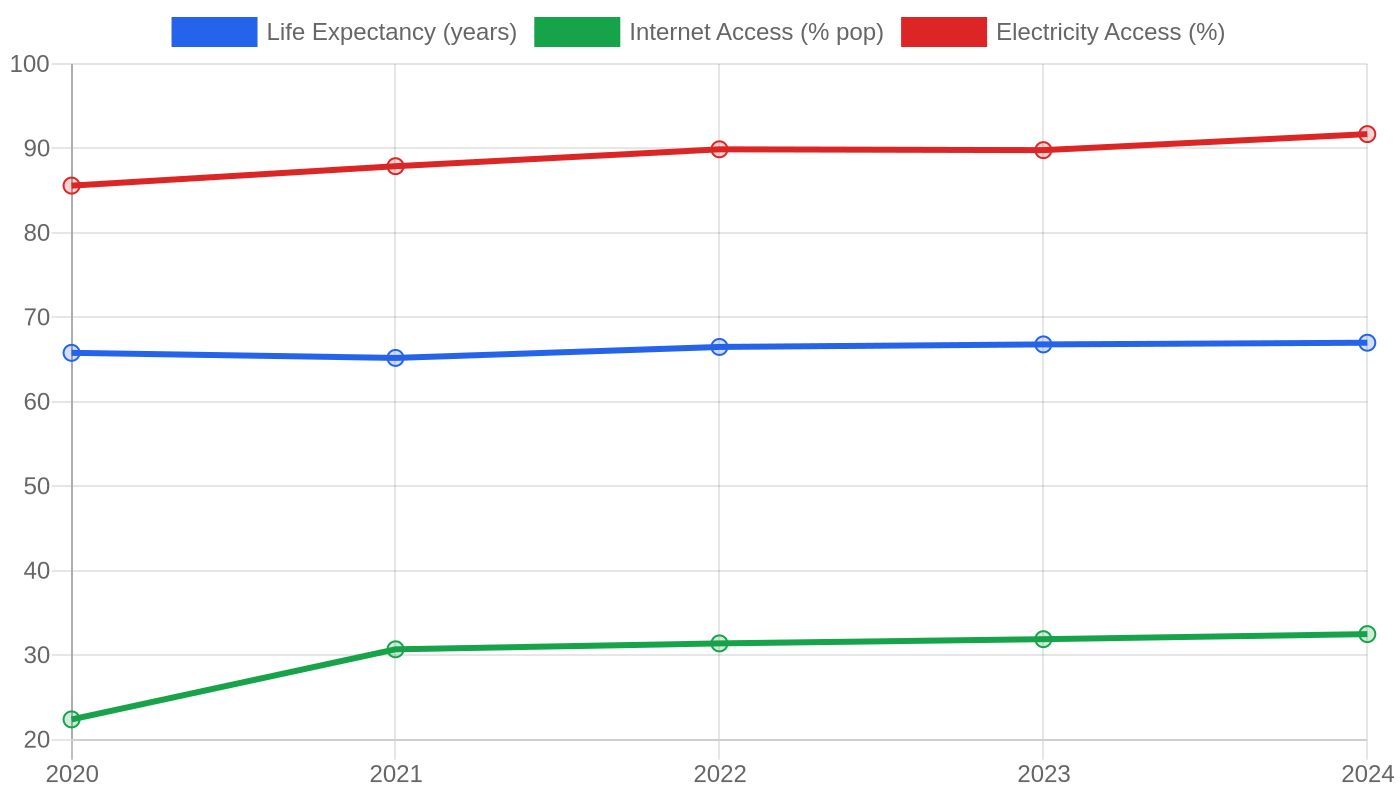
The economic profile of Comoros is currently shrouded in statistical opacity, presenting a significant challenge for analysts seeking precise quantitative metrics. According to the latest data from the World Bank, critical indicators including GDP growth, inflation CPI, unemployment rates, total GDP in USD, GDP per capita (PPP), GNI per capita, and overall population figures are listed as N/A.
This absence of hard data suggests either a gap in reporting mechanisms or the nascent nature of comprehensive economic tracking in the region. Despite this lack of numerical clarity, the industrial structure offers qualitative insights into where value is generated. The main industries driving the economy appear to be heavily skewed toward service-oriented sectors, particularly those facilitating connectivity.
Without specific employment statistics, it is difficult to gauge labor market health, but the dominance of aviation-related companies in the corporate list implies that transport and logistics are vital arteries for commerce. The inability to measure GDP per capita means we cannot assess standard of living improvements quantitatively, yet the existence of specialized financial institutions like Exim Bank Comoros indicates a functioning, albeit small, banking sector supporting trade.
Ultimately, the economy appears to rely on external connectivity and internal governance structures rather than large-scale industrial output, making it resilient to some global shocks but vulnerable to regional disruptions.
Cost of Living and Housing Dynamics
Assessing the cost of living in Comoros requires navigating around the absence of specific CPI data and housing price indices. With no official inflation figures provided by the World Bank, determining the purchasing power parity for residents is impossible through standard metric comparisons.
However, the presence of a robust network of aviation companies—such as Comores Air Services, Comoro Islands Airline, and Int’Air Îles—suggests that transportation costs may play a disproportionate role in household budgets. Travel and logistics likely represent a significant portion of daily expenses, given the island nation’s geographic fragmentation.
In terms of housing, the lack of rental yield data or property valuation metrics makes it difficult to compare rent versus buy scenarios against regional averages. One must infer that housing markets are likely localized and influenced by the limited availability of land on each of the three main islands. Daily expenses are probably driven by imported goods due to the reliance on air and sea freight, which could keep prices higher than in more self-sufficient agrarian economies.
Without concrete safety indices or crime statistics, the “cost” of living also includes an intangible premium for security and stability, which varies by neighborhood and island. Therefore, while exact numbers are missing, the structural reliance on imported services and goods paints a picture of a cost structure sensitive to global supply chain fluctuations.
Investment and Business Climate
For foreign direct investment and local entrepreneurship, the business climate in Comoros is distinctly characterized by the prominence of the aviation and financial services sectors. A review of the top companies reveals a striking concentration in consumer services, specifically within the airline industry. Entities such as AB Aviation, Central Bank of the Comoros, Exim Bank Comoros, and multiple carriers like Int’Air Îles and Comores Aviation International dominate the corporate landscape.
This suggests that opportunities for investment are likely concentrated in transport infrastructure, logistics support, and financial intermediation rather than manufacturing or technology. The presence of Exim Bank Comoros indicates a focus on facilitating export-import activities, which is crucial for an island economy dependent on trade. Meanwhile, the Central Bank of the Comoros plays a pivotal role in monetary policy and financial regulation, providing a framework for banking operations.
Investors looking at this market should note that the barrier to entry in heavy industry may be high due to infrastructure constraints, whereas service-based ventures face less regulatory friction. The multi-company presence in aviation hints at a competitive but fragmented market, offering niches for maintenance, charter services, or cargo handling.
Consequently, the business environment rewards those who can navigate logistical complexities and build partnerships with existing state-linked or private aviation firms.
Safety, Politics and Quality of Life
The social fabric of Comoros is deeply intertwined with its unique political structure and historical trajectory. Politics takes place within a framework of a federal presidential republic, where the President serves as both head of state and head of government. This system was solidified by the ratification of the Constitution of the Union of the Comoros via referendum on December 23, 2001, which established a multi-party system designed to balance power across the islands.
Prior to this constitutional milestone, the nation had experienced periods of instability, including classification as a military dictatorship, highlighting the significance of the current democratic framework. The transfer of power from Azali Assoumani to Ahmed Abdallah Mohamed represents a key moment in this ongoing political evolution, demonstrating the functioning of electoral processes.
Regarding quality of life, data on crime and safety indices is currently listed as N/A, preventing a quantitative assessment of personal security. Similarly, happiness data and broader well-being metrics are absent, leaving the subjective experience of residents largely undocumented in international databases. However, the federal nature of the state implies a degree of local autonomy that may influence community cohesion and local governance effectiveness.
The transition from authoritarian rule to a constitutional democracy suggests a gradual improvement in institutional stability, which is foundational for long-term social peace.
What’s Happening Now: Political Transitions and Institutional Evolution
The most dynamic aspect of Comoros today lies not in macroeconomic indicators, but in its political continuity and institutional development. The country is actively navigating the implications of its 2001 constitutional framework, which continues to shape executive authority and legislative balance. Recent political history highlights the significance of peaceful transitions, such as the noted shift from Azali Assoumani to Ahmed Abdallah Mohamed, underscoring the resilience of the multi-party system.
These developments are critical for understanding the current business environment, as political stability directly impacts investor confidence and regulatory predictability. While specific news events regarding inflation trends or new fiscal reforms are not detailed in the available data, the overarching narrative is one of consolidation. The federal presidential model allows for localized decision-making, which is essential for addressing the distinct needs of Comoros’ various islands.
Current affairs are thus defined by the maintenance of this delicate political equilibrium. Stakeholders are watching how the executive branch manages inter-island relations and upholds the rule of law established by the constitution. This period of institutional maturity contrasts with the earlier era of military dictatorship, marking a definitive break from past instability. As the nation moves forward, the focus remains on sustaining this democratic framework against potential future challenges.
The Bottom Line
Comoros presents a complex case study for observers interested in small island developing states where political structure outweighs immediate economic scale. The primary takeaway is that while hard economic data is scarce, the institutional framework is clear and historically significant. Investors and policymakers should focus on the aviation and financial sectors, which form the backbone of the visible corporate landscape.
Those assessing risk must weigh the proven democratic transition against the lack of transparent safety and cost-of-living metrics. Ultimately, Comoros is a nation defined by its governance experiments and strategic location, requiring a qualitative rather than purely quantitative approach to engagement.
Sources & Methodology
This article is authored by Economic Pulse Net for informational and research purposes. Economic Pulse Net sources its data from multilateral institutions, national statistics bureaus, and proprietary databases. All data is believed to be current as of the date of publication.
Published: October 14, 2026 | Category: Research — Comoros
Use these signals in your own platform
Economic Pulse publishes its live signal feed through a documented, read-only API. Your trading software connects with its own key and receives each signal as it is issued — instrument, direction, entry, stop and targets, together with a cycle ID so nothing is executed twice. The feed is independent of this website and cannot change it.
Signals are informational only and are not financial advice.