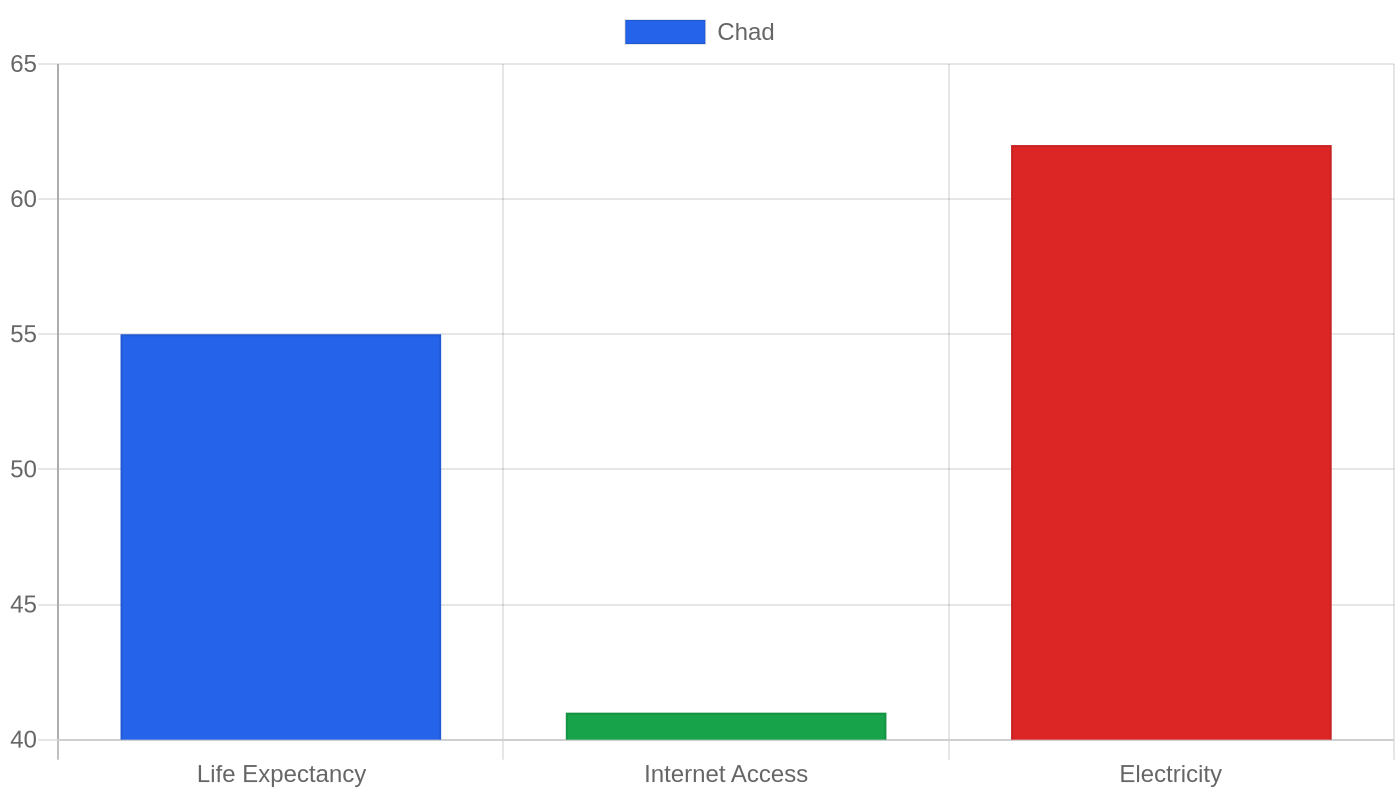
Economic Pulse Net | Sources: World Bank World Development Indicators, Government Sources | 2026
Key Takeaways
* Executive Dominance: The 2023 constitutional referendum has solidified a presidential republic where President Mahamat Déby holds immense power over the judiciary, military, and state enterprises.
Corporate Landscape: The business environment is anchored by key players in financials, basic materials, and telecommunications, including Commercial Bank Chad and Cotontchad.
Data Gaps: Comprehensive macroeconomic indicators such as GDP growth, inflation rates, and unemployment figures are currently unavailable from the World Bank, creating a challenge for precise economic forecasting.
Safety Uncertainty: Specific crime and safety indices are not currently reported, necessitating caution for investors and expatriates regarding security conditions.
Political Centralization: The political system is characterized by strong executive control, with the president influencing appointments across all levels of government and para-statal firms.
Economic Structure and Industrial Base
The economic architecture of Chad presents a complex picture defined more by its industrial pillars than by fluid macroeconomic metrics. While specific data points for GDP growth, inflation CPI, and unemployment remain unreported by the World Bank, the underlying structure of the economy relies heavily on primary sectors and state-linked entities. The presence of major companies like Cotontchad in the basic materials sector highlights the enduring importance of agriculture and cotton processing to national output.
Similarly, the existence of Mid Express Tchad in industrials suggests ongoing logistical and manufacturing activities that support domestic supply chains. Without concrete numbers on GDP per capita or total GDP in USD, assessing the scale of these industries requires looking at the corporate landscape rather than aggregate statistics. The absence of population data further complicates the calculation of productivity metrics, leaving analysts to rely on qualitative assessments of industrial capacity.
This lack of granular data does not mean the economy is inactive; rather, it indicates that the formal statistical reporting may be lagging behind actual commercial activity. Investors must therefore look beyond traditional headline figures and examine the operational health of key parastatals and private firms to gauge real economic momentum. The resilience of these core industries suggests a baseline level of economic activity that persists despite the statistical voids.
Understanding Chad’s economy today means recognizing the gap between official records and the tangible operations of its leading corporations.
Cost of Living and Daily Expenses
Navigating the cost of living in Chad involves understanding a market where housing and daily expenses are shaped by limited commercial infrastructure and import dependencies. Detailed metrics for rent versus buy ratios or specific consumer price indexes are not provided in current datasets, forcing observers to infer trends from available corporate data.
The operation of Société tchadienne des postes et de l’épargne indicates a financial ecosystem that facilitates savings and transactions, which is crucial for households managing daily budgets. Meanwhile, SotelTchad’s role in telecommunications suggests that communication costs are a significant component of household expenditures, connecting residents to broader economic networks.
Toumaï Air Tchad’s presence in consumer services implies that mobility and travel costs are also factors in the overall cost structure, likely affecting both business logistics and personal leisure. In the absence of direct inflation data, the stability of prices often hinges on the efficiency of these service providers and their ability to manage operational costs.
Regional comparisons are difficult without standardized purchasing power parity data, but the reliance on imported goods typically drives higher costs for essential items. Households must therefore allocate significant portions of their income to basic necessities and connectivity services. The interplay between public utilities and private service providers ultimately defines the affordability landscape for residents.
Investment and Business Climate
The investment landscape in Chad is characterized by a concentrated corporate sector where a few key entities dominate critical industries. Commercial Bank Chad stands as a pillar in the financials sector, providing the necessary capital infrastructure for businesses to operate and expand. Its prominence underscores the importance of banking services in facilitating trade and commerce within the country.
In the basic materials sector, Cotontchad represents a vital link in the agricultural value chain, offering opportunities for investors interested in agribusiness and export-oriented production. The industrials sector is supported by firms like Mid Express Tchad and Société tchadienne des postes et de l’épargne, which provide essential logistics and postal services that underpin commercial activity.
SotelTchad’s dominance in telecommunications highlights the growing digital infrastructure, which is increasingly important for modern business operations. These companies represent the primary entry points for foreign and domestic investment, given their established market positions. The concentration of economic power in these specific firms suggests that regulatory changes or operational shifts within them can have disproportionate effects on the broader business climate.
Investors should monitor the performance and strategic decisions of these entities closely, as they serve as barometers for the health of the Chadian economy. The business environment appears stable in terms of key players, though the lack of transparent macroeconomic data remains a hurdle for risk assessment.
Safety, Politics, and Quality of Life
The political and social fabric of Chad is deeply influenced by the centralization of power following the 2023 constitutional referendum. Under this new framework, Chad operates as a presidential republic with a strong executive branch headed by President Mahamat Déby. The president wields considerable influence over the appointment of the prime minister, cabinet members, judges, generals, provincial officials, and heads of para-statal firms.
This concentration of authority creates a political environment where policy direction is closely tied to the executive’s agenda. In cases of grave and immediate threat, the constitution allows for extraordinary measures, further reinforcing the dominance of the presidency. Regarding safety, specific crime and safety indices are not currently available, making it difficult to quantify risks precisely.
However, the political structure suggests that state control is tight, which may impact civil liberties and public order dynamics. The quality of life for citizens is thus shaped by both the availability of essential services and the political stability derived from this centralized system. Residents navigate a society where the government’s reach extends deeply into administrative and judicial functions. Understanding this political reality is essential for anyone assessing long-term engagement with the country.
What’s Happening Now: Political Consolidation
The most significant recent development in Chad is the implementation of the new constitution adopted after the 2023 referendum, which has fundamentally reshaped the governance model. President Mahamat Déby now exercises unprecedented control over the state apparatus, including the judiciary and military leadership.
This political consolidation is accompanied by a lack of updated economic indicators, suggesting that immediate priorities lie in maintaining political stability rather than releasing comprehensive statistical data. The dominance of the executive branch means that policy shifts are likely to be top-down, driven by presidential directives rather than broad legislative debate.
For businesses and investors, this means that navigating the regulatory environment requires close attention to executive decrees and appointments. The absence of fresh crime and safety data also reflects a potential focus on internal security matters over public reporting. As the country settles into this new political normal, the interaction between strong executive power and economic management will define the next phase of development.
Observers are watching to see how this centralized model impacts long-term investment confidence and institutional transparency. The current moment is defined by political certainty amidst economic opacity.
The Bottom Line
Chad presents a unique case for observers due to its highly centralized political structure and the dominance of a few key corporate entities. While the lack of detailed macroeconomic data makes traditional analysis challenging, the operational strength of companies like Commercial Bank Chad and Cotontchad provides tangible insights into economic activity.
Investors and policymakers must prioritize understanding the implications of President Déby’s expanded executive powers when evaluating risks and opportunities. This country demands a nuanced approach that values political context and corporate fundamentals over aggregate statistical trends.
Sources & Methodology
This article is authored by Economic Pulse Net for informational and research purposes. Economic Pulse Net sources its data from multilateral institutions, national statistics bureaus, and proprietary databases. All data is believed to be current as of the date of publication.
Published: October 12, 2026 | Category: Research — Chad
Use these signals in your own platform
Economic Pulse publishes its live signal feed through a documented, read-only API. Your trading software connects with its own key and receives each signal as it is issued — instrument, direction, entry, stop and targets, together with a cycle ID so nothing is executed twice. The feed is independent of this website and cannot change it.
Signals are informational only and are not financial advice.