Economic Pulse Net | Sources: World Bank World Development Indicators, Government Sources | 2026
Key Takeaways
* Executive Dominance: Under the post-2023 constitutional framework, President Mahamat Déby holds substantial power over the judiciary, military, and state-owned enterprises, creating a centralized political environment.
Corporate Landscape: The business sector is anchored by key players in financial services, telecommunications, and basic materials, with Commercial Bank Chad and Cotontchad leading their respective sectors.
Data Gaps: Comprehensive macroeconomic indicators such as GDP growth, inflation rates, and unemployment figures are currently unavailable, necessitating a focus on structural and political analysis rather than quantitative trends.
Security Context: Official crime and safety indices are not published, suggesting that risk assessment relies heavily on political stability and regional security dynamics rather than standardized statistical metrics.
The Architecture of Power and Governance
The economic trajectory of Chad is inextricably linked to its evolving political structure, which has undergone significant consolidation in recent years. Following the constitutional referendum adopted in 2023, Chad operates as a presidential republic characterized by a robust executive branch. This institutional shift has cemented the authority of the incumbent president, Mahamat Déby, who wields considerable influence across multiple facets of governance.
The president retains the exclusive power to appoint the prime minister and the cabinet, effectively shaping the administrative direction of the nation. Beyond executive appointments, this centralization extends to the judiciary and the military; the president exercises considerable influence over the appointment of judges and generals, ensuring loyalty within the state’s coercive and legal apparatus.
Furthermore, this control reaches into the economic sphere through the appointment of provincial officials and heads of para-statal firms, linking political allegiance directly to state resource management. In scenarios involving grave and immediate threats, the constitution grants the president expanded powers, allowing for rapid decision-making that can bypass standard legislative checks.
For investors and observers, this political reality implies that policy continuity and economic reforms are heavily dependent on the strategic priorities of the executive office, rather than decentralized or multi-party consensus.
Industrial Foundations and Corporate Players
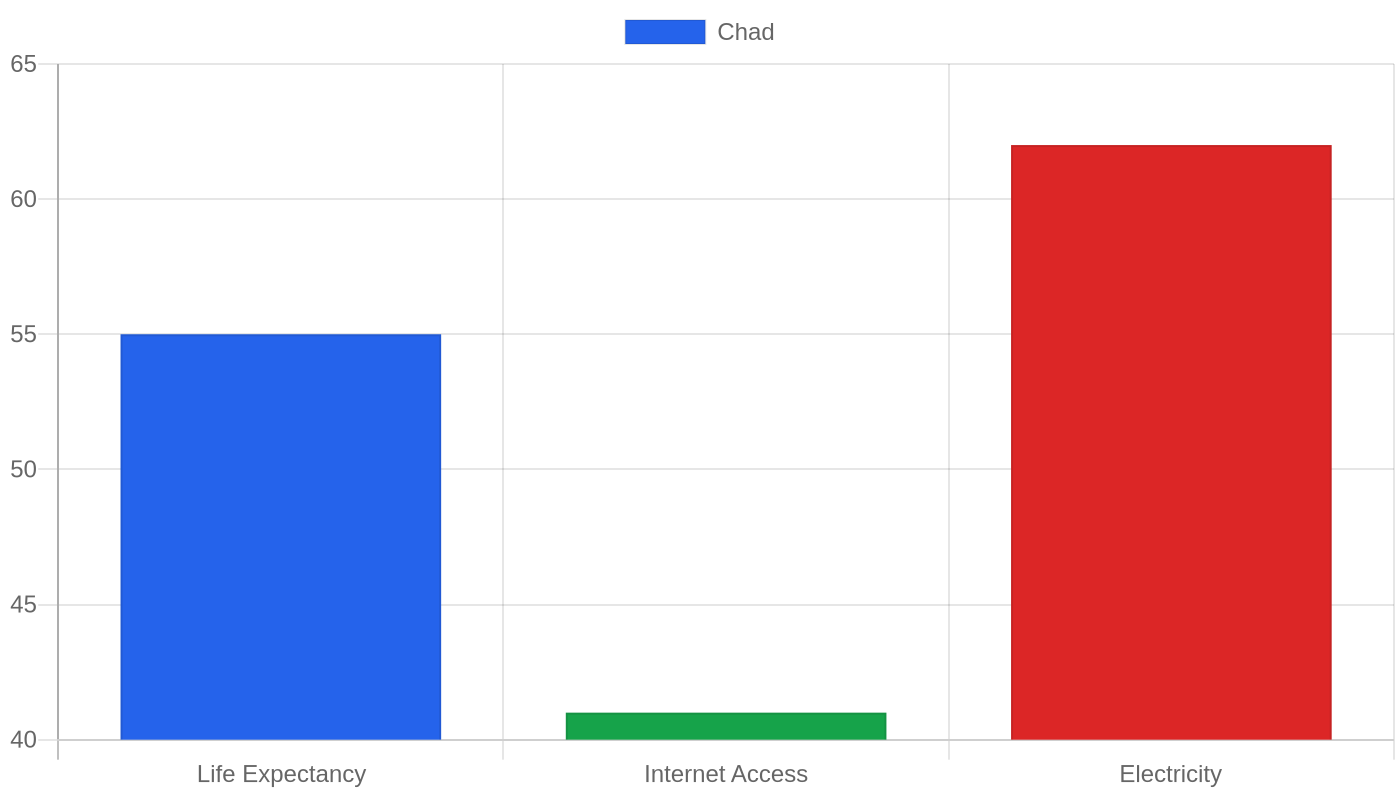
While broad macroeconomic data points such as GDP and per capita income remain unreported by the World Bank, the underlying industrial fabric of Chad reveals a concentrated corporate landscape dominated by specific key entities. The economy appears to rely on a handful of major organizations that serve as pillars for finance, logistics, and production. In the financial sector, Commercial Bank Chad stands out as a primary institution, facilitating the monetary flows necessary for domestic trade and investment.
The basic materials sector is represented by Cotontchad, highlighting the historical and ongoing importance of cotton agriculture to the national economy. Logistics and transportation are managed by entities such as Mid Express Tchad and Toumaï Air Tchad, which provide critical connectivity for goods and people across the landlocked country. Additionally, the telecommunications infrastructure is supported by SotelTchad, enabling digital communication and modern business operations.
The Société tchadienne des postes et de l’épargne further underscores the role of state-linked or para-statal entities in providing essential public services. These companies form the core of the observable business environment, suggesting that opportunities for engagement are likely tied to these established institutions and their supply chains.
The absence of detailed GDP figures does not diminish the significance of these actors; rather, it highlights the need to monitor the performance and strategic moves of these specific firms to gauge economic health.
Cost of Living and Daily Expenses
Assessing the cost of living in Chad requires navigating a landscape where standard consumer price index (CPI) data is not currently available from international bodies like the World Bank. Without specific inflation percentages or household expenditure statistics, a precise calculation of daily expenses or housing costs remains challenging for external analysts.
Typically, in economies with limited data transparency, the cost of living is heavily influenced by import dependencies and local production capabilities, particularly for food and energy. Housing markets, whether for renting or buying, are likely driven by localized demand and the availability of secure, formalized real estate, which may be scarce compared to regional neighbors.
However, the presence of structured financial and postal institutions suggests some level of formalized economic activity that supports a baseline of urban living standards. For expatriates and businesses, the lack of transparent CPI data means that budgeting must rely on direct observation and local negotiation rather than indexed comparisons. This opacity adds a layer of complexity to financial planning, requiring stakeholders to build buffers against potential unmeasured volatility in prices.
Consequently, understanding the cost of living in Chad is less about comparing national averages and more about assessing the specific operational costs within major urban centers where these key companies are headquartered.
Investment Climate and Business Environment
The investment landscape in Chad is defined by the interplay between a strong executive government and a concentrated set of major corporations. With the president holding sway over para-statal firms and key appointments, the business environment is highly responsive to top-down directives. Investors looking at sectors such as telecommunications, represented by SotelTchad, or aviation, via Toumaï Air Tchad, must navigate a regulatory framework that is closely aligned with state interests.
The dominance of Cotontchad in the basic materials sector indicates that agricultural processing and export remain vital, offering potential avenues for partnership or expansion. Similarly, the financial sector, led by Commercial Bank Chad, provides the necessary infrastructure for capital movement, though access may be influenced by political connections. The industrial segment, including Mid Express Tchad and the postal savings entity, shows a diversified but tightly knit network of service providers.
For foreign and domestic investors alike, success in this market likely depends on maintaining strong relationships with both the private leaders of these major firms and the governmental officials who oversee them. The absence of transparent unemployment or GDP growth data makes traditional valuation models difficult, shifting the focus toward qualitative assessments of political stability and corporate loyalty.
Safety, Political Stability, and Quality of Life
Navigating life and business in Chad involves careful consideration of both political dynamics and personal security. Official crime and safety indices are listed as unavailable, which complicates the ability to benchmark risk using standard global metrics. This lack of data often reflects either limited reporting mechanisms or the sensitive nature of security statistics in the region. Politically, the environment is stable under the current administration, but it is also highly centralized.
The constitutional changes of 2023 have reinforced the power of President Mahamat Déby, reducing the likelihood of sudden political upheaval but increasing the importance of alignment with the ruling party. Quality of life factors, such as access to healthcare, education, and digital connectivity, are mediated by the state-controlled or para-statal entities mentioned earlier. The happiness or well-being of the population is not captured in standard economic surveys, leaving a gap in understanding social sentiment.
For residents and visitors, the combination of unclear safety indices and a dominant political structure suggests that discretion and adherence to local norms are paramount. Security is likely maintained through strong state control, meaning that compliance with government regulations is a key component of personal and professional safety.
Current Affairs and Strategic Outlook
The most pressing aspect of Chad’s current economic narrative is the consolidation of power following the 2023 constitutional referendum. This political shift is not merely symbolic; it actively reshapes how economic decisions are made and implemented. The president’s enhanced authority over the judiciary and military ensures that any economic policies or reforms are executed with minimal internal resistance. This centralization creates a predictable, albeit rigid, operating environment for businesses.
While specific news items regarding recent policy shifts or inflation trends are not detailed in the provided data, the overarching theme is one of strengthened executive control. Companies like Cotontchad and Commercial Bank Chad are likely operating under new directives or oversight structures resulting from these political changes. The focus for stakeholders should be on monitoring how the executive branch utilizes its expanded powers to influence state-owned enterprises and provincial governance.
This period represents a critical juncture where the alignment of political will and economic activity is being redefined. Observers should watch for announcements regarding para-statal leadership changes, as these will signal the practical application of the new constitutional order.
The Bottom Line
Chad presents a unique profile for investors and researchers: a country with a clear political hierarchy and identifiable corporate anchors, yet lacking transparent macroeconomic data. Stakeholders should focus on the strategic importance of the major companies in finance, logistics, and agriculture, as they are the primary conduits of economic activity.
Success in this market requires a deep understanding of the political landscape, particularly the central role of the presidency in guiding state and semi-state entities. Those willing to navigate the opacity and engage with established local partners may find opportunities in a stabilized, centrally managed economy.
Sources & Methodology
This article is authored by Economic Pulse Net for informational and research purposes. Economic Pulse Net sources its data from multilateral institutions, national statistics bureaus, and proprietary databases. All data is believed to be current as of the date of publication.
Published: October 07, 2026 | Category: Research — Chad
Use these signals in your own platform
Economic Pulse publishes its live signal feed through a documented, read-only API. Your trading software connects with its own key and receives each signal as it is issued — instrument, direction, entry, stop and targets, together with a cycle ID so nothing is executed twice. The feed is independent of this website and cannot change it.
Signals are informational only and are not financial advice.