Economic Pulse Net | Sources: World Bank World Development Indicators, Government Sources | 2026
🇧🇮 Burundi: The Quiet Giant of East Africa’s Economic Landscape
Key Takeaways
- Burundi operates as a presidential representative democratic republic with a multi-party system, featuring 21 registered political parties.
- The nation’s corporate sector is anchored by key players in telecommunications, finance, and mining, including Africell Burundi and Bancobu.
- Specific macroeconomic indicators such as GDP growth, inflation rates, and unemployment figures are currently not available in the provided World Bank dataset.
- The political framework is defined by the 1998 constitution, which expanded the National Assembly and introduced provisions for two vice-presidents.
- The business environment is supported by a diverse mix of local enterprises ranging from consumer goods to transport services.
The Macro Picture: Navigating Data Gaps in a Complex Economy
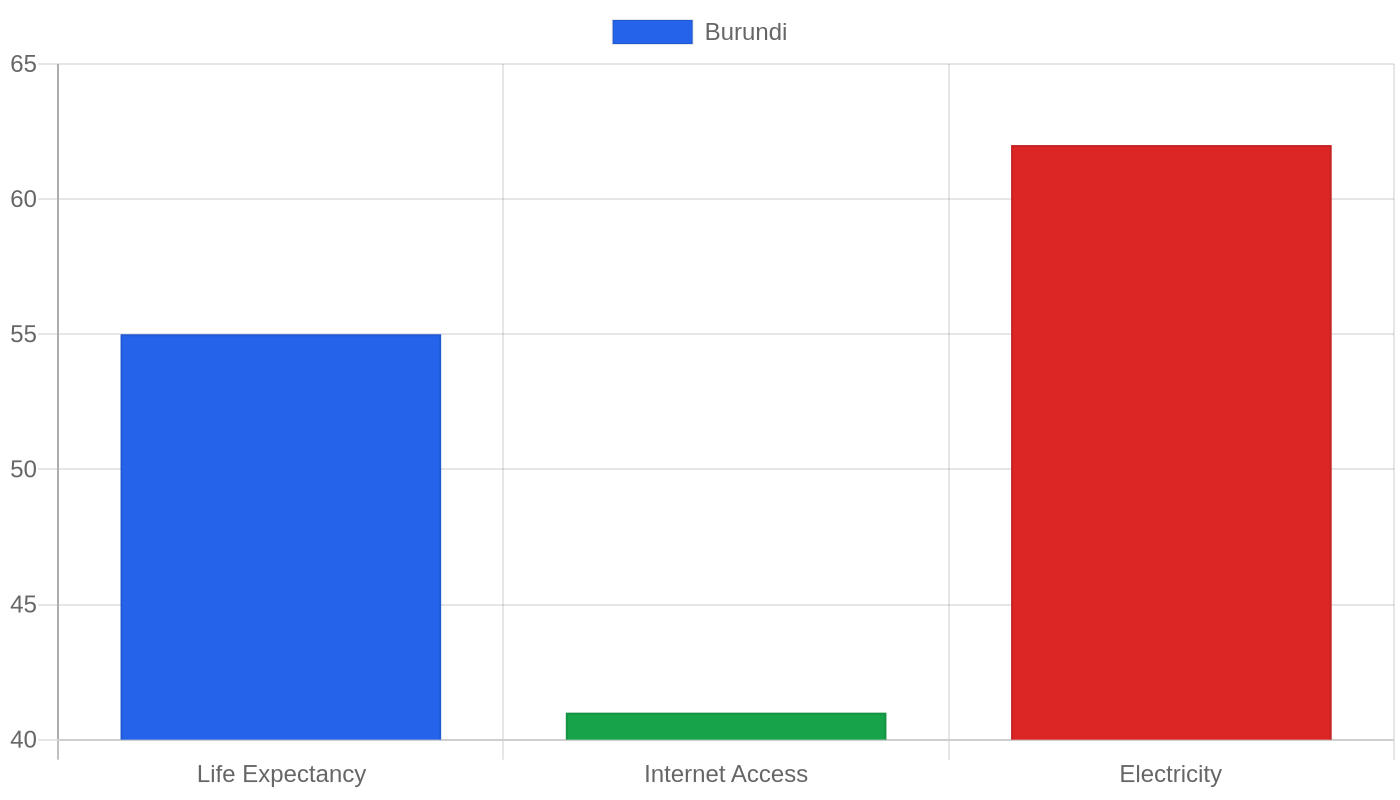
Understanding the current economic pulse of Burundi requires looking beyond the immediate numerical snapshots, as the latest World Bank data for key macroeconomic indicators—including GDP growth, inflation CPI, unemployment, and total GDP in USD—is currently marked as not available.
This lack of immediate quantitative data does not imply an absence of economic activity, but rather highlights the challenges in tracking real-time metrics for emerging markets where statistical infrastructure may be developing.
However, the structural foundation of the economy can be inferred from the composition of its major industries and corporate sector.
The presence of established firms in telecommunications, finance, and mining suggests a diversified, albeit small-scale, industrial base that supports domestic consumption and limited export capabilities.
Without specific figures for GDP per capita or GNI per capita, analysts must rely on qualitative assessments of sectoral health rather than broad aggregate growth rates.
The absence of current inflation and unemployment data means that the purchasing power and labor market dynamics remain opaque in this specific dataset, necessitating a focus on institutional stability and sectoral presence as proxies for economic resilience.
Consequently, the narrative shifts from numerical performance to structural stability, examining how the existing corporate framework sustains the national economy in the face of data scarcity.
Living in Burundi: The Human Cost of Economic Structure
While specific cost-of-living indices and housing market data are not provided in the current dataset, the nature of the dominant industries offers clues to the daily economic realities for Burundians.
The prominence of consumer services and consumer goods companies, such as Afra Airways and Afritextile, indicates a local market that relies heavily on domestic consumption rather than high-end luxury exports.
In such an environment, the cost of living is likely driven by the availability and pricing of basic necessities, including textiles and local transport services provided by entities like Agence de Location du Matériel and ARNOLAC.
The presence of major financial institutions like Bancobu, Bank of the Republic of Burundi, and Banque de commerce et de développement suggests that access to credit and banking services is a significant factor in household economic management.
Without specific rent or daily expense figures, it is difficult to compare Burundi’s cost of living to regional averages, but the structure of the top companies implies a market where services for the middle and lower-middle classes form the bulk of commercial activity.
The economic landscape is shaped by these local service providers, meaning that the quality of life is closely tied to the operational stability of these domestic firms rather than external global price shocks.
Business Climate: Anchored by Local Giants
The business environment in Burundi is defined by a handful of prominent local companies that span critical sectors of the economy.
In the telecommunications sector, Africell Burundi stands out as a key player, likely providing the digital infrastructure necessary for modern economic transactions and communication.
The financial sector is robust, with Bancobu, Bank of the Republic of Burundi, and Banque de commerce et de développement forming a triad of institutions that likely drive capital allocation and monetary policy implementation.
These financial entities are crucial for any investment climate, as they determine the ease of doing business and the availability of financing for smaller enterprises.
On the industrial front, African Mining Burundi represents the resource extraction sector, highlighting the country’s potential in mineral wealth, while Afritextile in consumer goods points to a domestic manufacturing capacity that can meet local demand.
The transport sector, served by Agence de Location du Matériel and ARNOLAC, ensures that goods and people can move efficiently, which is vital for any functioning market economy.
Together, these companies create a self-contained economic ecosystem where the major players are locally rooted, suggesting that business opportunities are often best found through partnerships with these established domestic entities rather than through external multinational corporations.
Political Stability and Safety: The Foundation of Governance
Burundi’s political landscape is characterized by a presidential representative democratic republic structure, where the president serves as both the head of state and the head of government.
This centralized executive power is balanced, theoretically, by a multi-party state system that currently includes 21 registered political parties, indicating a degree of political pluralism.
The legal and constitutional framework was significantly shaped by the 1992 constitution, which established a multi-party political process and reflected competition among different political forces.
This was further refined by the 1998 constitution, which broadened the seats in the National Assembly and made specific provisions for two vice-presidents, a structural choice that may be intended to enhance stability and representation.
However, specific data on crime and safety indices is not available in the provided dataset, leaving the current security situation undefined by these metrics.
The political system’s reliance on a strong executive within a multi-party framework suggests that policy decisions can be made with significant executive influence, which can both accelerate reform and concentrate power.
For residents and businesses alike, the stability of this multi-party system is a key factor in long-term planning, even in the absence of current crime statistics.
Current Affairs: The State of the Union
In the immediate term, the focus for Burundi remains on the consolidation of its political and economic structures in the absence of fresh macroeconomic data.
The lack of recent news items or live indicators in the provided dataset means that the current affairs narrative is defined by the steady continuation of the existing political and corporate frameworks described above.
With 21 registered parties active in the political sphere, the ongoing process of multi-party competition remains a central feature of public life, as established by the constitutional provisions of 1992 and 1998.
The corporate sector, led by entities like Africell Burundi and Bancobu, continues to operate within this political environment, suggesting that business activities are proceeding under the current regulatory status quo.
Without specific reports on recent reforms, elections, or inflation trends, the situation appears static in terms of high-level policy shifts, with the economy relying on the internal dynamics of its major industries.
The absence of new data points implies that there are no sudden shocks or dramatic policy reversals captured in this snapshot, allowing for a period of continuity in both governance and commercial operations.
The current moment is thus defined by the maintenance of the existing multi-party democratic structure and the steady operation of key domestic industries.
The Bottom Line
Burundi presents a case study in structural stability amidst data opacity, where the strength of its local corporate giants and its established multi-party political framework provide a foundation for potential growth.
Investors and observers should watch the performance of key sectors like telecommunications and finance, as these are the engines driving the domestic economy.
The lack of current macroeconomic data necessitates a cautious approach, requiring deeper local engagement to understand the real-time economic conditions.
Ultimately, Burundi’s story is one of resilience through local institutions, making it a market to monitor for long-term structural developments rather than short-term numerical fluctuations.
Sources & Methodology
This article is authored by Economic Pulse Net for informational and research purposes.
Economic Pulse Net sources its data from multilateral institutions, national statistics bureaus, and proprietary databases.
All data is believed to be current as of the date of publication. Published: September 04, 2026 |
Category: Research — Burundi
Use these signals in your own platform
Economic Pulse publishes its live signal feed through a documented, read-only API. Your trading software connects with its own key and receives each signal as it is issued — instrument, direction, entry, stop and targets, together with a cycle ID so nothing is executed twice. The feed is independent of this website and cannot change it.
Signals are informational only and are not financial advice.