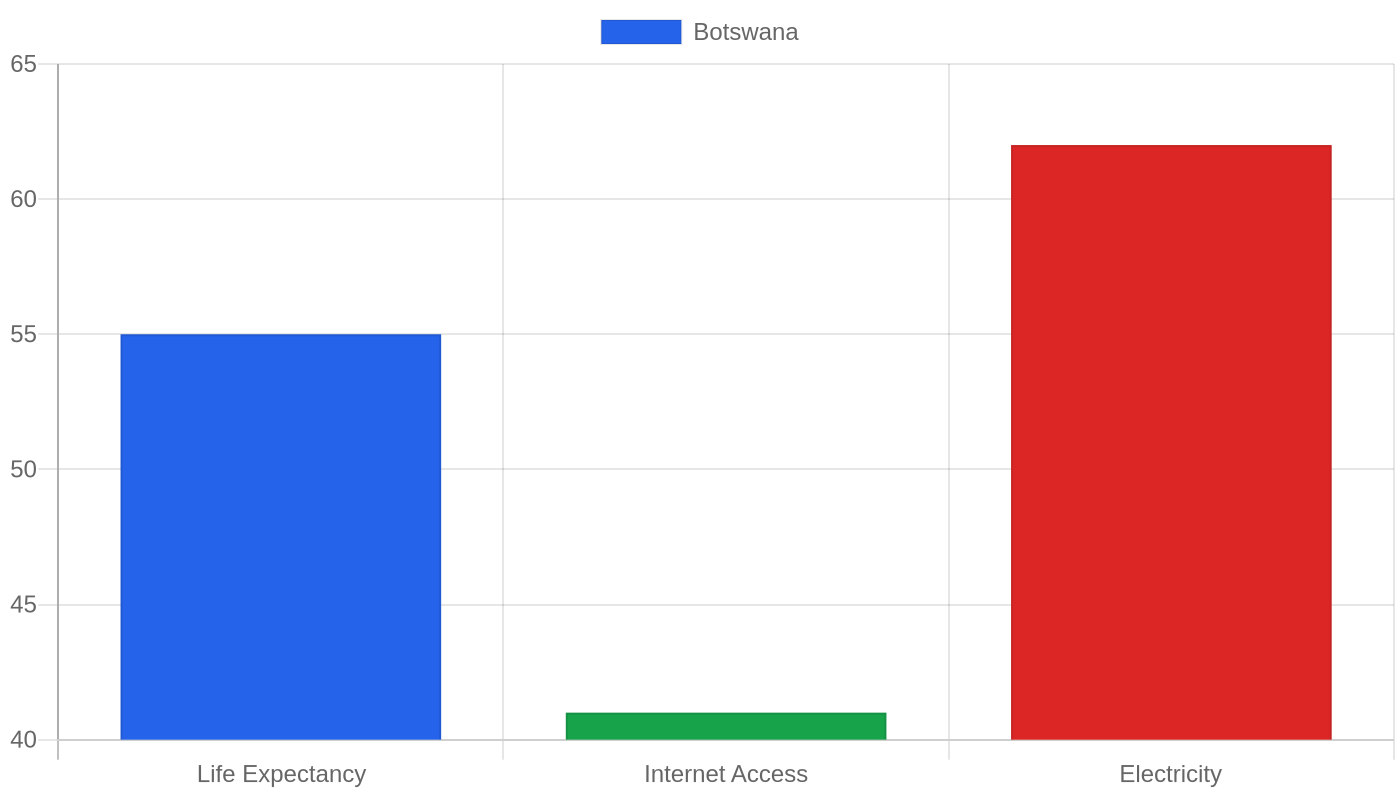
Economic Pulse Net | Sources: World Bank World Development Indicators, Government Sources | 2026
Key Takeaways
* Democratic Stability: Botswana stands as Africa’s longest uninterrupted democracy, offering a rare political anchor with a centralized government rooted in both Westminster traditions and local tribal governance.
Institutional Framework: Since independence in 1966, the nation has established robust governing institutions based in Gaborone, where national law supersedes local statutes to ensure uniform regulatory enforcement.
Corporate Landscape: The economy is anchored by major state-linked and private entities across financials, utilities, and consumer services, including Bank of Botswana, Air Botswana, and the Botswana Meat Commission.
Data Transparency Gap: While the political structure is well-documented, key macroeconomic indicators such as GDP growth, inflation rates, and unemployment figures are currently unreported in standard World Bank datasets, requiring investors to look beyond traditional metrics for assessment.
A Governance Model Built on Continuity
Botswana’s economic narrative cannot be separated from its political history, which serves as the bedrock for all business activity in the region. As a parliamentary republic governed by the Constitution of Botswana, the country offers a level of institutional predictability that is increasingly scarce on the continent.
It holds the distinction of being the longest uninterrupted democracy in Africa, a status achieved through a governmental structure that uniquely blends the United Kingdom’s Westminster system with the Tswana people’s traditional tribal governments. This hybrid model allows for modern legislative processes while respecting indigenous leadership structures, creating a stable environment for long-term planning.
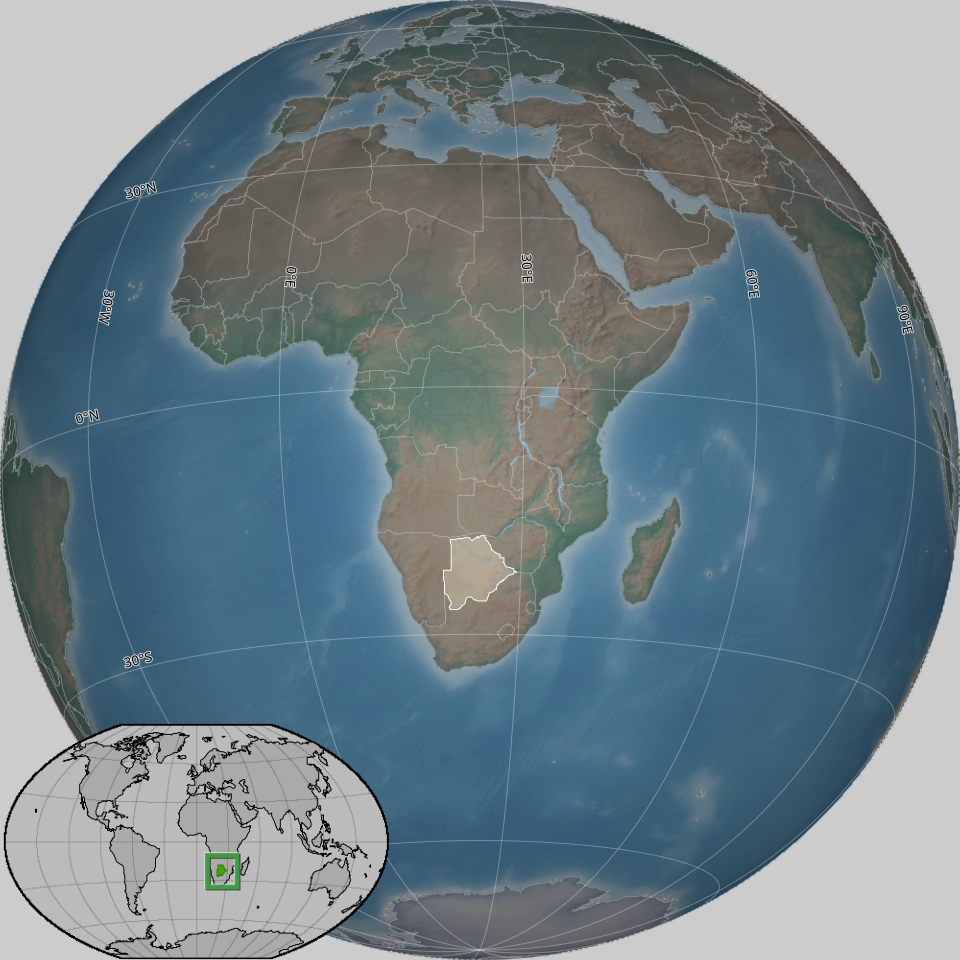
The seat of government is located in Gaborone, where the centralized nature of the administration ensures that national law takes precedence over local law, reducing regulatory fragmentation. These governing institutions were firmly established after the nation became an independent state in 1966, providing decades of continuity that have attracted steady foreign direct investment despite the absence of recent high-frequency economic data points.
Navigating the Corporate Ecosystem
The commercial landscape of Botswana is defined by a mix of essential service providers and industrial giants that form the backbone of daily economic life. Investors looking at the top companies see a concentration in financial services and utilities, sectors critical for any emerging market.
The Bank of Botswana and BancABC represent the financial pillar, managing liquidity and credit flow for businesses, while the Botswana Stock Exchange provides the necessary platform for capital formation and corporate listing. In the utility sector, the Botswana Power Corporation ensures energy infrastructure supports industrial growth, working in tandem with Botswana Telecommunications Corporation to maintain digital connectivity.
Consumer-facing industries are equally prominent, with the Botswana Meat Commission playing a vital role in agricultural exports and processing, and Air Botswana facilitating regional trade and tourism. Additional industrials like Botswana Railways and BotswanaPost handle the physical logistics of goods movement, while media outlets like the Botswana Guardian contribute to the informational ecosystem.
Together, these entities create a diversified corporate base that mitigates risk for stakeholders, even as specific GDP per capita or total GDP figures remain unavailable for precise valuation modeling.
Living Costs and Housing Dynamics
For expatriates and returning citizens, understanding the cost of living is essential, though specific CPI inflation percentages are not currently reported by the World Bank. The general expense profile is shaped by the availability of key services provided by the aforementioned corporations, particularly telecommunications and power, which are regulated monopolies or semi-state entities.
Housing costs in Gaborone likely reflect the stability of the currency and the centralization of economic activity, though exact rent-to-buy ratios require localized survey data not present in the current dataset. Daily expenses are influenced by the efficiency of logistics providers like BotswanaPost and Botswana Railways; efficient transport networks typically keep consumer goods prices competitive compared to landlocked neighbors with poorer infrastructure.
Without specific unemployment percentages, the labor market dynamics remain opaque, but the presence of a formalized banking sector suggests a structured approach to household finance management. Prospective residents should anticipate a cost structure that prioritizes stability over low-cost volatility, relying on the robustness of the national grid and telecom infrastructure rather than informal market arbitrage.
Safety, Politics, and Quality of Life
Safety and political security are among Botswana’s strongest selling points for international observers. The Crime Index and Safety Index are listed as N/A, which often correlates with lower crime rates in stable democracies, though official statistics are required for confirmation. The political landscape remains calm, with no history of coups or violent regime changes since 1966, contributing to a high quality of life for those who value rule of law over rapid, disruptive change.
The centralized government in Gaborone ensures that legal disputes are resolved within a clear framework, enhancing the sense of personal and property security. Happiness data, while not explicitly quantified in the provided text, can be inferred from the stability of the democratic institutions and the consistent operation of civil services.
For families and long-term residents, the blend of Western-style parliamentary procedures with traditional community structures creates a social fabric that is both orderly and culturally rich. This environment reduces the “political risk premium” that investors and expats often face in other parts of sub-Saharan Africa.
Current Affairs and Business Climate
While headline economic numbers like GDP growth are not available, the ongoing operational status of major companies indicates a functioning economy. Recent developments would likely focus on the performance of the Botswana Meat Commission in global markets and the expansion efforts of the Botswana Stock Exchange. The continued operation of Air Botswana suggests sustained demand for travel, either domestic or regional, pointing to resilient consumer services.
Business climate updates would emphasize the regulatory consistency provided by the centralized government, which simplifies compliance for multinational corporations. There is no indication of immediate policy shifts or emergency reforms, suggesting a period of steady maintenance rather than radical transformation. The lack of new inflation data implies price stability, or at least a lack of hyperinflationary pressures that would dominate news cycles.
Stakeholders should monitor the strategic moves of BancABC and the Bank of Botswana, as their lending patterns will signal broader economic confidence before official GDP figures are released.
The Bottom Line
Botswana remains a critical watchlist country for investors seeking political stability and institutional depth in Africa. Its status as the continent’s longest-running democracy provides a safe harbor for capital, even in the absence of granular monthly economic data. Companies like Bank of Botswana and the Botswana Meat Commission offer tangible exposure to the real economy, bypassing the need for speculative GDP forecasts.
For those willing to look past missing statistical metrics, Botswana represents a mature, rule-of-law-based market with enduring structural advantages.
Sources & Methodology
This article is authored by Economic Pulse Net for informational and research purposes. Economic Pulse Net sources its data from multilateral institutions, national statistics bureaus, and proprietary databases. All data is believed to be current as of the date of publication.
Published: October 30, 2026 | Category: Research — Botswana
Use these signals in your own platform
Economic Pulse publishes its live signal feed through a documented, read-only API. Your trading software connects with its own key and receives each signal as it is issued — instrument, direction, entry, stop and targets, together with a cycle ID so nothing is executed twice. The feed is independent of this website and cannot change it.
Signals are informational only and are not financial advice.