Economic Pulse Net | Sources: World Bank World Development Indicators, Government Sources | 2026
Key Takeaways
– Political Paradox: Benin operates as a presidential representative democracy, but observers note that the judiciary’s independence has been “gradually hollowed out” by President Patrice Talon, raising questions about the health of one of West Africa’s most stable democracies.
– Service Sector Dominance: The country’s top companies are overwhelmingly concentrated in consumer services and financials, with a notable cluster of aviation firms—including Afric’Air Charter, Afrique Airlines, and Benin Golf Air—indicating a transport and logistics tilt.
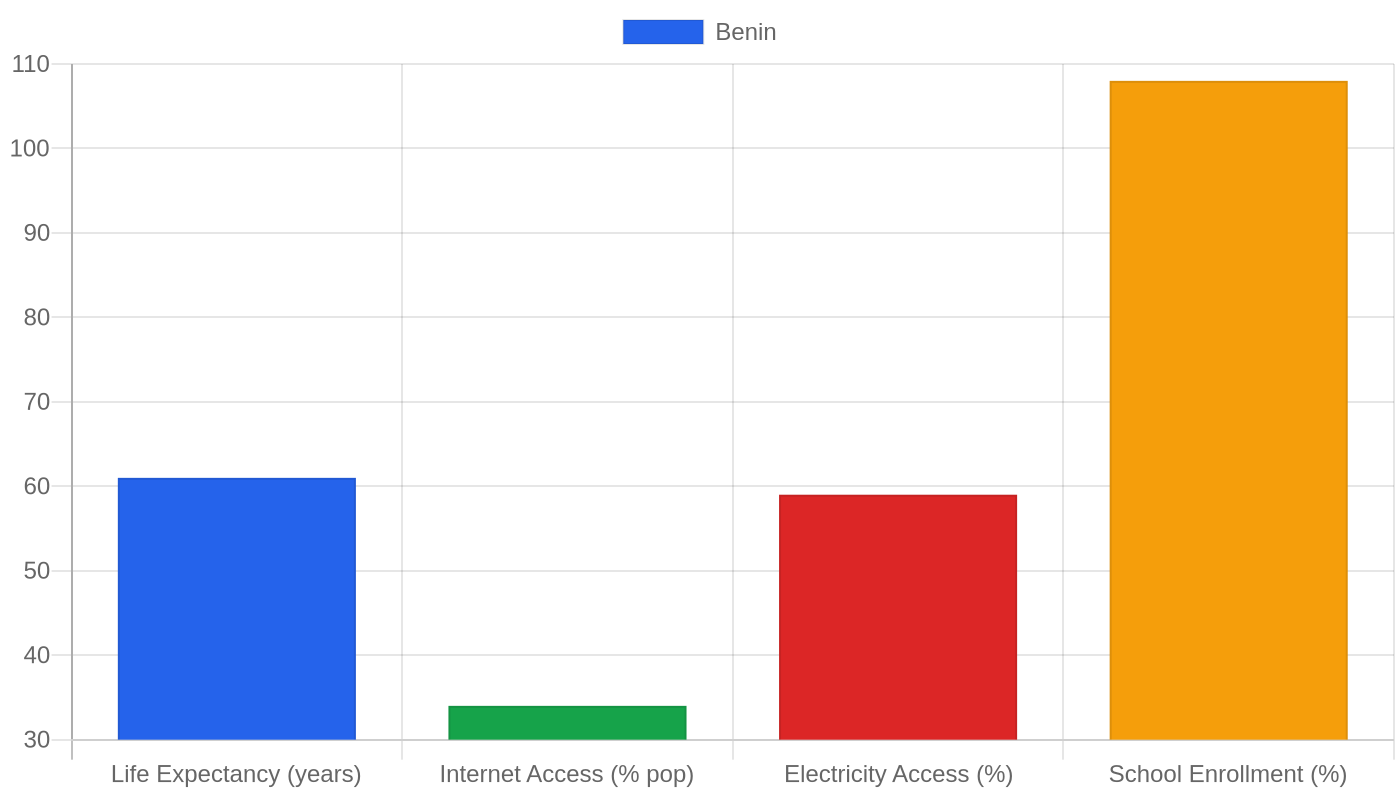
– Data Darkness: Critical economic indicators from the World Bank—GDP growth, inflation, unemployment, and GDP per capita—are all listed as “N/A,” reflecting either reporting lags or transparency gaps that make economic analysis a challenge.
– Financial Footprint: Major banks like Banque Internationale du Bénin and Financial Bank Benin anchor the financial sector, while La Poste du Bénin represents the industrials category, suggesting a traditional economy with modernizing ambitions.
– Energy & Infrastructure: The presence of Communauté Électrique du Bénin among top companies highlights the centrality of power generation and distribution to Benin’s development trajectory.
The Unseen Economy — Growth Without Numbers
Benin’s economic story is, at present, a tale told in shadows. The World Bank’s latest data set offers no figures for GDP growth, inflation, unemployment, or GDP per capita—a silence that speaks volumes about either the challenges of data collection in West Africa or a deliberate opacity in economic reporting. What we do know, from the structural evidence, is that Benin is a nation built on services.
The roster of the country’s top companies reads like a directory of the consumer economy. Of the ten largest firms by revenue or influence, six operate in consumer services: Afric’Air Charter, Afrique Airlines, Benin Golf Air, Compagnie Béninoise de Négoce et de Distribution, COTAIR, and Royal Air. This is not a manufacturing powerhouse. This is a nation that moves people, goods, and money.
The aviation cluster alone—four airlines among the top ten—suggests that transport logistics, both domestic and regional, form a critical artery of the Beninese economy.
The financial sector is equally prominent. Banque Internationale du Bénin and Financial Bank Benin represent the banking backbone, facilitating trade, remittances, and the everyday transactions that keep the consumer economy humming. La Poste du Bénin, classified under industrials, hints at a postal and logistics infrastructure that connects urban centers to rural hinterlands.
What is missing from this picture is manufacturing, agriculture, or extractive industries. Benin is not a commodities giant. It does not feature an oil company, a mining firm, or a large agricultural exporter among its top corporate names. This is a service-driven economy, vulnerable to regional shocks but also nimble in its reliance on human capital rather than heavy infrastructure.
Without GDP data from the World Bank, we cannot quantify growth, but we can infer that Benin’s economic pulse is measured in flights taken, bank transactions processed, and goods distributed—not in tons of ore extracted or barrels pumped.
The Price of Living — Housing, Costs, and the Unseen Burden
The cost of living in Benin remains a statistical blank—no data from the World Bank or other sources provided here sheds light on housing costs, rental markets, or daily expenses. But the absence of data does not mean the absence of pressure.
In a service-dominated economy where the largest employers are airlines and banks, the cost of urban living—particularly in the economic capital, Cotonou—is likely to be shaped by the same forces that affect much of coastal West Africa: imported food prices, energy costs, and the premium on formal-sector housing.
The presence of Communauté Électrique du Bénin among the top companies underscores the importance of electricity to daily life and business operations. In a region where power outages are common and electricity tariffs can consume a significant portion of household income, the efficiency of the national utility directly impacts the cost of living.
Rent versus buy decisions in Benin would logically follow patterns seen elsewhere in Francophone West Africa, where land ownership is often tied to complex customary tenure systems, and rental markets in cities cater to a growing class of salaried workers in banking, aviation, and distribution.
Without hard numbers, the prudent conclusion is that Benin’s cost of living is a story of contrasts: affordable by global standards but straining for those in the formal economy who must navigate high import dependency and unreliable public services. The data gap itself is a form of information poverty that makes life planning difficult for both citizens and investors.
Business on the Tarmac — Investment Climate and Corporate Landscape
Benin’s investment climate is written in its corporate registry. The dominance of aviation companies is the most striking feature: Afric’Air Charter, Afrique Airlines, Benin Golf Air, COTAIR, and Royal Air all appear among the top ten. This suggests that air transport is not merely a convenience but a strategic sector.
For a country with a coastline on the Gulf of Guinea and land borders with Nigeria, Niger, Burkina Faso, and Togo, aviation serves both tourism and the movement of goods and business travelers.
The financial sector offers the other pillar of opportunity. Banque Internationale du Bénin and Financial Bank Benin indicate a banking system capable of supporting trade finance, small business lending, and regional transactions. For investors, the question is whether the regulatory environment keeps pace with the ambitions of these institutions.
The political landscape, as described, shows a president who has consolidated power and a judiciary whose independence has been “gradually hollowed out.” This creates a dual reality: a stable executive branch that can push through reforms, but also a weakening of the checks and balances that long-term investors typically value.
La Poste du Bénin, as the sole industrials representative among top companies, hints at a logistics and distribution infrastructure that could be leveraged for e-commerce and last-mile delivery—a sector with growth potential across West Africa. The absence of manufacturing or technology firms among the top ten suggests that these sectors remain nascent, offering first-mover opportunities for investors willing to navigate the political and infrastructure challenges.
Democracy Under Pressure — Politics, Safety, and Quality of Life
Benin’s political framework is, on paper, a model for West Africa: a presidential representative democratic republic with a multi-party system, where executive power is exercised by the government, legislative power is shared between the government and the legislature, and the judiciary is officially independent. In practice, the picture is more complicated.
The data provided notes that the judiciary’s independence “has been gradually hollowed out by Talon,” and the Constitutional Court is headed by—the sentence cuts off, but the implication is clear.
President Patrice Talon, a wealthy businessman turned politician, has been in power since 2016. His tenure has been marked by economic reforms and infrastructure projects, but also by concerns over political space. Opposition figures have faced legal challenges, and the media environment has tightened. For a country that was once hailed as a democratic success story in a region plagued by coups, Benin’s political trajectory is under scrutiny.
On safety and crime, the data provides no index numbers. However, Benin has historically been considered one of the safer countries in West Africa, with lower rates of violent crime than some neighbors.
The quality of life, absent happiness or well-being data, must be inferred from the economic structure: a service economy with a growing middle class in banking and aviation, but with the fragility that comes from dependence on regional stability and the health of the Nigerian economy, which is Benin’s dominant trade partner.
Current Affairs — The Talon Era and the Data Vacuum
Right now, Benin is navigating a period of political consolidation and economic uncertainty. The most significant development is the ongoing concern over democratic backsliding under President Talon. The hollowing out of judicial independence, as noted in the political landscape data, is not a historical footnote—it is a live issue. Opposition parties and civil society groups have raised alarms about the shrinking space for dissent, even as the government points to infrastructure investments and economic stability.
The data vacuum from the World Bank is itself a current affair. Without recent GDP growth, inflation, or unemployment figures, analysts and investors are flying blind. This may reflect genuine statistical capacity challenges, or it may be a deliberate choice by authorities to limit the availability of data that could be used to criticize government performance. Either way, it complicates the task of assessing Benin’s economic health in real time.
The aviation sector, dominated by the cluster of top companies, faces its own pressures. Regional fuel costs, maintenance expenses, and competition from Nigerian and Ethiopian carriers shape the operating environment. The banking sector, meanwhile, must navigate regional regulatory harmonization under the West African Economic and Monetary Union (UEMOA) while dealing with domestic political risk.
For the average Beninese citizen, the current moment is defined by the gap between the country’s democratic aspirations and the reality of centralized power, between the promise of a service economy and the absence of data that would allow them to measure progress. The next election cycle, expected within the Talon era, will be a critical test of whether Benin’s democratic framework can withstand the pressures that have toppled other West African republics.
The Bottom Line
Benin is a country worth watching for investors and analysts interested in West Africa’s middle-tier economies—those that are neither resource-rich giants nor failed states, but rather service-driven democracies grappling with political maturity. The aviation and banking sectors offer entry points, but the hollowing out of judicial independence and the absence of basic economic data are red flags that demand caution.
For democracy watchers, Benin represents a test case: can a multi-party system survive the ambitions of a business-minded president? The answer will shape not just Benin’s future, but the trajectory of democratic governance across the region.
Sources & Methodology
This article is authored by Economic Pulse Net for informational and research purposes. Economic Pulse Net sources its data from multilateral institutions, national statistics bureaus, and proprietary databases. All data is believed to be current as of the date of publication.
Published: July 30, 2026 | Category: Research — Benin
Use these signals in your own platform
Economic Pulse publishes its live signal feed through a documented, read-only API. Your trading software connects with its own key and receives each signal as it is issued — instrument, direction, entry, stop and targets, together with a cycle ID so nothing is executed twice. The feed is independent of this website and cannot change it.
Signals are informational only and are not financial advice.