Economic Pulse Net | Sources: World Bank World Development Indicators, Government Sources | 2026
Key Takeaways
– Angola’s economy remains overwhelmingly dependent on its oil and gas sector, with Angola LNG standing as a flagship enterprise, yet the government is pursuing diversification through its stock exchange and derivatives market.
– The country’s political structure is defined by a three-branch system—executive, legislative, and judicial—with strong presidential authority shaping economic policy and investment decisions.
– Despite holding significant natural resource wealth, Angola faces structural challenges in developing non-oil industries and improving living standards for its population.
– Telecommunications infrastructure is emerging as a growth sector, led by companies like Angola Cables, signalling potential for digital economy expansion.
– The absence of recent World Bank data on GDP growth, inflation, and unemployment underscores the difficulty in tracking Angola’s economic trajectory with precision.
The Petro-State Paradox — Navigating Growth Without the Numbers
Angola stands as one of Africa’s most resource-rich economies, yet the latest World Bank data presents a curious vacuum: GDP growth, inflation, unemployment, GDP per capita, and GNI per capita are all listed as unavailable. This statistical silence does not mean the economy has stopped moving. Rather, it reflects the challenges of data collection in a country where the formal economy is heavily concentrated in extractive industries, and vast swathes of activity operate outside official measurements.
The backbone of Angola’s economic identity remains hydrocarbons. Angola LNG, a major player in the oil and gas sector, represents the country’s ambition to move beyond crude exports into value-added processing. The World Bank has long noted that Angola’s economy is among the most oil-dependent in sub-Saharan Africa, with petroleum accounting for the vast majority of export revenues and government income.
This dependence creates a volatile economic profile: when global oil prices rise, government coffers swell; when they fall, the entire budget comes under strain.
The challenge for Angola is the classic resource curse dilemma. Without recent World Bank data on inflation or employment, it is difficult to assess whether the country is making progress on its stated goal of economic diversification. What is clear from the available information is that the industrial base remains narrow. The dominant industries listed are extractive and service-oriented, with little evidence of manufacturing or agricultural transformation at scale.
For the Angolan worker, this means employment opportunities are concentrated in either the formal oil sector—which is capital-intensive and employs relatively few people—or the informal economy, which is difficult to measure and often precarious.
The Price of Living — Housing and Daily Expenses in Luanda
Luanda has historically ranked among the world’s most expensive cities for expatriates, a legacy of the oil boom that created a two-tier economy: one for international workers and the local elite, and another for the majority of Angolans. Housing costs in the capital are driven by a combination of limited supply, high construction costs, and demand from the oil and gas industry.
Renting in desirable neighbourhoods can consume a significant portion of household income, while buying property remains out of reach for many due to high interest rates and a mortgage market that is still developing.
The cost of everyday goods is similarly shaped by Angola’s import dependency. The country produces relatively little of its own food or manufactured goods, meaning that most consumer items—from rice to electronics—must be imported. This exposes households to currency fluctuations and global price shocks. When the kwanza weakens, as it has periodically done, the cost of imported essentials rises sharply, squeezing household budgets.
For the average Angolan family, daily expenses are a constant negotiation between what is needed and what is affordable, with little margin for error.
Business Frontiers — From Diamonds to Data Cables
Angola’s corporate landscape tells a story of both tradition and transition. The African Diamond Producers Association reflects the country’s status as a major diamond producer, a sector that has historically run alongside oil as a key export earner. Basic materials remain a pillar of the economy, but the list of top companies reveals a more diverse picture than the headlines might suggest.
In the consumer services sector, companies like Aeronáutica, Air 26, Alada, Alfa 5, and Angola Air Charter point to a growing aviation and logistics industry, serving both domestic travel and regional connections. Ancar, in consumer goods, indicates some domestic manufacturing capacity. Perhaps most significant for the future is Angola Cables, a telecommunications company that is positioning the country as a connectivity hub for the region.
With fibre-optic networks linking Angola to South America and the rest of Africa, the company is laying the groundwork for a digital economy that could reduce the country’s reliance on physical resource extraction.
The Angola Stock Exchange and Derivatives, listed among the top companies, represents the government’s most ambitious institutional reform. Launched to provide capital-raising opportunities for Angolan businesses and to attract foreign portfolio investment, the exchange is still in its early stages. Its success will depend on whether enough companies choose to list and whether investors gain confidence in the regulatory framework.
For now, it remains a symbol of intent rather than a driver of economic transformation.
Security, Stability, and the Quality of Life Question
The World Bank data provides no crime or safety index for Angola, making it difficult to offer precise comparisons with regional peers. However, the broader picture is shaped by the country’s political structure. The Angolan government operates with three branches—executive, legislative, and judicial—with executive authority concentrated in the presidency, supported by the Vice-President and the Council of Ministers.
This system has provided political stability since the end of the civil war in 2002, but critics argue that it concentrates power in ways that can stifle accountability and slow economic reform.
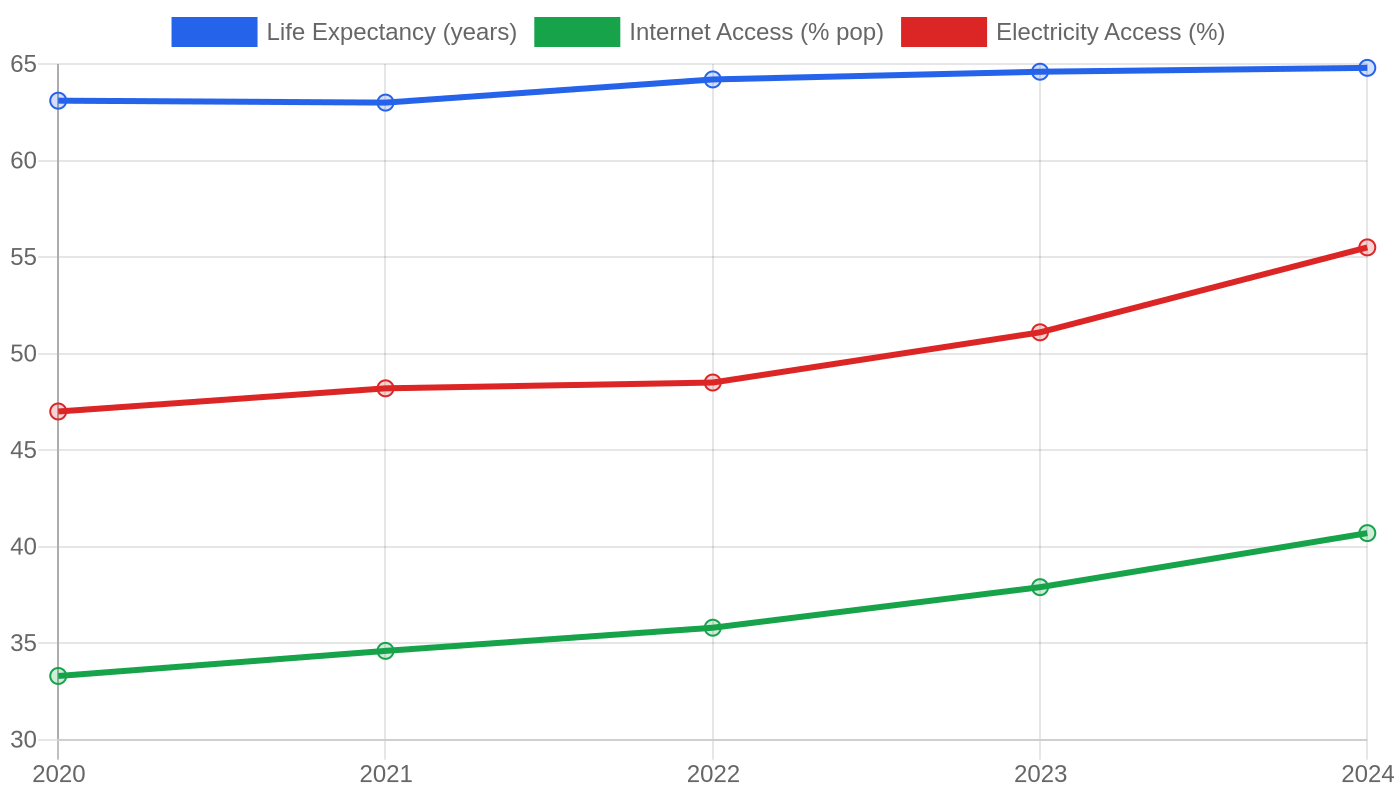
For the average citizen, quality of life is influenced by factors that go beyond crime statistics. Access to reliable electricity, clean water, healthcare, and education varies dramatically between urban and rural areas. Luanda’s infrastructure has improved in recent years, but many Angolans outside the capital still face daily challenges in accessing basic services.
The absence of happiness or well-being data in the available information is itself telling: Angola has not been a regular participant in global surveys that measure life satisfaction, which may reflect both logistical challenges and a political culture that has not prioritised such measurements.
What’s Happening Now — The Reform Agenda Takes Shape
Angola is currently navigating a period of cautious economic reform, even as the data gaps make it difficult to track progress in real time. The government has signalled its commitment to moving beyond the oil-dependent model that has defined the economy for decades.
The continued operation and development of the Angola Stock Exchange and Derivatives is a concrete step toward creating a more diversified financial system, one that could channel domestic savings into productive investment and attract foreign capital that is currently hesitant to enter a market dominated by extractive industries.
The telecommunications sector, led by Angola Cables, is another area of active development. As the country expands its digital infrastructure, there are opportunities for growth in fintech, e-commerce, and business process outsourcing. These are sectors that could create jobs for Angola’s young and growing population, which the World Bank data does not capture but which is a demographic reality shaping the country’s future.
At the same time, the political landscape remains stable under the current constitutional framework. The executive branch, with the President at its helm, continues to drive economic policy. The question for investors and observers is whether the pace of reform will accelerate or stall. Without recent World Bank data on inflation and growth, it is impossible to say with certainty whether the reforms are working.
But the direction of travel—toward diversification, financial deepening, and digital connectivity—is clear, even if the destination remains uncertain.
The Bottom Line
Angola is a country in transition, rich in resources but searching for a more sustainable economic model. Investors with a long-term horizon and a tolerance for volatility may find opportunities in telecommunications, financial services, and consumer goods. However, the lack of recent economic data from the World Bank means that anyone watching Angola must be prepared to operate with incomplete information, relying on corporate developments and political signals rather than official statistics.
For the Angolan people, the hope is that the reforms now underway will eventually translate into better jobs, lower prices, and a higher quality of life—but that outcome is far from guaranteed.
Sources & Methodology
This article is authored by Economic Pulse Net for informational and research purposes. Economic Pulse Net sources its data from multilateral institutions, national statistics bureaus, and proprietary databases. All data is believed to be current as of the date of publication.
Published: July 19, 2026 | Category: Research — Angola
Use these signals in your own platform
Economic Pulse publishes its live signal feed through a documented, read-only API. Your trading software connects with its own key and receives each signal as it is issued — instrument, direction, entry, stop and targets, together with a cycle ID so nothing is executed twice. The feed is independent of this website and cannot change it.
Signals are informational only and are not financial advice.