Economic Pulse Net | Sources: World Bank World Development Indicators, Government Sources | 2026
Key Takeaways
– Angola’s economy remains overwhelmingly dependent on oil and gas, with the Angola LNG company standing as a pillar of the nation’s industrial base, yet the government has made limited progress in broadening its economic foundations.
– The political landscape operates under a three-branch system with strong executive authority concentrated in the presidency, shaping both business climate and daily life.
– The country’s top companies span consumer services, telecommunications, and financial markets—including the Angola Stock Exchange and Derivatives—signaling nascent efforts to build a more sophisticated economy.
– Despite holding significant natural resource wealth, Angola faces structural challenges in translating that wealth into broad-based prosperity and stability for its population.
The Hydrocarbon Paradox — Growth Without Transformation
Angola’s economic story is written in the language of crude oil. The nation sits as one of sub-Saharan Africa’s largest petroleum producers, yet the World Bank data tells a story of gaps rather than certainties. With GDP growth figures, inflation rates, and unemployment numbers all marked as unavailable in the latest reporting, what emerges is a portrait of an economy where even the most basic metrics remain elusive to international observers.
The dominance of Angola LNG in the country’s corporate landscape underscores the fundamental reality: hydrocarbons drive everything. This single company, operating in the oil and gas sector, represents the lifeblood of national revenue, government budgets, and foreign exchange earnings. When global oil prices fluctuate, Angola’s entire economic machinery feels the tremor.
Yet there are signs of ambition beyond petroleum. The presence of the Angola Stock Exchange and Derivatives among the top companies signals an attempt to build financial infrastructure that could eventually channel investment into non-oil sectors. Telecommunications firms like Angola Cables suggest connectivity and digital infrastructure are receiving attention.
The consumer services sector, represented by companies such as Aeronáutica, Air 26, and Alada, points to a domestic economy that is trying to serve its people beyond the extractive industries.
The problem remains one of transformation. For decades, Angola has earned its wealth from what lies beneath the ground rather than what is built upon it. The World Bank’s inability to provide standard economic indicators may itself be telling—when an economy is this concentrated, and when data systems may not be fully developed across all sectors, the picture becomes fragmented.
What is clear is that Angola’s prosperity is not yet diversified enough to withstand the global energy transition that looms on the horizon.
The Cost of Living — Where Oil Wealth Meets Daily Struggle
Understanding the cost of living in Angola requires reading between the lines of absent data. When the World Bank provides no figures for GDP per capita, GNI per capita, or inflation, the journalist must look to the texture of the economy for clues. Angola has historically experienced periods of very high inflation, and the gap between the capital Luanda and the rest of the country has been stark.
Housing in Luanda has long been among the most expensive in Africa, driven by oil-sector demand, limited supply of quality housing, and a construction sector that has struggled to keep pace with urbanization. Rent for a decent apartment in a good neighborhood can consume the majority of a middle-class salary. The cost of imported goods—from food to electronics—is amplified by a currency that has faced repeated pressures.
For the average Angolan, daily expenses revolve around the price of basic staples imported from abroad, transportation costs in a city notorious for traffic, and the premium paid for anything that requires hard currency. The gap between those connected to the oil economy and those working in agriculture, small trade, or informal services is wide. This is a country where the cost of living tells a story of inequality as much as it tells a story of prices.
Investment and Business Climate — A Market in the Making
The corporate roster of Angola reveals an economy at a crossroads. The African Diamond Producers Association, listed among top companies in basic materials, reminds us that diamonds join oil as a source of mineral wealth. But the list also includes companies like Alfa 5 in industrials and Ancar in consumer goods—businesses that suggest domestic manufacturing and services are trying to gain a foothold.
The Angola Stock Exchange and Derivatives represents perhaps the most significant institutional development for investors. A functioning stock exchange can provide capital for growing companies, offer exit opportunities for early investors, and create a transparent mechanism for pricing risk. For foreign investors looking beyond the oil sector, the exchange could become a gateway to opportunities in telecommunications, consumer services, and logistics.
Yet the business climate remains challenging. The concentration of executive authority in the presidency, as described in the political landscape data, means that regulatory decisions, contract enforcement, and licensing can be highly centralized. Companies operating in Angola must navigate a system where political connections and bureaucratic processes are deeply intertwined.
The presence of multiple aviation companies—Aeronáutica, Air 26, Angola Air Charter—suggests that transportation and logistics are active sectors, likely serving both the oil industry and a growing domestic travel market.
Safety, Politics and Quality of Life — Governing the Petro-State
The political structure of Angola is formally democratic, with three branches of government: executive, legislative, and judicial. But the data makes clear that executive authority is exercised by the president with the assistance of the vice-president and the Council of Ministers. This concentration of power has been a defining feature of Angolan governance since independence, shaping everything from oil revenue management to daily life for citizens.
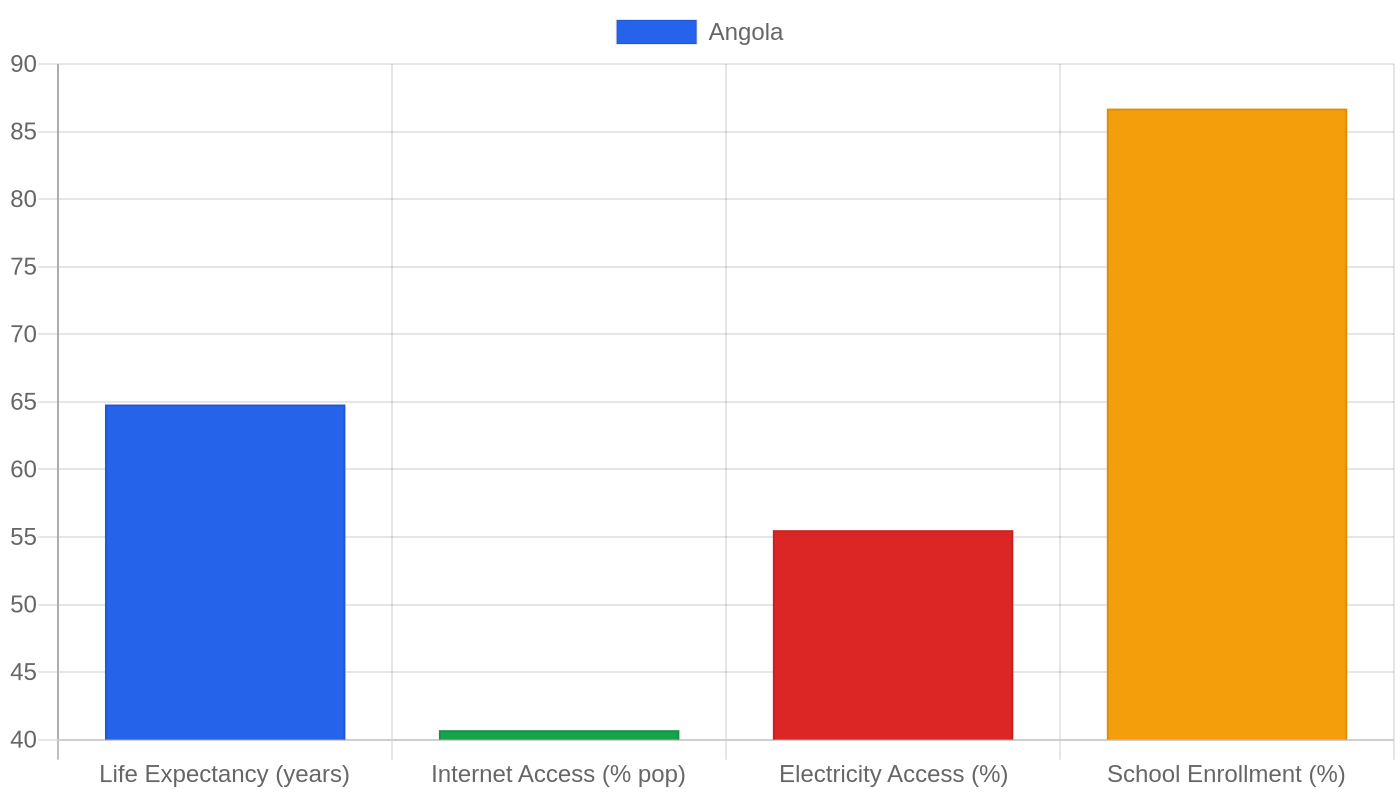
Crime and safety indices are unavailable in the data, but Angola’s reputation among regional observers has been mixed. Luanda has faced challenges with street crime, while the broader country has experienced periods of significant instability in its past. The quality of life for ordinary Angolans is shaped by access to basic services—electricity, clean water, healthcare, education—which have improved in some areas but remain uneven.
The political landscape matters enormously for economic life. When executive authority is strong and centralized, the business environment depends heavily on the priorities and competence of those at the top. Angola’s history of civil conflict, which ended in 2002, still echoes in the country’s institutions and infrastructure. The current generation of leaders faces the challenge of building a state that can deliver prosperity beyond the oil patch, and that task is as much political as it is economic.
What’s Happening Now — The Push for Economic Sovereignty
The most telling development in Angola’s current affairs is the very structure of its corporate landscape. The emergence of the Angola Stock Exchange and Derivatives as a top company signals that policymakers are serious about building financial infrastructure that can support a more diversified economy. This is not a cosmetic change—it represents a bet that Angola can attract investment on terms that serve national development.
The telecommunications sector, anchored by Angola Cables, is another arena of transformation. As digital connectivity expands, it creates opportunities for financial inclusion, e-commerce, and service delivery that bypass traditional infrastructure bottlenecks. For a country with vast geography and a population spread across urban centers and remote provinces, fiber optics and mobile money may matter more than new roads.
The consumer services sector, with multiple aviation companies, suggests that domestic mobility is growing. As Angola’s middle class expands—however slowly—demand for travel, entertainment, and services is likely to increase. Companies like Aeronáutica, Air 26, and Alada are positioning themselves to serve that demand. The question is whether the broader economy can generate enough growth to sustain these enterprises without the cushion of high oil prices.
The Bottom Line
Angola is a country of immense natural wealth and equally immense structural challenges. For investors with patience and risk tolerance, the emergence of the stock exchange, telecommunications growth, and consumer services expansion offer opportunities beyond the traditional oil and diamond sectors. For policymakers and development economists, Angola represents a test case of whether resource-rich nations can successfully diversify before their primary assets lose value in a changing global economy.
For the Angolan people, the stakes are simple and profound: whether the wealth beneath their feet can finally translate into prosperity in their hands.
Sources & Methodology
This article is authored by Economic Pulse Net for informational and research purposes. Economic Pulse Net sources its data from multilateral institutions, national statistics bureaus, and proprietary databases. All data is believed to be current as of the date of publication.
Published: July 17, 2026 | Category: Research — Angola
Use these signals in your own platform
Economic Pulse publishes its live signal feed through a documented, read-only API. Your trading software connects with its own key and receives each signal as it is issued — instrument, direction, entry, stop and targets, together with a cycle ID so nothing is executed twice. The feed is independent of this website and cannot change it.
Signals are informational only and are not financial advice.