Economic Pulse Net | Sources: World Bank World Development Indicators, Government Sources | 2026
Key Takeaways
- Data Scarcity: Official World Bank metrics for GDP growth, inflation, and unemployment are currently unavailable, creating a significant opacity in assessing the current economic health of the North African giant.
- Political Opaqueness: The country’s governance structure remains defined by an unelected group of “décideurs” (deciders), often referred to as “le pouvoir,” which wields substantial influence over state affairs and even presidential selection.
- State-Led Enterprise: The corporate landscape is dominated by large, state-affiliated or state-influenced entities in critical sectors such as telecommunications, logistics, and consumer services, including giants like Algérie Télécom and Cevital.
- Post-2019 Transition: Following the 2019 protests that toppled key military intelligence figures, the political landscape continues to navigate a complex transition, with elected politicians retaining limited sway over national policy.
The Opacity of the Macro Picture
Understanding the current economic trajectory of Algeria is currently an exercise in navigating significant data voids.
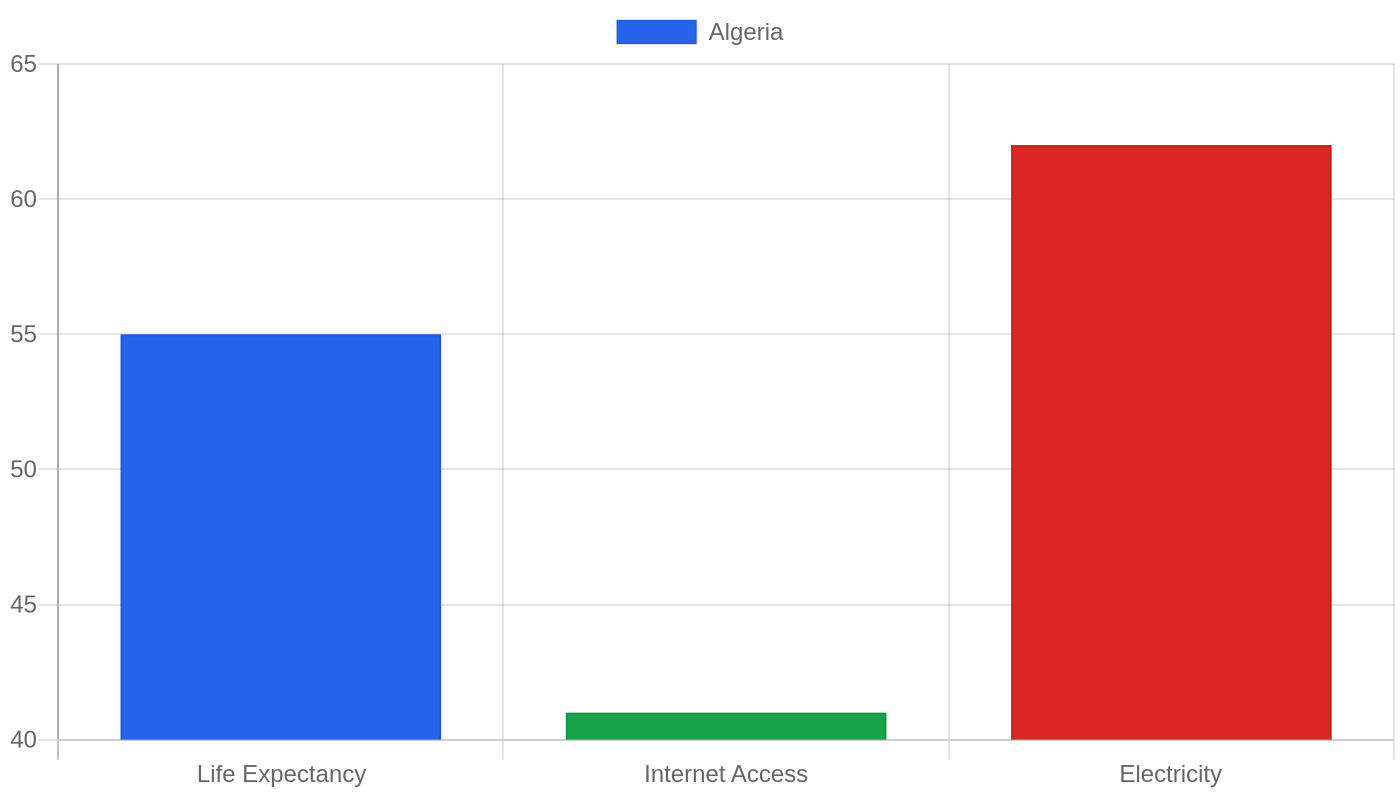
According to the latest available records from the World Bank, specific figures for GDP growth, Consumer Price Index (CPI) inflation, and unemployment rates are listed as “N/A.” This absence of hard data is not merely a statistical footnote; it reflects a broader challenge in measuring the pulse of an economy that remains heavily influenced by state intervention and opaque decision-making processes.
Without clear indicators on GDP per capita or Gross National Income (GNI) per capita, it becomes difficult to precisely gauge the standard of living or the purchasing power of the average Algerian citizen.
The lack of updated population figures in this specific dataset further compounds the difficulty in calculating per-capita metrics, leaving analysts and investors to rely on qualitative assessments rather than quantitative benchmarks.
This data gap suggests that either the statistical reporting mechanisms are undergoing a significant overhaul or that the economic indicators are too volatile or politically sensitive to be released in a standardized, accessible format.
Consequently, the “why” behind the economic situation is harder to pinpoint without the “what,” forcing observers to look beyond traditional macroeconomic numbers to understand the underlying structural realities of the North African economy.
Living Costs in a Data-Scarce Environment
While specific figures for housing costs, rent-to-buy ratios, and daily expense breakdowns are not provided in the current dataset, the general economic context of Algeria suggests a cost of living that is heavily influenced by state subsidies and the strength of the Dinar.
In the absence of precise World Bank data on inflation or GDP per capita, it is challenging to make direct comparisons to regional averages or to provide a granular analysis of whether renting or buying is more advantageous for the average resident.
The economic landscape is likely shaped by the availability of subsidized goods and services, which can distort market prices and create a dual economy where official rates differ significantly from black-market or informal sector prices.
For expatriates and international businesses, the lack of transparent, up-to-date cost-of-living indices adds a layer of complexity to budgeting and compensation planning.
Without concrete data on housing markets, the decision to engage in long-term real estate investments or short-term rentals remains speculative, relying more on anecdotal evidence and local market sentiment than on hard statistical backing.
This uncertainty highlights a broader issue in economies where formal data reporting is limited, requiring stakeholders to employ more cautious and flexible financial strategies.
Dominance of the Corporate Giants
The business environment in Algeria is characterized by the presence of major players that dominate key sectors of the economy.
A review of the top companies reveals a landscape where state-linked or large-scale enterprises hold significant market power.
In the telecommunications sector, Algérie Télécom and Djezzy stand out as critical infrastructure providers, shaping how millions of citizens connect and conduct business.
The logistics and transportation sectors are anchored by entities such as Air Algérie, Air Express Algeria, and Algérie Ferries, which are essential for both domestic connectivity and international trade.
In the consumer services and goods sectors, companies like Cevital, Algérie Poste, and Echorouk TV play pivotal roles in daily life, from banking and mail services to media consumption.
The presence of Antinea Airlines and Asmidal in basic materials further illustrates the breadth of industrial activity, though the specific performance metrics for these firms are not detailed in the current data.
This concentration of power in a few large companies suggests that foreign investors and local entrepreneurs must navigate a complex web of relationships with these established giants, who often benefit from state support and established distribution networks.
Power, Politics, and Safety
The political landscape of Algeria is frequently described as authoritarian, a characterization that deeply influences the safety and quality of life for its citizens.
Elected politicians are reported to have relatively little sway over national affairs, with decision-making power resting largely with an unelected group of civilian and military figures known as the “décideurs” or “le pouvoir.” This group has historically exercised de facto control over the country, including the selection of the president, a dynamic that was significantly disrupted during the 2019 protests.
The removal of Mohamed Mediène, the head of military intelligence, during that period marked a pivotal moment in the country’s political evolution, yet the underlying structures of power remain opaque.
While specific Crime and Safety Indices are currently listed as “N/A,” the political tension inherent in a system where unelected bodies hold significant power can contribute to social instability.
The lack of transparent safety data makes it difficult for international observers to accurately assess the risk environment, but the political narrative suggests a society where public dissent is carefully managed and the rule of law is often secondary to the will of the “deciders.”
Navigating the Post-2019 Transition
The current period in Algeria is defined by the aftermath of the 2019 social and political upheaval, which challenged the traditional power structures of “le pouvoir.” The downfall of key figures like Mohamed Mediène signaled a shift, yet the transition to a more transparent and democratic governance model remains incomplete.
As the World Bank data remains unavailable for key economic indicators, the economic policy direction is likely being shaped by these same unelected decision-makers, prioritizing stability and state control over market liberalization.
The business climate reflects this cautious approach, with major companies like Djezzy and Algérie Télécom operating in a regulated environment that protects incumbent interests.
Recent developments suggest that while there are efforts to modernize certain sectors, the fundamental power dynamics have not shifted dramatically, leaving both domestic businesses and international partners to adapt to a landscape where political risk is a constant consideration.
The absence of fresh economic data means that any assessment of current reforms or policy shifts is necessarily speculative, relying on the observable actions of the state and the major corporate players rather than on hard statistical evidence.
The Bottom Line
Algeria presents a complex investment and observational environment where political power dynamics significantly outweigh transparent economic metrics.
For international observers, the country requires a deep understanding of the “décideurs” and their influence on policy, as traditional economic data is scarce or unavailable.
Businesses and investors should approach Algeria with a focus on long-term relationships with state-affiliated giants and a clear understanding of the regulatory and political risks.
While the economy is anchored by strong domestic players in telecommunications, logistics, and consumer goods, the lack of clear macroeconomic data suggests that caution and thorough due diligence are essential for anyone looking to engage with the Algerian market.
Sources & Methodology
This article is authored by Economic Pulse Net for informational and research purposes.
Economic Pulse Net sources its data from multilateral institutions, national statistics bureaus, and proprietary databases.
All data is believed to be current as of the date of publication. Published: September 03, 2026 |
Category: Research — Algeria
Use these signals in your own platform
Economic Pulse publishes its live signal feed through a documented, read-only API. Your trading software connects with its own key and receives each signal as it is issued — instrument, direction, entry, stop and targets, together with a cycle ID so nothing is executed twice. The feed is independent of this website and cannot change it.
Signals are informational only and are not financial advice.