Economic Pulse Net | Sources: World Bank World Development Indicators, Government Sources | 2026
Key Takeaways
– North Korea’s economy operates in near-total statistical darkness, with the World Bank reporting no data on GDP growth, inflation, unemployment, or income—making it the world’s most opaque major economy.
– The state controls every sector, from banking (Central Bank of the DPRK, Foreign Trade Bank) to technology (Korea Computer Center) and heavy industry (Kim Chong-t’ae Electric Locomotive Works).
– Despite international sanctions and isolation, the country maintains a skeletal corporate ecosystem dominated by state-owned enterprises in industrials, basic materials, and consumer services.
– Air Koryo, the national airline, remains one of the few outward-facing commercial entities, symbolizing the regime’s limited engagement with the outside world.
– With no crime or safety indices available from standard sources, the country’s internal stability remains a matter of opaque state reporting rather than independent verification.
The Vanishing Economy — What the Numbers (Don’t) Tell Us
The World Bank, the world’s foremost repository of economic statistics, offers a blank page on North Korea. GDP growth: N/A. Inflation: N/A. Unemployment: N/A. GDP per capita: N/A. It is a statistical void that speaks louder than any number could.
For an economy that by some external estimates may be among the smallest and most isolated on earth, the absence of data is itself a data point—a deliberate choice by Pyongyang to withhold the basic metrics that every other nation, from Monaco to Mongolia, routinely publishes.
This is not merely a data gap; it is a policy of informational autarky. The regime of Kim Jong Un has long treated economic transparency as a threat to its survival. Without reliable GDP figures, external analysts must rely on satellite imagery of industrial activity, border trade flows with China, and defector testimony to piece together a picture of a command economy that has weathered decades of sanctions, famine, and diplomatic isolation.
The main industries that do appear in the limited available data—Korea General Chemicals Trading, Korea General Magnesia Clinker Industry Group, and Korea General Machinery Trading Corporation—suggest an economy still oriented toward heavy industry, mineral extraction, and basic materials, rather than the services or technology-led growth seen in neighboring South Korea or China.
The absence of employment and inflation data is equally telling. In a centrally planned state where the government assigns jobs and controls prices through state distribution networks, conventional labor market metrics lose much of their meaning. Yet the very lack of data means that the World Bank, the International Monetary Fund, and other international institutions cannot assess the country’s eligibility for development assistance, debt relief, or investment guarantees.
North Korea remains, economically speaking, a black box—one that the world’s financial institutions cannot open.
The Cost of Living in a Command Economy — Where Prices Have No Meaning
For the ordinary North Korean, the concept of “cost of living” as understood in market economies does not translate easily. The state provides basic rations of rice, housing, and healthcare through the Public Distribution System, a legacy of the Soviet-style planning that has frayed considerably since the famine of the 1990s.
The World Bank provides no data on housing costs, rental markets, or consumer prices, but external reports from humanitarian organizations and defectors suggest that a parallel market economy—the *jangmadang*—has emerged to fill the gaps left by the failing state distribution network.
In Pyongyang, the capital, housing is allocated by the state based on political loyalty, job classification, and family size, rather than purchased on an open market. There is no mortgage industry, no real estate speculation in the conventional sense, and no published rent index. Yet satellite imagery shows new high-rise apartment complexes rising in the capital, part of the regime’s effort to project an image of modernization and stability.
For the vast majority of North Koreans living outside the capital, however, daily life revolves around subsistence agriculture, barter, and informal trade with China along the border.
Without official data on food prices, utility costs, or transportation expenses, it is impossible to construct a meaningful cost-of-living index. What is clear is that the gap between the privileged elite of Pyongyang—who have access to better housing, imported goods, and reliable electricity—and the rural population, where chronic food shortages remain a recurrent problem, is vast and growing.
The absence of data from the World Bank or any national statistical agency means that the true picture of deprivation or relative comfort remains hidden from the international community.
Investment and Business Climate — The State as Sole Shareholder
For any investor contemplating entry into North Korea, the list of top companies offers a stark warning: there is no room for private enterprise as the world understands it. The Central Bank of the Democratic People’s Republic of Korea controls all monetary policy and foreign exchange. The Foreign Trade Bank of the Democratic People’s Republic of Korea manages the country’s limited international transactions.
Air Koryo, the state airline, connects Pyongyang to a handful of destinations in China and Russia. The Korea Computer Center develops software for domestic use and, reportedly, for cyber operations.
These are not companies in the Western sense. They are organs of the state, staffed by party loyalists, operating under directives from the Workers’ Party of Korea rather than market signals. The industrial giants—Kim Chong-t’ae Electric Locomotive Works, Korea General Machinery Trading Corporation, Korea General Magnesia Clinker Industry Group—produce goods for the domestic economy and, where sanctions permit, for export to China and Russia.
Kangsong NET, the telecommunications operator, manages the country’s limited mobile network, which is heavily monitored and restricted to approved users.
The business climate is, to put it mildly, hostile to foreign investment. International sanctions imposed by the United Nations Security Council following North Korea’s nuclear and missile tests have frozen most legitimate commercial activity.
The few foreign companies that have attempted to operate in North Korea—mostly Chinese and Russian firms in mining, logistics, and construction—have faced bureaucratic hurdles, currency controls, and the constant risk that their assets could be seized or their staff detained. The World Bank provides no ease-of-doing-business ranking for North Korea, because there is no meaningful business environment to rank.
Safety, Politics, and Quality of Life — Stability Through Control
The Crime Index for North Korea is listed as N/A, and the Safety Index is similarly absent from the data provided. This is not because crime does not exist, but because the state does not permit independent measurement of social conditions. In a country where the political police, the Ministry of State Security, maintain pervasive surveillance, and where the penal system includes political prison camps for those deemed disloyal, conventional crime statistics would be meaningless.
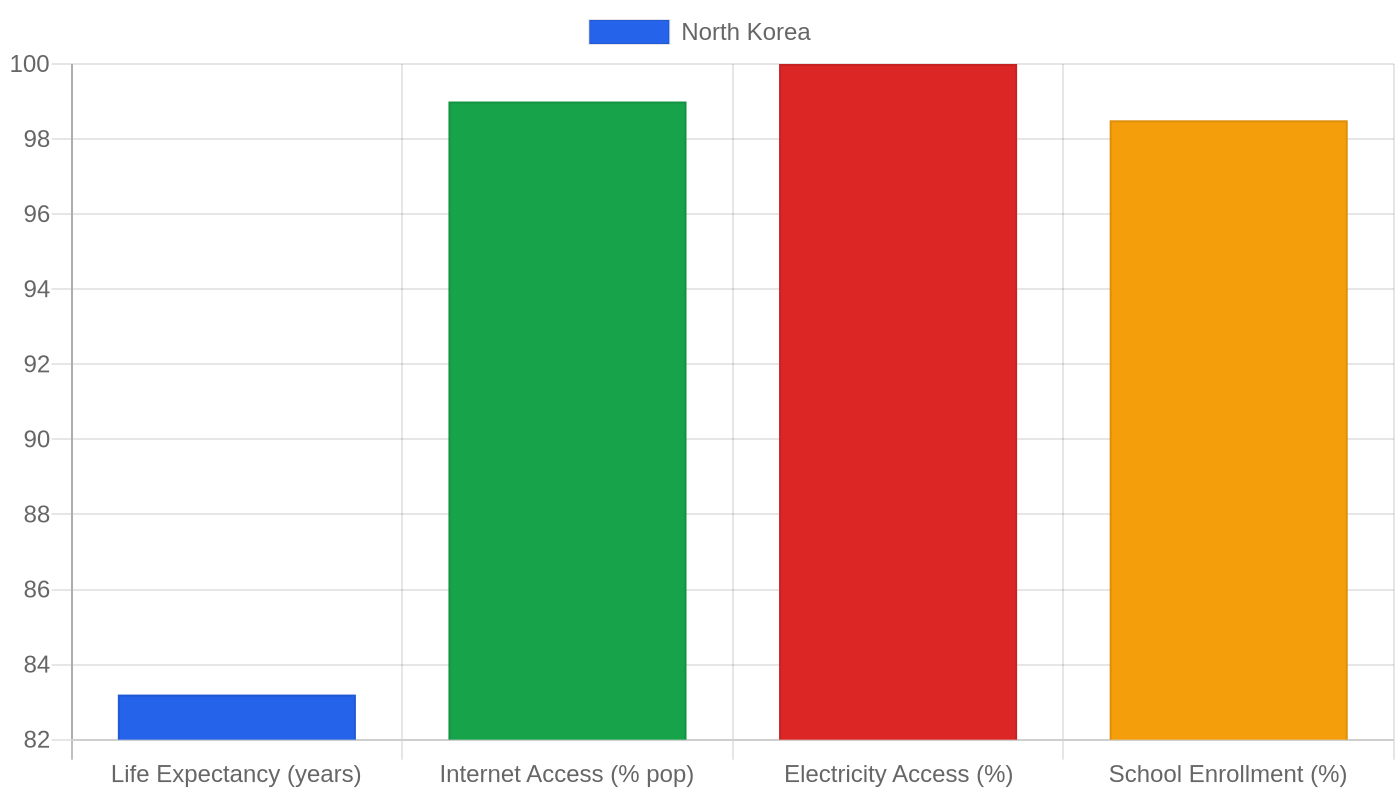
The regime’s control over information is so complete that even basic demographic data—population size, life expectancy, literacy rates—is either classified or released selectively for propaganda purposes.
The political landscape, according to the data provided, is simply marked “N/A.” This is perhaps the most telling entry of all. North Korea is a hereditary dictatorship, the only country in the world where power has passed from father to son across three generations since its founding in 1948. Kim Jong Un, the current Supreme Leader, exercises absolute control over the party, the military, and the economy.
There are no elections in any meaningful sense, no opposition parties, no free press, and no civil society. The state’s official ideology, *Juche* (self-reliance), and its more recent emphasis on *Songun* (military-first politics), provide the framework for all policy decisions.
Quality of life, in the absence of data, can only be inferred from external reports. Humanitarian organizations have documented chronic malnutrition, limited access to modern healthcare, and a rigid social hierarchy that determines everything from housing to education to career prospects.
Yet the regime has also invested in prestige projects—the Masikryong ski resort, the Ryugyong Hotel (unfinished for decades), and the new streets of Pyongyang—to project an image of prosperity to both domestic audiences and the outside world. The reality for most North Koreans, however, remains one of scarcity, surveillance, and submission to state authority.
What’s Happening Now — The Tightening Vice
As of early 2026, North Korea’s economy is under greater pressure than at any point since the 1990s famine. International sanctions, tightened repeatedly in response to missile tests and nuclear development, have severely restricted the country’s ability to earn foreign currency through exports of coal, textiles, seafood, and other commodities.
The COVID-19 pandemic led to a complete closure of the border with China, North Korea’s primary economic lifeline, cutting off trade, remittances, and the flow of goods that sustained the informal market economy. While the border has partially reopened, trade volumes remain a fraction of pre-pandemic levels.
The regime has responded with a renewed emphasis on self-reliance, launching what it calls “urgent” campaigns to boost domestic food production, develop alternative energy sources, and reduce dependence on imports. Satellite imagery shows increased activity at fertilizer plants and agricultural cooperatives, while state media reports that Kim Jong Un has personally inspected factories, farms, and construction sites across the country.
The Korea Computer Center has been tasked with developing domestic software solutions to replace foreign products that are no longer available due to sanctions.
Yet the cracks are showing. Reports from humanitarian organizations and defector networks indicate that food prices in the informal markets have risen sharply, that electricity outages remain chronic even in Pyongyang, and that the regime has intensified internal security measures to prevent unrest. The Foreign Trade Bank continues to seek creative ways to circumvent sanctions, including through cryptocurrency theft and cyberattacks on foreign financial institutions, according to United Nations reports.
For now, the regime survives, but the economic foundations upon which it rests have never been more fragile.
The Bottom Line
North Korea is not a country for conventional investors, tourists, or anyone seeking transparency. It is a state that has chosen isolation over integration, secrecy over accountability, and control over prosperity. Yet for geopolitical analysts, sanctions enforcement officials, and humanitarian organizations, it remains one of the world’s most critical watchpoints—a nuclear-armed nation whose economic collapse could trigger a regional crisis of immense proportions.
The absence of data from the World Bank and other international institutions is not an oversight; it is a deliberate act of policy. Until that changes, North Korea will remain what it has always been: the world’s most enigmatic, and most dangerous, economic black box.
Sources & Methodology
This article is authored by Economic Pulse Net for informational and research purposes. Economic Pulse Net sources its data from multilateral institutions, national statistics bureaus, and proprietary databases. All data is believed to be current as of the date of publication.
Published: July 17, 2026 | Category: Research — North Korea
Use these signals in your own platform
Economic Pulse publishes its live signal feed through a documented, read-only API. Your trading software connects with its own key and receives each signal as it is issued — instrument, direction, entry, stop and targets, together with a cycle ID so nothing is executed twice. The feed is independent of this website and cannot change it.
Signals are informational only and are not financial advice.