Economic Pulse Net | Sources: World Bank World Development Indicators, Government Sources | 2026
Key Takeaways
– The Marshall Islands operates under a mixed parliamentary-presidential system established by its 1979 Constitution, making it one of the Pacific’s more stable political frameworks despite its small size
– Universal suffrage for all citizens above 18 ensures broad political participation across 24 constituencies, with the capital atoll of Majuro electing five senators to the Nitijela
– Economic data from the World Bank remains largely unavailable, reflecting the challenges of tracking GDP, inflation, and employment in a remote island nation
– The country’s economic story is defined less by conventional metrics and more by its unique geopolitical position, environmental vulnerability, and reliance on external partnerships
– Political continuity under the 1979 Constitution provides a foundation for governance, but the nation faces existential questions about climate change and economic self-sufficiency
The Invisible Economy — What the Numbers Don’t Tell You
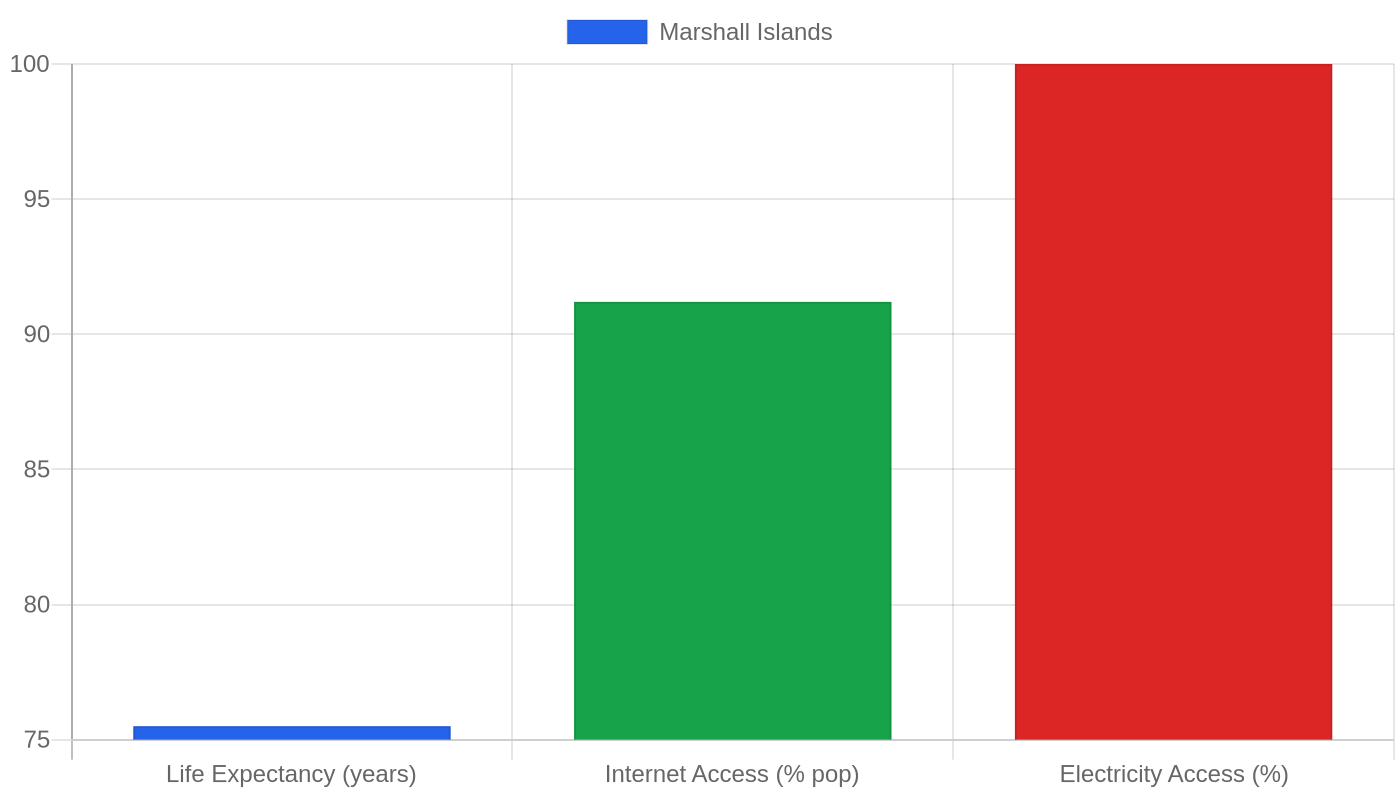
The World Bank data for the Marshall Islands presents an unusual challenge for any economic journalist: the key indicators simply do not exist in the available dataset. GDP growth, inflation, unemployment, GDP in dollar terms, GDP per capita based on purchasing power parity, and GNI per capita are all listed as unavailable. Even the population figure is missing from the provided information.
This absence of data is itself a story—it speaks to the difficulty of measuring economic activity in a nation of scattered coral atolls and low-lying islands spread across nearly two million square kilometers of ocean.
The Marshall Islands’ economy has historically relied on three pillars: fishing licenses, particularly from distant-water fishing nations; grants and assistance under the Compact of Free Association; and a small but significant trust fund established through international agreements. The country’s exclusive economic zone is vast, and tuna fisheries represent perhaps the most tangible source of revenue.
Yet without concrete World Bank figures, we must acknowledge that the formal economy is small, cash-based in many areas, and heavily dependent on external flows.
What matters here is not the absence of numbers but the reality they obscure. The Marshall Islands faces structural challenges common to microstates: a narrow production base, high import dependence, vulnerability to external shocks, and limited human capital. The cost of delivering public services across dozens of inhabited atolls is extraordinarily high. Inflation, when it does register, is often driven by fuel and food import prices—factors entirely beyond local control.
Employment is dominated by the public sector, with private enterprise concentrated in retail, construction, and small-scale services.
The Price of Paradise — Living Costs on Remote Atolls
Housing in the Marshall Islands presents a stark divide between the capital, Majuro, and the outer islands. On Majuro, which concentrates roughly half the country’s population on a narrow strip of land, housing costs reflect the extreme scarcity of buildable land. The atoll’s average width is just a few hundred meters, and rising sea levels are already encroaching on residential areas.
Rent for a modest home in Majuro can consume a significant portion of household income, though precise figures are not available from the provided data.
The cost of living across the Marshall Islands is driven primarily by import logistics. Nearly everything—from food and clothing to construction materials and fuel—must be shipped in, often from as far away as Australia, Japan, or the United States. This creates a price structure that is markedly higher than in most of Southeast Asia and comparable to more developed Pacific island nations. Daily expenses for basics like rice, canned goods, and fresh produce reflect these transportation costs.
The outer islands face even steeper prices due to the additional expense of inter-atoll shipping, which is irregular and weather-dependent.
Business in a Blue Economy — Investment and Opportunity
The top companies operating in the Marshall Islands are not listed in the provided data, but the business environment is shaped by the country’s unique status as a flag state for international shipping. The Marshall Islands Ship Registry is one of the largest in the world, registering thousands of vessels that never come near the islands but generate substantial fee income.
This maritime services sector represents the most significant business opportunity, alongside fisheries and the potential for niche tourism.
The investment climate in the Marshall Islands is constrained by size, distance, and infrastructure limitations. There is no stock exchange, limited banking services, and a small domestic market. However, the country’s political stability under the 1979 Constitution provides a degree of predictability for investors. Sectors to watch include sustainable fisheries management, renewable energy development (given the high cost of imported diesel), and climate adaptation technologies.
The government has expressed interest in expanding the private sector, but the data does not indicate major recent business developments or foreign direct investment flows.
Governance and Daily Life — Safety, Politics, and Well-Being
The crime index and safety index for the Marshall Islands are both listed as unavailable in the provided data, which is consistent with the country’s reputation as a generally safe society. Crime rates in Majuro are higher than on the outer islands, reflecting the typical urban-rural divide, but violent crime is not a defining feature of daily life.
The most pressing safety concerns are environmental: the threat of storm surges, droughts, and the slow but inexorable rise of sea levels that could render parts of the country uninhabitable within decades.
Politically, the Marshall Islands operates under a system that blends parliamentary and presidential features. The 1979 Constitution established the framework, and elections occur every four years under universal suffrage for all citizens aged 18 and above. The 24 constituencies send representatives to the Nitijela, the unicameral legislature, with Majuro electing five senators. The President serves as both head of state and head of government, a concentration of executive power typical of the mixed system.
Political life is characterized by shifting coalitions and personal loyalties rather than strong ideological divisions, and the small population means that politics is highly personal and community-based.
Quality of life in the Marshall Islands is difficult to measure without standard indicators like the Human Development Index or happiness rankings. What can be said is that the country maintains strong communal bonds, traditional cultural practices, and a connection to the ocean that defines identity. The main challenges to well-being are health outcomes linked to non-communicable diseases, limited educational and economic opportunities for youth, and the psychological toll of living with environmental uncertainty.
The Present Moment — Sovereignty, Climate, and Survival
The most current affairs facing the Marshall Islands today revolve around the intersection of climate change and sovereignty. The country has been among the most vocal Pacific nations in international climate negotiations, warning that rising sea levels threaten not just its economy but its very existence as a sovereign state.
The provided data does not include specific recent news reports, but the trajectory is clear: the Marshall Islands is pursuing legal and diplomatic strategies to ensure that even if land becomes uninhabitable, the nation’s identity and rights under international law are preserved.
The political landscape remains focused on securing the future. The government continues to negotiate the terms of its relationship with key partners, managing the trust fund that provides budget support and advocating for greater action on climate mitigation from major emitters. Domestically, the Nitijela debates issues of land use, infrastructure investment, and how to balance tradition with development.
The absence of recent economic data in the provided materials suggests that the Marshall Islands’ most urgent story is not about quarterly growth figures but about long-term survival and adaptation.
The Bottom Line
The Marshall Islands is not a country that investors or economists typically track for growth metrics or market opportunities. It is, however, a nation that demands attention for what it represents: the front line of climate change, a test case for how small island states can maintain sovereignty in a warming world, and a reminder that economic development cannot be separated from environmental reality.
Anyone interested in the future of the Pacific, the geopolitics of climate adaptation, or the resilience of small nations should watch the Marshall Islands closely—not for its GDP, but for its lessons on survival.
Sources & Methodology
This article is authored by Economic Pulse Net for informational and research purposes. Economic Pulse Net sources its data from multilateral institutions, national statistics bureaus, and proprietary databases. All data is believed to be current as of the date of publication.
Published: July 18, 2026 | Category: Research — Marshall Islands
Use these signals in your own platform
Economic Pulse publishes its live signal feed through a documented, read-only API. Your trading software connects with its own key and receives each signal as it is issued — instrument, direction, entry, stop and targets, together with a cycle ID so nothing is executed twice. The feed is independent of this website and cannot change it.
Signals are informational only and are not financial advice.