Economic Pulse Net | Sources: World Bank World Development Indicators, Government Sources | 2026
Key Takeaways
– The Marshall Islands operates under a mixed parliamentary-presidential system established by its 1979 Constitution, with universal suffrage for all citizens above 18 and elections held every four years.
– The Nitijela, the nation’s unicameral legislature, comprises twenty-four constituencies, with the capital atoll of Majuro electing five senators — making it the political epicenter of the country.
– The President serves as both head of state and head of government, concentrating executive authority in a single office within the Pacific’s distinctive governance framework.
– Economic data remains limited, reflecting the challenges of tracking a dispersed island nation’s financial metrics, yet the political structure provides a stable foundation for policy continuity.
– For investors and observers, the Marshall Islands represents a sovereign nation navigating the complexities of climate vulnerability, geopolitical positioning, and sustainable development.
The Sovereign Economic Canvas — A Nation Beyond the Numbers
The Marshall Islands presents a fascinating paradox for economic analysts: a nation whose formal statistical profile remains largely opaque, yet whose strategic significance in the Pacific region continues to grow.
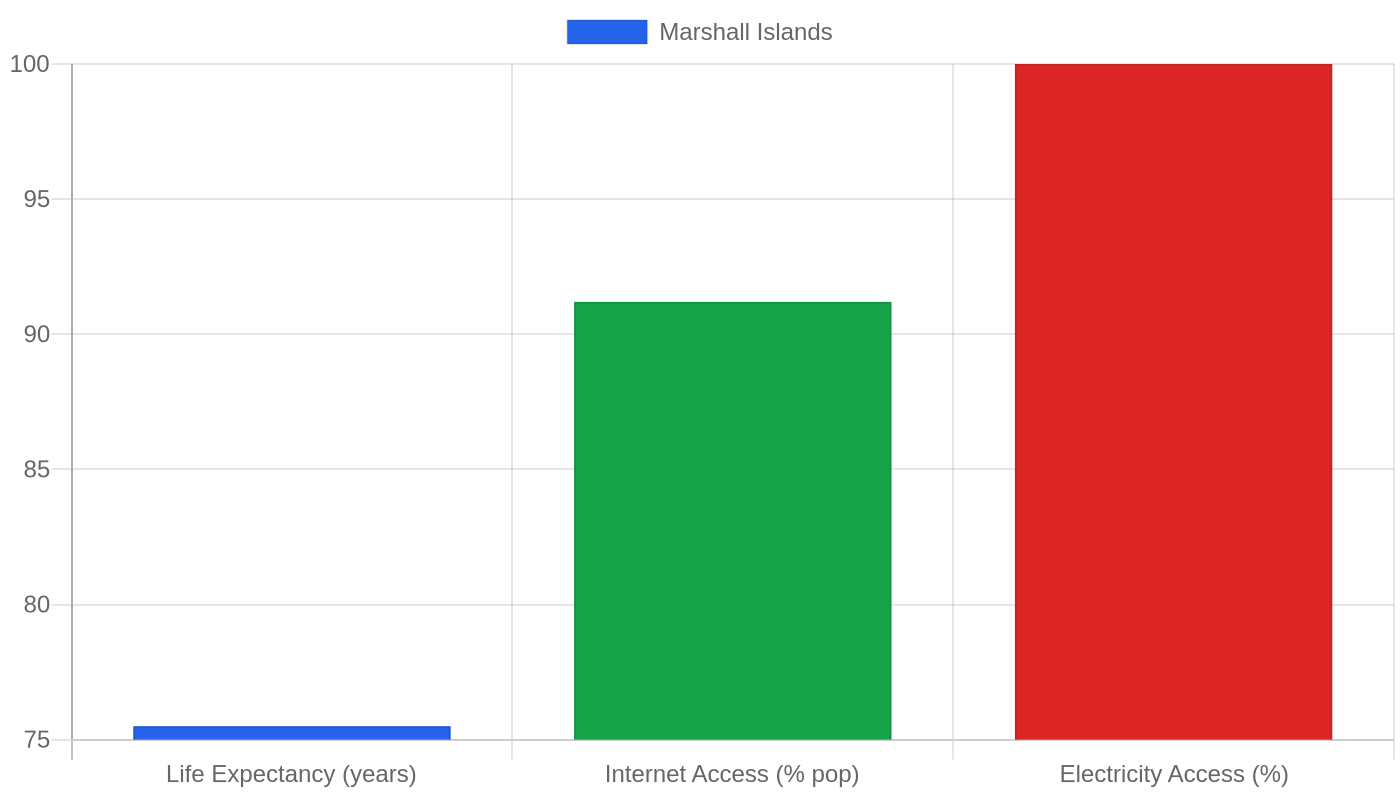
The World Bank’s latest data shows GDP growth figures, inflation rates, unemployment statistics, and GDP per capita measurements all currently unavailable — a situation not uncommon for small island developing states with dispersed populations across numerous atolls and limited statistical infrastructure.
This absence of hard numbers, however, does not diminish the economic narrative unfolding across this sprawling Pacific nation. The Marshall Islands’ economy has historically been shaped by its geography — a dual chain of 29 coral atolls and five islands spread across roughly 750,000 square miles of ocean, with a landmass totaling just 70 square miles.
This extraordinary dispersion creates inherent economic challenges: transportation costs are prohibitive, infrastructure development is logistically complex, and economies of scale remain elusive.
The nation’s economic foundations rest upon several pillars that, while not captured in traditional GDP measurements, define its financial reality. Fisheries access fees, derived from the nation’s vast exclusive economic zone, represent a significant revenue stream, as do the compact-related grants and international development assistance that flow into the country.
The service sector, centered primarily in Majuro and Ebeye, provides employment in government administration, retail trade, and a growing but still modest tourism industry.
What makes the Marshall Islands economically distinctive is its resilience in the face of structural constraints. The nation has developed creative mechanisms to generate revenue from its geography — from maritime registry services that have made it one of the world’s largest ship registries, to leveraging its strategic Pacific position for international partnerships. The workforce, while small, demonstrates adaptability across sectors ranging from public administration to emerging private enterprise.
The absence of conventional economic indicators should not be interpreted as economic stagnation. Rather, it reflects the reality of a nation where economic activity is distributed across thousands of miles of ocean, where subsistence fishing and agriculture coexist with modern service industries, and where the informal economy plays a significant role alongside formal sector employment.
For the discerning observer, the Marshall Islands offers a case study in economic sovereignty — a nation charting its own course with limited data but unlimited determination.
Atoll Living — The Cost of Paradise in the Pacific
Understanding the cost of living in the Marshall Islands requires a fundamental shift in perspective from continental economic models. With no comprehensive housing cost indices, rent-to-buy comparisons, or daily expense tracking available, one must consider the structural factors that shape household economics across this island nation.
The geography of the Marshall Islands creates a unique supply-demand dynamic for housing. On Majuro, the capital atoll, land is scarce and concentrated, driving property values upward in a constrained market. The traditional land tenure system, which vests ownership in clans and families rather than individuals, creates a distinct real estate landscape where leasehold arrangements often take precedence over freehold ownership.
This system, while culturally significant, can limit the development of conventional housing markets.
Daily expenses in the Marshall Islands reflect the nation’s import dependency. With limited arable land and no significant manufacturing base, virtually all consumer goods — from foodstuffs to fuel to building materials — must be imported, subjecting prices to international shipping costs and global commodity fluctuations.
Fresh produce is particularly expensive, with much of it flown in from abroad, while locally caught fish and traditional crops like breadfruit and coconut provide more affordable alternatives.
For residents, the cost of living in Majuro and Ebeye — the two most densely populated centers — is substantially higher than in the outer atolls, where subsistence lifestyles reduce cash expenditure but also limit access to services and employment opportunities. This urban-rural cost divide mirrors patterns seen across the Pacific region, where capital cities command premium prices for housing, utilities, and imported goods while outer islands operate on different economic logic.
The remittance economy plays a crucial role in household finances, with Marshallese communities abroad sending funds back to support family members. This flow of money, while not captured in traditional economic statistics, represents a vital lifeline for many families navigating the high cost of island living.
Business Horizons — Enterprise and Opportunity in a Sovereign State
The Marshall Islands’ business environment is defined by its dual character: a formal economy centered on government, fisheries, and international services, alongside a vibrant informal sector that sustains communities across the atolls. The nation’s corporate landscape, while not featuring globally recognized consumer brands, includes enterprises operating in shipping, fisheries, and professional services that punch well above their weight internationally.
The international ship registry stands as the crown jewel of the Marshall Islands’ business sector. As one of the world’s largest flags of convenience, it generates substantial revenue and positions the nation as a serious player in global maritime commerce. This registry, administered through a public-private partnership, demonstrates how a small nation can leverage regulatory frameworks to create significant economic value — a model that other Pacific states have studied with interest.
Fisheries represent another cornerstone of business activity. The nation’s vast exclusive economic zone contains some of the world’s richest tuna fishing grounds, and licensing fees paid by international fishing fleets contribute substantially to government revenue.
The Pacific Islands Forum Fisheries Agency framework, which coordinates fisheries management across the region, has strengthened the Marshall Islands’ negotiating position, allowing it to extract greater value from its marine resources.
For entrepreneurs, the business environment in the Marshall Islands offers both opportunities and obstacles. The small domestic market limits scalability, but the nation’s strategic position and international connections provide access to broader Pacific and global markets.
The government has signaled interest in diversifying the economy, with potential sectors including tourism development, digital services, and renewable energy — all areas where the nation’s natural attributes and strategic position could be leveraged.
Foreign investment, while not extensively documented in available data, flows into sectors where the Marshall Islands offers competitive advantages: maritime services, fisheries processing, and increasingly, climate adaptation infrastructure. The nation’s legal framework, rooted in its constitutional system, provides a degree of certainty for investors, though the complexities of land tenure and the challenges of operating across dispersed atolls require careful navigation.
Governance and Security — Navigating Sovereignty in a Changing Pacific
The Marshall Islands’ political system, established by the 1979 Constitution, creates a distinctive governance model that balances democratic accountability with executive effectiveness. The mixed parliamentary-presidential system, which the World Bank and constitutional scholars have documented, ensures that political power flows from the Nitijela — the nation’s parliament — while concentrating executive authority in a president who serves as both head of state and head of government.
This constitutional framework has provided remarkable political stability since independence. Elections held every four years under universal suffrage for all citizens above 18 ensure broad democratic participation, with the twenty-four constituencies ensuring representation across the nation’s dispersed atolls. The capital atoll of Majuro, with its five senators, wields significant political influence — a concentration that reflects its demographic and economic dominance.
The political landscape is characterized by a focus on issues that resonate deeply with the Marshallese people: climate change adaptation, sustainable development, preservation of cultural heritage, and the negotiation of international partnerships that respect national sovereignty. The government’s approach to these challenges reflects a pragmatic nationalism — engaging constructively with international partners while maintaining firm control over domestic affairs.
In terms of safety and security, the Marshall Islands presents a profile typical of Pacific island nations. The crime index data currently unavailable, but the nation’s small, tightly-knit communities and strong cultural traditions generally contribute to social cohesion. The challenges that do exist — youth unemployment, substance abuse, and the social dislocations that can accompany urbanization — are managed through community networks and government programs rather than heavy-handed enforcement.
Quality of life in the Marshall Islands is shaped by factors that transcend conventional measurements. The strong communal bonds, deep connection to traditional culture, and the natural beauty of the atolls provide intangible benefits that offset some of the material challenges. The nation’s leadership in climate advocacy, despite its minimal contribution to global emissions, reflects a moral authority that resonates internationally and contributes to national pride.
The Current Moment — A Nation at the Crossroads of History
The Marshall Islands in 2026 stands at a pivotal moment, navigating the intersection of environmental urgency, geopolitical realignment, and domestic development priorities. The political system established by the 1979 Constitution continues to function effectively, with the Nitijela serving as the arena where the nation’s future is being debated and decided.
The capital atoll of Majuro remains the political and economic heartbeat of the nation, its five senators wielding outsized influence in national affairs. The concentration of population and economic activity in Majuro and Ebeye continues to shape policy decisions, even as the government grapples with how to ensure that the benefits of development reach the outer atolls.
Climate change remains the existential issue that frames all other policy considerations. The government’s advocacy on the international stage, while not captured in economic statistics, has positioned the Marshall Islands as a moral leader among climate-vulnerable nations. This advocacy is matched by domestic efforts to build resilience, though the scale of the challenge far exceeds the nation’s financial and technical capacity.
The political calendar maintains its rhythm, with elections every four years providing regular opportunities for citizens to shape their nation’s direction. The universal suffrage enshrined in the constitution ensures that all voices — from the urban centers of Majuro and Ebeye to the outer atolls — are heard in the national conversation.
As the Marshall Islands navigates this complex landscape, the nation’s leaders are focused on securing a future that honors the past while embracing the possibilities of the present. The constitutional framework provides the stability needed for long-term planning, even as the urgent challenges of climate change demand immediate action.
The Bottom Line
The Marshall Islands deserves attention from anyone interested in the future of sovereign small states in the Pacific region. This is a nation that has built a functioning democracy on scattered atolls, created significant economic value from its maritime resources, and positioned itself as a moral voice on climate change — all while maintaining cultural traditions that stretch back millennia. For investors, the opportunities lie in fisheries, maritime services, and climate adaptation infrastructure.
For policymakers, the Marshall Islands offers lessons in resilience, sovereignty, and the art of navigating between great power interests while maintaining independent agency. And for those who believe that nations are more than their GDP statistics, this Pacific nation demonstrates that sovereignty, culture, and determination can create value that no spreadsheet can capture.
Sources & Methodology
This article is authored by Economic Pulse Net for informational and research purposes. Economic Pulse Net sources its data from multilateral institutions, national statistics bureaus, and proprietary databases. All data is believed to be current as of the date of publication.
Published: August 08, 2026 | Category: Research — Marshall Islands
Use these signals in your own platform
Economic Pulse publishes its live signal feed through a documented, read-only API. Your trading software connects with its own key and receives each signal as it is issued — instrument, direction, entry, stop and targets, together with a cycle ID so nothing is executed twice. The feed is independent of this website and cannot change it.
Signals are informational only and are not financial advice.