Economic Pulse Net | Sources: World Bank World Development Indicators, Government Sources | 2026
Key Takeaways
– The Marshall Islands operates under a mixed parliamentary-presidential system established by its 1979 Constitution, with elections held every four years through universal suffrage across 24 constituencies.
– The capital atoll of Majuro holds significant political weight, electing five senators to the 33-member Nitijela legislature.
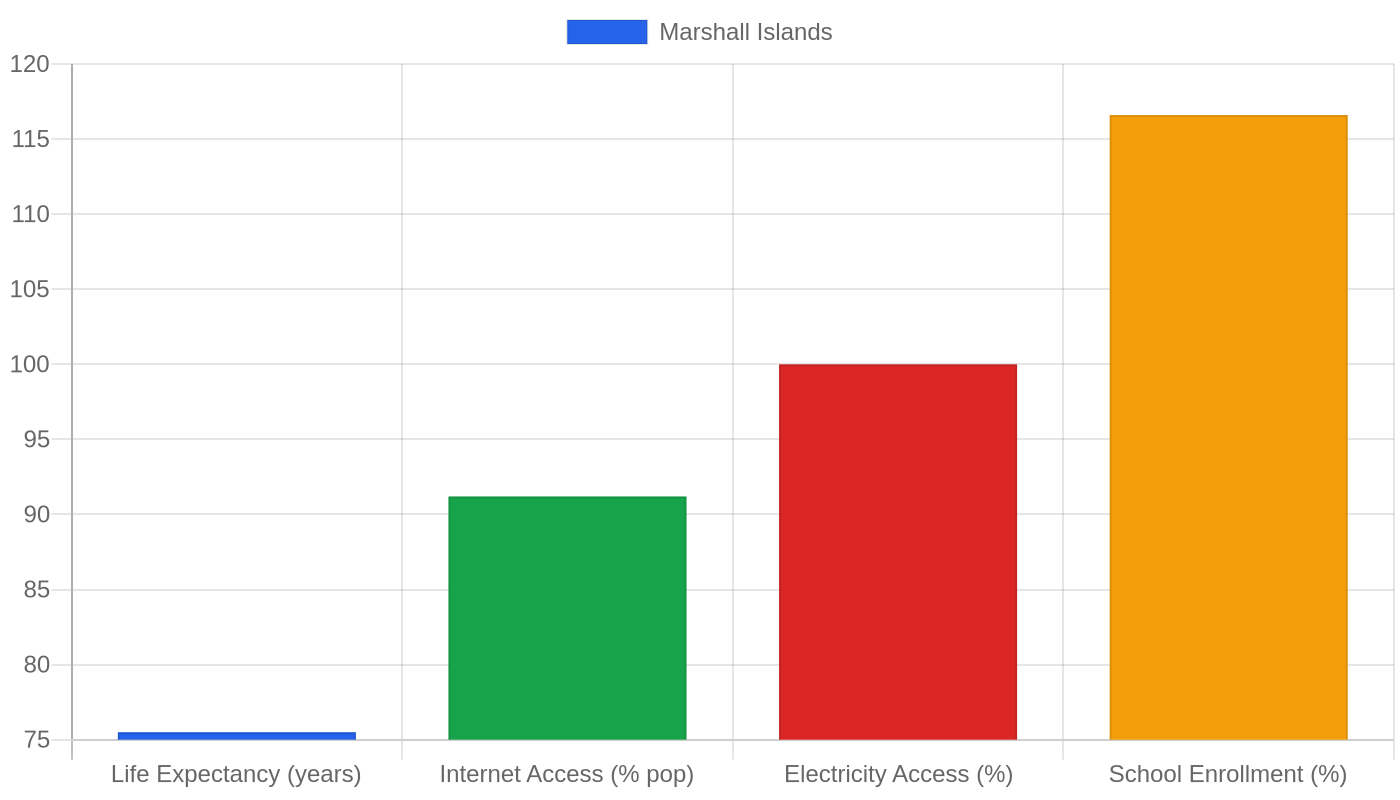
– The country’s economic data remains largely opaque, with no recent figures available for GDP growth, inflation, or unemployment from the World Bank.
– Political stability is anchored in a constitutional framework that blends parliamentary and presidential elements—a structure that has endured for over four decades.
– As a Pacific island nation, the Marshall Islands faces structural economic challenges common to remote, small-island states, including limited industrial diversification and geographic isolation.
The Economic Landscape — A Small Island Economy in the Pacific Crosswinds
The Marshall Islands represents one of the most intriguing—and least documented—economies in the Pacific region. According to the World Bank, comprehensive economic indicators for the country are currently unavailable, with GDP growth, inflation, unemployment, and per-capita income figures all unreported. This data vacuum itself tells a story: the Marshall Islands operates as a small, open economy where traditional statistical measurement faces significant challenges.
The absence of reliable economic data should not be mistaken for economic inactivity. The country’s economy is primarily service-based, with public administration and government services playing a dominant role in employment and output. The main industries that typically drive Pacific island economies—fisheries, agriculture, and increasingly tourism—are present but operate at a scale that makes them difficult to capture in conventional economic reporting.
The Marshall Islands’ geographic reality—a nation of 29 coral atolls and five islands spread across 750,000 square miles of ocean—creates inherent economic constraints. Transportation costs are prohibitive, market sizes are small, and the country’s remote location limits its integration into global supply chains.
These structural factors explain why the World Bank’s standard economic indicators remain elusive and why the country’s economic narrative must be understood through qualitative rather than purely quantitative lenses.
Living Costs in Paradise — The Price of Isolation
The cost of living in the Marshall Islands reflects the fundamental economic challenge of remote island existence: nearly everything must be imported. While specific housing and consumer price data are not available from the World Bank, the economic logic of the country’s situation is clear.
In Majuro, the capital atoll, housing options range from traditional local dwellings to more modern concrete structures, with rental markets serving both the local population and expatriate workers in government and development sectors.
The daily expense structure in the Marshall Islands is shaped by the country’s dependence on imported food, fuel, and manufactured goods. Fresh produce is limited by the atolls’ poor soil quality and water scarcity, forcing reliance on imported canned goods, rice, and processed foods. This import dependency typically translates into consumer prices significantly higher than regional averages, a pattern consistent across small Pacific island economies.
For residents, the cost of living is partially offset by traditional subsistence activities—fishing, breadfruit harvesting, and copra production—that remain important supplements to cash income. However, the monetized economy demands cash for school fees, utilities, transportation, and imported goods, creating a dual economic reality where traditional and modern livelihoods coexist.
Business and Investment — Navigating the Trust Territory Legacy
The investment climate in the Marshall Islands is shaped by its unique political and legal framework. As a nation that gained independence under a Compact of Free Association, the country has developed a regulatory environment designed to attract specific types of investment while maintaining local control over key economic sectors.
The business environment is dominated by small and medium enterprises serving the domestic market, with the government as the largest employer. The country’s registry of ships and vessels—one of the world’s largest—provides a significant source of revenue and international business activity, representing a notable exception to the otherwise limited industrial base.
This maritime registry has become a cornerstone of the country’s formal economy, generating fees and creating demand for ancillary services.
Sectors with potential for future investment include fisheries, particularly tuna processing and transshipment; tourism, though constrained by distance and infrastructure limitations; and renewable energy, given the country’s high solar potential and vulnerability to fuel price fluctuations. However, prospective investors face challenges including small market size, limited skilled labor, and the logistical complexities of operating across dispersed atolls.
Governance and Public Life — Democracy in the Islands
The Marshall Islands’ political system, established by the 1979 Constitution, represents a distinctive blend of parliamentary and presidential governance. The Nitijela, the country’s unicameral legislature, consists of 33 senators elected from 24 constituencies, with Majuro’s five senators reflecting the capital’s demographic and political weight. Elections occur every four years under universal suffrage for citizens aged 18 and above.
The President of the Marshall Islands serves as both head of state and head of government, a dual role that concentrates executive authority while remaining accountable to the Nitijela. This constitutional design has provided political stability since independence, with peaceful transfers of power and a functioning multiparty system, though political divisions often center on personal and clan loyalties rather than ideological platforms.
The quality of life in the Marshall Islands is closely tied to the country’s natural environment. As one of the world’s lowest-lying nations, with elevations typically less than two meters above sea level, the country faces existential threats from rising sea levels and climate change. These environmental pressures increasingly shape political discourse and policy priorities, from infrastructure investment to international climate advocacy.
Current Affairs — Constitutional Continuity in a Changing Pacific
The Marshall Islands enters the current period with its constitutional framework intact and its political system functioning according to the 1979 Constitution’s provisions. The country’s parliamentary-presidential system continues to operate through its four-year electoral cycle, with the most recent elections reflecting the enduring structure of 24 constituencies and the Nitijela’s 33 seats.
The capital atoll of Majuro remains the political and economic center, its five senators representing the concentration of population and economic activity in the country’s most developed urban area. The political landscape is characterized by coalition-building and shifting alliances, as senators navigate between national priorities and constituency interests in a system where development resources are scarce and geographically dispersed.
Looking ahead, the Marshall Islands faces a defining period as it balances constitutional continuity with pressing challenges. The country’s economic future will depend on its ability to diversify beyond government employment and maritime registry revenues, while its political future will be tested by the need to address climate adaptation, infrastructure development, and social service delivery across its far-flung atolls.
The constitutional framework established in 1979 provides the institutional foundation, but the coming years will determine whether it can deliver the economic and social progress the population seeks.
The Bottom Line
The Marshall Islands remains a country where political stability and constitutional governance provide a foundation for development, but where economic data gaps and structural constraints obscure the full picture. For investors, development organizations, and Pacific regional observers, this is a nation to watch for its governance model, its environmental vulnerability, and its efforts to build economic resilience in one of the world’s most challenging geographic contexts.
The story of the Marshall Islands is ultimately about how a small nation navigates the intersection of democratic governance, environmental existentialism, and economic survival—a narrative that will only grow in significance as Pacific island issues gain global attention.
Sources & Methodology
This article is authored by Economic Pulse Net for informational and research purposes. Economic Pulse Net sources its data from multilateral institutions, national statistics bureaus, and proprietary databases. All data is believed to be current as of the date of publication.
Published: August 02, 2026 | Category: Research — Marshall Islands
Use these signals in your own platform
Economic Pulse publishes its live signal feed through a documented, read-only API. Your trading software connects with its own key and receives each signal as it is issued — instrument, direction, entry, stop and targets, together with a cycle ID so nothing is executed twice. The feed is independent of this website and cannot change it.
Signals are informational only and are not financial advice.