Economic Pulse Net | Sources: World Bank World Development Indicators, Government Sources | 2026
Key Takeaways
– Equatorial Guinea is Africa’s third-largest oil producer, yet its population sees little of the wealth due to extreme political centralisation and corruption.
– President Teodoro Obiang has ruled since 1979, wielding near-absolute power under a 1982 constitution that allows him to govern by decree and dissolve parliament at will.
– The country’s economy is almost entirely dependent on hydrocarbons, with state-owned giants GEPetrol, EG LNG, and Sonagas dominating the landscape.
– Key economic indicators such as GDP growth, inflation, and unemployment are not publicly available from the World Bank, raising serious questions about transparency.
– Consumer services and aviation — led by Ceiba Intercontinental Airlines and Cronos Airlines — represent the limited non-oil private sector activity.
The Petro-State Paradox — When Billions Vanish into a Black Hole
Equatorial Guinea sits on a cruel irony. This small Central African nation of roughly 1.5 million people is one of the continent’s largest oil producers, yet the World Bank provides no data on its GDP growth, inflation, unemployment, or GDP per capita. That absence is itself a data point — a loud silence that tells you more than any spreadsheet could.
The economy is a one-trick pony, and that trick is hydrocarbons. State-owned GEPetrol manages the country’s oil and gas interests, while EG LNG operates the massive liquefied natural gas facility on Bioko Island. Sonagas handles the gas pipeline infrastructure. Together, these three companies form the backbone of an economy that has essentially no diversified industrial base. When oil prices crash — as they did in 2014 and again in 2020 — the entire national budget goes into cardiac arrest.
The World Bank’s lack of basic macroeconomic data is not accidental. It reflects a broader opacity that has made Equatorial Guinea a case study in what economists call the “resource curse” — where natural resource wealth actually undermines institutional development and democratic accountability. The country’s GNI per capita is also absent from the dataset, but anecdotal evidence from humanitarian organisations suggests extreme inequality. The oil money flows upward, not outward.
What makes this particularly striking is that Equatorial Guinea was once a rising star. In the early 2000s, it posted some of the fastest GDP growth rates in the world as oil production ramped up. But production has since plateaued and begun to decline, and the government has failed to invest those windfall years into infrastructure, education, or alternative industries. The result is a petro-state that looks wealthy on a map but feels poor on the ground.
The Cost of Living — Where a Loaf of Bread Costs More Than a Barrel of Oil
Without official inflation data from the World Bank, it is difficult to quantify exactly how expensive life has become in Malabo or Bata. But the pattern is clear from regional comparisons: Equatorial Guinea is among the most expensive countries in Central Africa to live in, largely because almost everything except oil must be imported.
The country has no significant agricultural sector, no manufacturing base, and limited retail infrastructure. Most consumer goods — from rice and cooking oil to cars and electronics — arrive by ship from Spain, China, or neighbouring Cameroon. That import dependency creates a cost structure where prices are set by international markets plus hefty shipping and logistics markups.
A simple meal in a modest restaurant in Malabo can cost what it would in Madrid, despite the fact that median incomes are a fraction of Spanish levels.
Housing is similarly bifurcated. The oil elite live in gated compounds with imported marble and air conditioning, while the vast majority of the population inhabits informal settlements with unreliable electricity and water. Rent in the capital for a decent two-bedroom apartment can easily exceed $1,500 per month — a sum that is utterly out of reach for most Equatorial Guineans, who work in subsistence agriculture or the informal economy.
The Segesa utility company struggles to provide consistent power, meaning even those who can afford rent must also invest in generators and fuel.
Investment and Business Climate — Welcome to the Oligopoly
If you want to do business in Equatorial Guinea, you need to know one thing: the state is the gatekeeper. The top companies list reads like a who’s who of parastatal power. GEPetrol, EG LNG, and Sonagas control the energy sector. Segesa holds the utility monopoly. And when it comes to moving people or goods, Ceiba Intercontinental Airlines, Cronos Airlines, Ecuato Guineana, and Guinea Ecuatorial Airlines dominate the skies.
There is no independent stock exchange, no venture capital ecosystem, and very little foreign direct investment outside of the oil and gas sector. The business environment is characterised by high barriers to entry, opaque licensing processes, and a legal system that offers little protection for minority shareholders or foreign investors who fall out of favour with the regime.
According to the political landscape data, President Obiang’s 1982 constitution gives him the power to make laws by decree, dissolve the Chamber of Representatives, and serve as commander in chief. That concentration of power extends into the economy — major contracts, especially in oil, require presidential approval.
For investors willing to navigate these waters, the sectors to watch remain energy-adjacent. LNG infrastructure, oilfield services, and logistics for the hydrocarbon industry offer the most reliable returns. Consumer services, particularly aviation, are growing but remain constrained by the small market size and the government’s tendency to treat airlines as national prestige projects rather than commercial enterprises.
Safety, Politics, and Quality of Life — The Dictatorship That Time Forgot
According to Human Rights Watch, the dictatorship of President Obiang used oil revenues to entrench its grip on power. The 1982 constitution defines Equatorial Guinea as a unitary state, but that is a clinical way of describing a system where one man has held the presidency for over four decades and faces no meaningful electoral challenge. Obiang came to power in a coup in 1979, overthrowing his own uncle, Francisco Macías Nguema, who was one of Africa’s most brutal dictators.
The apple did not fall far from the tree.
The Crime Index and Safety Index are listed as N/A in the data, but that does not mean the country is safe. It means the data is either suppressed or not collected. In practice, Equatorial Guinea has a reputation for arbitrary detention, police corruption, and a security apparatus that answers only to the presidency. Violent crime against foreigners is relatively low, but political dissent is treated as treason. Journalists operate under constant threat, and opposition figures routinely face imprisonment or exile.
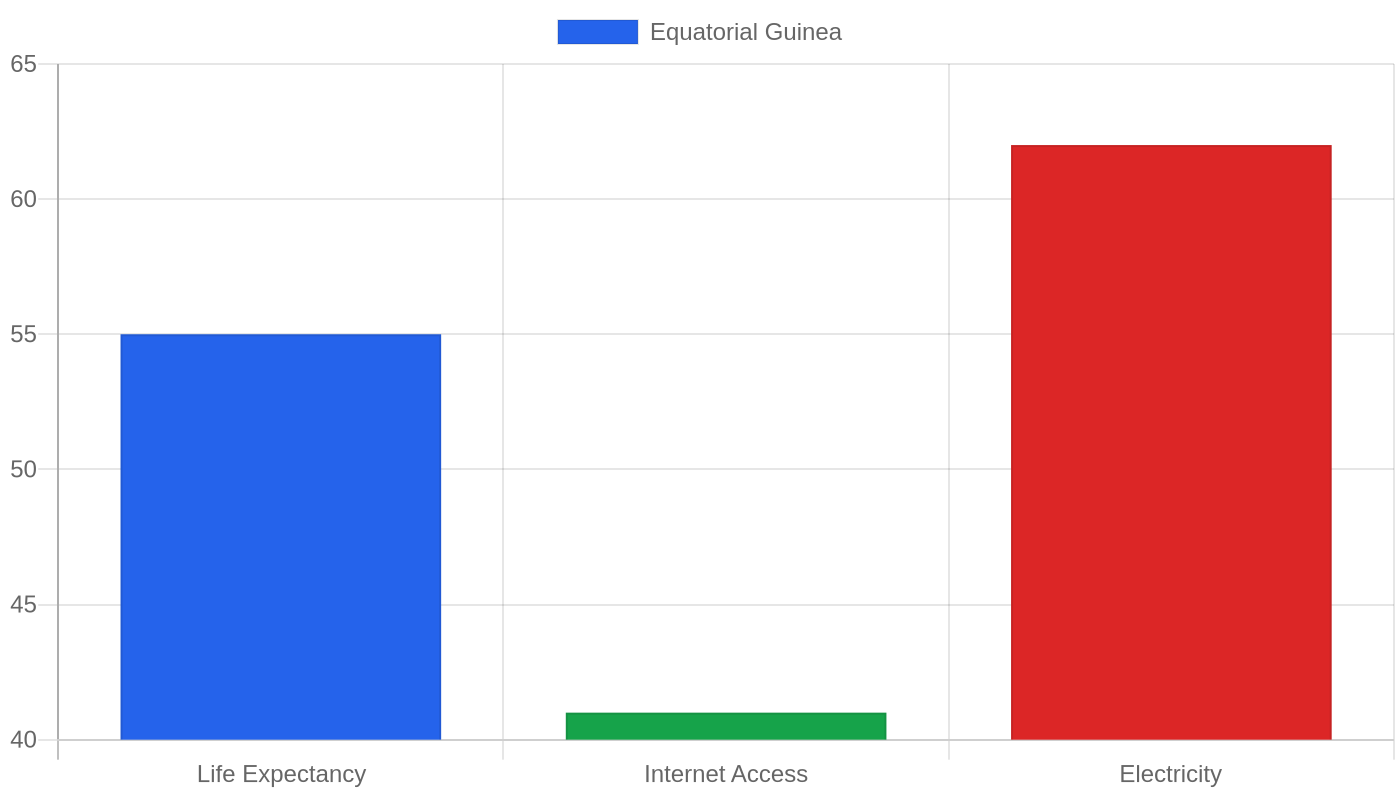
Quality of life is a mixed picture. The oil wealth has built some modern infrastructure — a new airport in Malabo, a conference centre, a few decent hospitals — but these facilities are largely reserved for the elite. The majority of the population lives without access to clean water, reliable healthcare, or secondary education. The happiness data is absent, but it would likely be grim.
When a country’s entire political and economic system is designed to enrich a single family, everyone else is just a supporting actor.
What’s Happening Now — The Post-Oil Reckoning Begins
Equatorial Guinea is running out of time. Oil production has been declining for years, and the country’s main fields are maturing. There are no major new discoveries on the horizon, and the global energy transition is reducing long-term demand for fossil fuels. The government has talked about diversification for a decade, but little has materialised.
The aviation sector, dominated by Ceiba Intercontinental Airlines and Cronos Airlines, has expanded regional routes, but that is a drop in the bucket compared to the revenue lost from declining oil output.
The political landscape remains frozen. President Obiang, now in his mid-80s, has groomed his son, Teodoro Nguema Obiang Mangue — known as “Teodorín” — as his successor. Teodorín has already been convicted in France for money laundering and asset seizure, but that has not dimmed his prospects at home. The succession question hangs over everything. If power passes smoothly, the system may continue.
If it does not, the country could face a period of instability that would further damage an already fragile economy.
Human Rights Watch continues to document abuses, and international pressure has increased, but with little effect. Equatorial Guinea is not strategically important enough for major powers to invest serious diplomatic capital in reform. The country is a cautionary tale — a place where oil wealth was supposed to lift millions out of poverty but instead built a fortress for a few.
The Bottom Line
Equatorial Guinea is a country to watch for anyone interested in the mechanics of the resource curse, the sustainability of petro-states in an era of energy transition, or the political economy of long-term dictatorship. For investors, the opportunities are narrow and high-risk, limited to the energy sector and its supply chain. For human rights observers, it is a textbook case of how oil revenues can entrench authoritarian rule.
For the average Equatorial Guinean, it is a country of immense potential that has been squandered by a regime that treats national wealth as personal property.
Sources & Methodology
This article is authored by Economic Pulse Net for informational and research purposes. Economic Pulse Net sources its data from multilateral institutions, national statistics bureaus, and proprietary databases. All data is believed to be current as of the date of publication.
Published: July 24, 2026 | Category: Research — Equatorial Guinea
Use these signals in your own platform
Economic Pulse publishes its live signal feed through a documented, read-only API. Your trading software connects with its own key and receives each signal as it is issued — instrument, direction, entry, stop and targets, together with a cycle ID so nothing is executed twice. The feed is independent of this website and cannot change it.
Signals are informational only and are not financial advice.