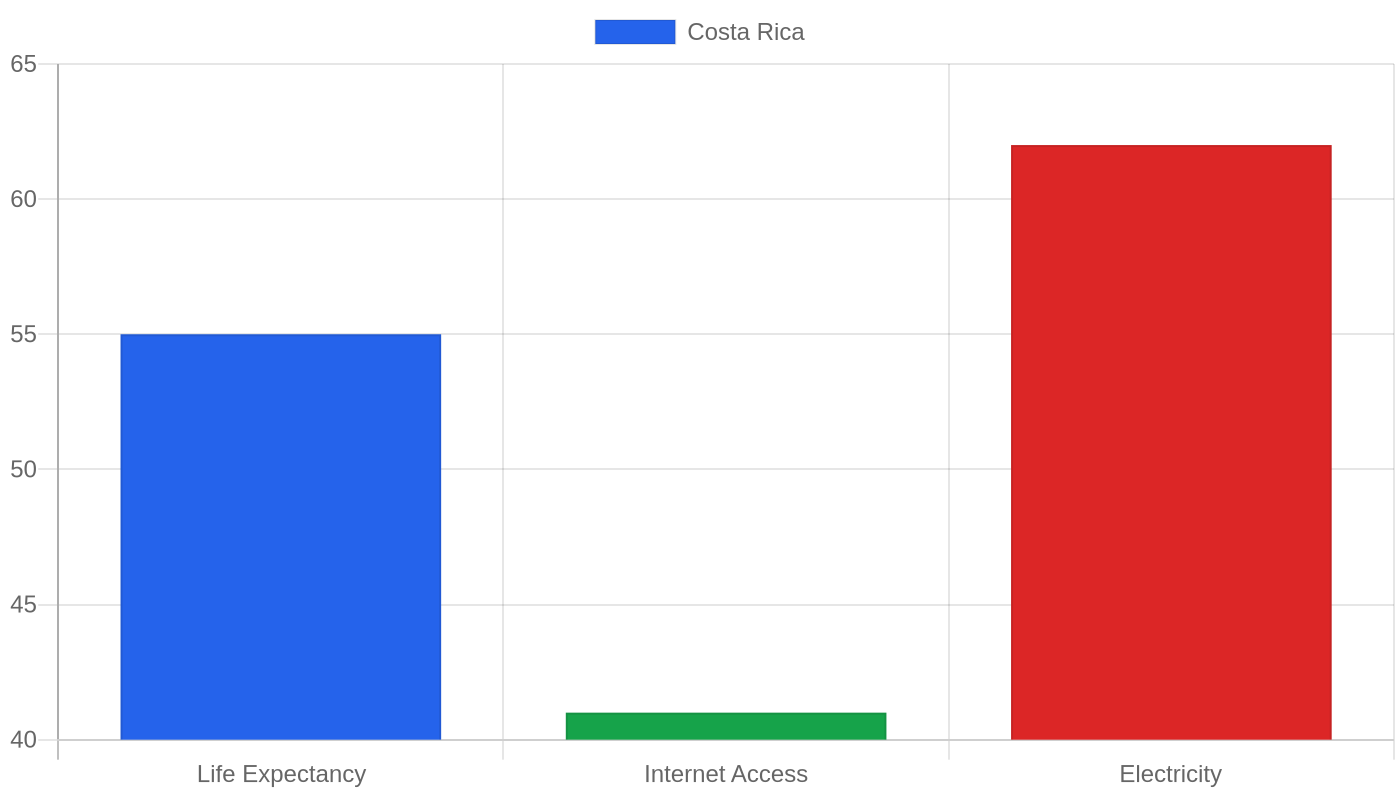
Economic Pulse Net | Sources: World Bank World Development Indicators, Government Sources | 2026
Key Takeaways
– Costa Rica’s economy is anchored by a unique blend of eco-tourism, agricultural exports, and a growing high-tech services sector, though the latest World Bank growth figures remain unpublished.
– The corporate landscape is a fascinating split between legacy consumer goods giants and a vibrant consumer services sector, with household names like Dos Pinos and Café Britt leading the charge.
– The country’s famed political stability, rooted in the 1949 Constitution and the abolition of its army, continues to be its most valuable economic asset.
– While headline inflation and unemployment data are pending, the structural story is one of a middle-income nation wrestling with the cost of its own success.
– Investors are watching a market where “pura vida” lifestyle meets hard-nosed business fundamentals, creating a unique risk-reward profile in Central America.
The Paradox of Prosperity: Growth, Stability, and the Data Gap
Costa Rica has long been the outlier in Central America—a nation that traded its military for schools and hospitals in 1949 and has been reaping the peace dividend ever since. The World Bank’s latest data snapshot shows GDP growth, inflation, and unemployment figures all currently unavailable, which in itself tells a story of a statistical agency in transition. But the absence of fresh numbers doesn’t obscure the structural reality: this is an economy built on resilience rather than raw material extraction.
The productive matrix is a study in clever diversification. On one side, you have the traditional pillars—agriculture, particularly premium coffee and bananas—which have evolved into branded consumer experiences. On the other, a sophisticated services and utilities sector has emerged, anchored by the state-owned Instituto Costarricense de Electricidad (ICE), which powers the nation with one of the highest rates of renewable energy penetration in the world.
This green energy advantage is not merely an environmental talking point; it is a competitive shield against global fossil fuel price shocks, insulating local industry and attracting environmentally conscious foreign capital. The challenge now is whether the economy can generate enough formal employment to absorb a young, educated workforce, especially as the global tourism market fluctuates.
The World Bank’s silence on the latest GDP print leaves analysts guessing, but the underlying fundamentals—a stable democracy, an open economy, and a strategic location—remain the bedrock upon which any recovery will be built.
The Price of Paradise: Housing and the Cost of Living
Ask any Tico or expat about life in Costa Rica, and the conversation inevitably turns to the cost of living—a topic where the country’s dual identity as both a developing nation and a lifestyle destination collides. Housing in the capital, San José, and the coveted Central Valley region follows a familiar pattern: renting is the pragmatic choice for mobile professionals, while buying property is increasingly seen as a hedge against inflation and a long-term bet on the country’s stability.
Outside the metropolitan core, in beach towns and mountain retreats, the market is driven by foreign demand, which pushes prices in prime areas toward regional highs, while local wages lag behind.
The daily economic reality for the average Costa Rican involves a delicate balancing act. While basic groceries and public services remain affordable by regional standards, imported goods—from electronics to vehicles—carry heavy tariffs that inflate their price significantly. The consumer goods giants like Dos Pinos and Florida Ice and Farm Company dominate supermarket shelves, providing local staples that keep the food bill reasonable, but the allure of imported brands comes at a premium.
For a middle-class family, the equation is manageable but tight; for those on minimum wage, the pressure is palpable. The government’s challenge is to maintain the social safety net that the 1949 Constitution envisioned without pricing the country out of its own prosperity.
Green Gold and Digital Dreams: The Investment Landscape
For investors, Costa Rica offers a narrative that is hard to resist: a stable democracy in a volatile region, with a workforce that is increasingly bilingual and technically skilled. The top companies list reveals the market’s texture. There’s the enduring strength of the consumer goods sector, where cooperatives like Dos Pinos have become national champions, and Florida Ice and Farm Company has evolved into a conglomerate with interests ranging from beverages to real estate.
Meanwhile, the consumer services sector is booming, with aviation and tourism companies like Nature Air and Avianca Costa Rica connecting the country’s eco-lodges and rainforests to the world.
The most intriguing play, however, is the rise of the “green” economy. With ICE providing clean, reliable power, Costa Rica is positioning itself as a hub for data centers and light manufacturing—sectors that are energy-hungry but want to avoid carbon footprints. The tourism industry, long the country’s cash cow, is also pivoting toward high-end, low-impact travel, a shift that favors established brands like Café Britt, which has transformed coffee tasting into a cultural experience.
The business climate is not without friction—bureaucracy can be slow, and the state’s presence in key sectors like energy and telecoms remains dominant—but for those willing to navigate the system, the rewards are a stable currency, a strategic time zone, and a brand that screams “sustainability” to global consumers.
The Peace Dividend: Politics, Safety, and the “Pura Vida” Factor
It is impossible to discuss Costa Rica’s economy without discussing its political miracle. The 1949 Constitution created a presidential system where executive power is checked by a robust legislative assembly and an independent electoral tribunal. The president, elected for a four-year term, holds significant power—appointing ministers, diplomats, and the heads of autonomous institutions—but the system’s genius lies in its consensus-building nature.
This political culture has fostered an environment of institutional predictability that is rare in Latin America, making it a safe harbor for long-term investment.
The social contract extends to safety. While crime indices are pending, the broader narrative is of a country that, while grappling with the same regional issues of drug trafficking and petty crime, maintains a social fabric that is far more cohesive than its neighbors. The abolition of the army in 1949 redirected funds into education and health, creating a human capital base that is the envy of the region.
This “pura vida” ethos—a philosophy of contentment and resilience—is not just a tourist slogan; it is an economic asset that lowers social tension and attracts a creative class of digital nomads and retirees. The quality of life is high, and for investors, that translates into a stable workforce and a society that is unlikely to erupt into the kind of political instability that plagues other emerging markets.
Navigating the New Normal: Current Affairs and the Road Ahead
Right now, Costa Rica is at a crossroads, managing the transition from a pandemic-era slowdown to a new growth model. The government is walking a tightrope, trying to control fiscal deficits while maintaining the social programs that define its identity. The latest data from the World Bank is pending, but the chatter in San José is all about the cost of living—how to keep the lights on, literally and figuratively, without stifling the green energy revolution that ICE has championed.
There is a palpable sense of urgency in the business community. The consumer services sector, battered by the tourism downturn, is innovating with new niche offerings, from bird-watching expeditions to wellness retreats, betting that the “experience economy” will rebound strongly. Meanwhile, the traditional consumer goods giants are digitizing their supply chains and exploring new export markets, recognizing that domestic growth alone won’t sustain their ambitions.
The political landscape is also shifting, with a new generation of leaders pushing for tax reform and a more open energy market, challenging the state’s monopolistic grip. The next few quarters will be critical: if Costa Rica can thread the needle—reducing its deficit without cutting the social fabric—it will emerge as a model for the region. If it fails, the “pura vida” dream could sour into a fiscal nightmare.
For now, the world watches, waiting for the next data release to see which path this green nation will take.
The Bottom Line
Costa Rica remains a compelling watch for investors and policymakers alike, not because of its size, but because of its symbolism. It is a test case for whether a developing nation can achieve prosperity through stability, education, and environmental stewardship rather than resource extraction. The current data vacuum makes precise predictions difficult, but the structural story—a stable democracy, a green energy backbone, and a resilient consumer base—remains intact.
For those seeking a safe, long-term play in Central America, or for those simply looking to understand how a small nation can punch above its weight, Costa Rica is the story to follow. The numbers may be missing, but the narrative is clear: this is a country that has built its wealth on peace, and it’s betting that peace will see it through the storm.
Sources & Methodology
This article is authored by Economic Pulse Net for informational and research purposes. Economic Pulse Net sources its data from multilateral institutions, national statistics bureaus, and proprietary databases. All data is believed to be current as of the date of publication.
Published: August 03, 2026 | Category: Research — Costa Rica
Use these signals in your own platform
Economic Pulse publishes its live signal feed through a documented, read-only API. Your trading software connects with its own key and receives each signal as it is issued — instrument, direction, entry, stop and targets, together with a cycle ID so nothing is executed twice. The feed is independent of this website and cannot change it.
Signals are informational only and are not financial advice.