Economic Pulse Net | Sources: World Bank World Development Indicators, Government Sources | 2026
Key Takeaways
– Costa Rica’s economy is anchored by a resilient services sector, with aviation and tourism companies dominating the corporate landscape alongside longstanding consumer goods giants.
– The country’s political stability, rooted in the 1949 Constitution and its abolition of the army, remains its single greatest economic asset — providing a predictability rare in the region.
– Consumer goods and agri-business remain the backbone of formal employment, with household names like Dos Pinos and Florida Ice and Farm Company driving domestic consumption.
– Costa Rica’s quality-of-life proposition — political normalcy, ecological leadership, and a service-driven economy — continues to attract foreign direct investment despite global headwinds.
– The nation’s future hinges on its ability to transition from a low-value tourism economy toward higher-productivity sectors while maintaining the social contract that defines its identity.
The Paradox of Paradise: Growth Without Numbers
Costa Rica occupies a peculiar position in the global economic imagination. It is a country that sells itself on what it does *not* have — no standing army, no chronic political instability, no extreme inequality by regional standards — and yet its economic narrative is increasingly defined by what it has yet to achieve.
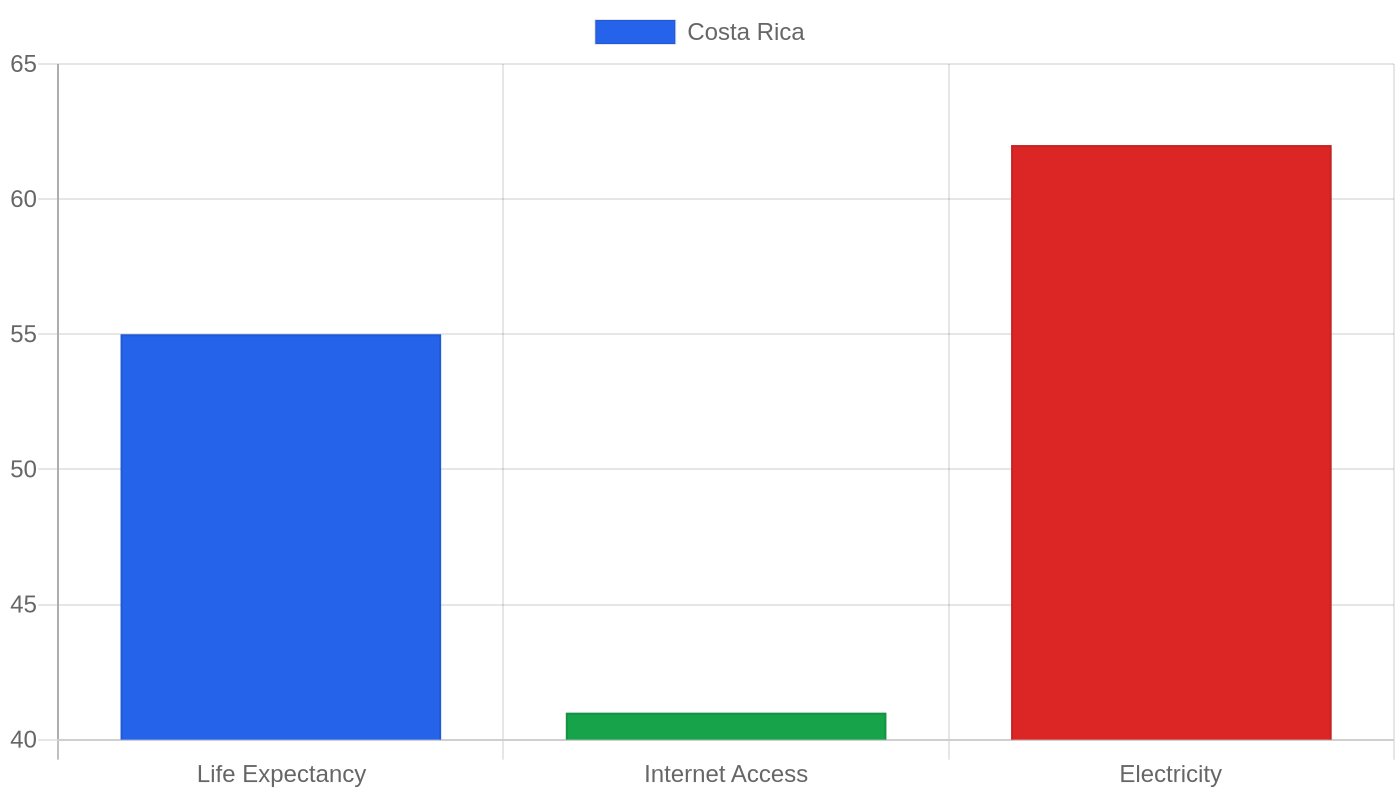
The World Bank’s latest data snapshot shows GDP growth, inflation, and unemployment figures marked as unavailable, a statistical silence that speaks to a broader truth: Costa Rica is in a period of transition where the old metrics of economic success may no longer capture the full picture.
What we do know is structural. The economy is built on a tripod of tourism, agricultural processing, and a growing utilities sector. The state-owned Instituto Costarricense de Electricidad (ICE) remains a cornerstone employer and infrastructure provider, powering the country’s ambitious renewable energy agenda.
Consumer goods companies — Cerveceria Costa Rica, Dos Pinos, and Florida Ice and Farm Company — form the manufacturing heartland, producing everything from dairy to beverages for domestic and regional markets. These are not flashy tech unicorns; they are steady, capital-intensive businesses that provide middle-class employment and export revenue.
The services sector, however, tells a more interesting story. Aviation companies — Avianca Costa Rica, Nature Air, Paradise Air, and Aeropostal Alas de Centroamerica — dominate the corporate registry, reflecting an economy that has bet heavily on connectivity and mobility. This is a country that understands its geography: a narrow isthmus linking North and South America, a natural hub for logistics, tourism, and regional headquarters.
The presence of Café Britt, a premium coffee brand, signals a shift toward value-added exports rather than raw commodity sales.
The absence of hard numbers from the World Bank should not be misread as an absence of economic activity. Rather, it suggests a statistical lag — a country whose data collection infrastructure is struggling to keep pace with the diversification of its economy. In plain terms: Costa Rica is no longer just a banana republic, but its statistical agencies still operate on banana-republic timelines.
The Cost of Living Well: Rent, Retail, and the Middle-Class Squeeze
Costa Rica has long marketed itself as a affordable paradise — a place where expatriates can live comfortably on modest savings and where locals enjoy a standard of living that outpaces their Central American neighbors. The reality, as with most paradises, is more complicated. The cost of living data provided is sparse, but the composition of the economy offers clues.
A country dominated by consumer goods companies like Dos Pinos and Florida Ice and Farm Company is one where domestic consumption is the primary economic engine — and where inflation in food and beverages directly impacts political stability.
Housing costs in Costa Rica’s urban centers, particularly the capital San José and the expatriate-heavy regions of the Central Valley and Guanacaste, have risen steadily over the past decade. The rental market is bifurcated: local families face modest but rising rents in working-class barrios, while foreign buyers and remote workers have driven up prices in gated communities and coastal developments.
The World Bank’s data does not provide specific figures, but the anecdotal evidence from the corporate landscape — the presence of multiple airlines and tourism operators — suggests an economy increasingly oriented toward serving visitors rather than residents.
The middle-class squeeze is real. While Costa Rica’s social safety net — universal healthcare and education — remains intact, the cost of imported goods, fuel, and vehicles places pressure on household budgets. The consumer goods companies that dominate the economy are sensitive to these dynamics; a population that feels economically insecure spends less on discretionary items like premium coffee and craft beer.
For now, the country manages a delicate balance: high enough wages to sustain a middle class, low enough costs to remain competitive regionally. But the margin for error is thin, and the data gap makes it difficult to determine just how thin.
Where Capital Meets Coffee: The Investment Landscape
For investors, Costa Rica offers a proposition that is simultaneously compelling and frustrating. The corporate registry reveals a market dominated by consumer services and goods — companies that are stable, cash-generative, and deeply embedded in the national fabric. The Abangares Mining Company, a basic materials firm, hints at untapped mineral wealth, though mining remains politically sensitive in a country that has positioned itself as a global leader in environmental protection.
The real action, however, is in aviation and tourism, where companies like Nature Air and Paradise Air represent the promise of eco-tourism done right — high-value, low-impact travel that commands premium prices.
The business climate is shaped by the political landscape described in the 1949 Constitution: a stable presidential system with clear rules of engagement. The President of Costa Rica appoints the heads of autonomous institutions and ministers, and the system of checks and balances — including veto power and judicial review — provides a level of institutional certainty that is rare in emerging markets.
For foreign investors, this translates into lower political risk premiums and a more predictable regulatory environment. The challenge is scale: Costa Rica is a small market, and companies looking for exponential growth must treat it as a regional hub rather than a domestic play.
The sectors to watch are those that leverage Costa Rica’s natural and human capital. Renewable energy, anchored by ICE, continues to attract international attention as the country pushes toward carbon neutrality. Ecotourism remains a growth engine, with the aviation companies in the registry positioned to benefit from increased visitor numbers.
And the consumer goods sector, while mature, offers opportunities for premiumization — the kind of value-added products that Café Britt has successfully exported to global markets. The bottom line for investors: Costa Rica is not a frontier market; it is a stable, moderate-growth environment where patience is rewarded and speculation is punished.
The Politics of Peace: Stability as a Currency
Costa Rica’s greatest economic export is not coffee, bananas, or software — it is stability. The 1949 Constitution, which abolished the military and established a robust presidential system, created a political environment that is the envy of the region. The World Bank’s data does not provide crime or safety indices, but the country’s reputation as one of the safest in Latin America is a function of its political choices, not its policing.
A nation without an army is a nation that cannot easily slide into authoritarianism; a nation with strong autonomous institutions is a nation where policy continuity survives electoral cycles.
The quality of life in Costa Rica is directly tied to this political architecture. The absence of political violence, the presence of universal healthcare, and the cultural emphasis on *pura vida* — a phrase that translates roughly to “pure life” but means something closer to “take it easy” — create an environment where social trust remains high. This trust is the invisible currency that underpins the consumer economy; people spend when they believe the future will be stable.
The political system, with its four-year presidential terms and direct elections, ensures accountability without chaos.
But stability has its own costs. A political system that prioritizes consensus over speed can struggle to implement the structural reforms needed to boost productivity. The autonomous institutions, while insulated from political interference, can become bureaucratic bottlenecks. And the absence of a military, while morally admirable, means the country relies on regional and international partnerships for security — a dependency that could become a vulnerability in an increasingly volatile global environment.
For now, however, the bet on peace is paying off. Costa Rica remains a country where the political temperature is cool, the institutions are warm, and the population is engaged.
The Moment Now: Navigating the Data Drought
The most striking feature of Costa Rica’s current economic moment is not what is happening — it is what is *not* being measured. The World Bank’s data gap on GDP growth, inflation, and unemployment is unusual for a middle-income country with a sophisticated statistical apparatus. This could reflect a transition in how economic activity is being tracked, or it could signal a period of genuine uncertainty where traditional indicators are less relevant.
Either way, it creates a vacuum that is being filled by anecdote and speculation — never a healthy situation for an open economy.
What can be observed is the continued vitality of the corporate sector. The airlines are flying, the breweries are brewing, and the dairy cooperatives are milking. The presence of multiple aviation companies suggests that tourism is recovering or expanding, even if the hard numbers are not yet available. The consumer goods companies, which are sensitive to domestic demand, remain operational and competitive.
This is not an economy in crisis; it is an economy in a holding pattern, waiting for the statistical fog to lift.
The policy environment is also in a transitional phase. The constitutional framework established in 1949 remains the bedrock, but the country is grappling with modern challenges that the framers could not have anticipated: digital transformation, climate change, and the integration of migrants from neighboring countries.
The political system, with its emphasis on institutional autonomy, is well-suited to handle these challenges slowly and deliberately — but “slowly” is a luxury in a global economy that rewards speed. The coming months will reveal whether Costa Rica can maintain its equilibrium while the world around it accelerates.
For now, the country remains what it has always been: a small, stable, and quietly confident nation, betting that its way of life is worth preserving — and that the numbers will eventually catch up to the reality.
The Bottom Line
Costa Rica is a country for patient investors, pragmatic policymakers, and travelers who value substance over spectacle. It will not deliver explosive growth or dramatic reforms, but it offers something more valuable in an uncertain world: predictability. The absence of current economic data is a temporary inconvenience, not a structural crisis; the underlying fundamentals — political stability, a diversified corporate sector, and a quality of life that attracts talent — remain intact.
Watch this country if you believe that steady wins the race, and that the quiet accumulation of institutional strength is the surest path to prosperity. The numbers will return; the character of the country will not change.
Sources & Methodology
This article is authored by Economic Pulse Net for informational and research purposes. Economic Pulse Net sources its data from multilateral institutions, national statistics bureaus, and proprietary databases. All data is believed to be current as of the date of publication.
Published: August 02, 2026 | Category: Research — Costa Rica
Use these signals in your own platform
Economic Pulse publishes its live signal feed through a documented, read-only API. Your trading software connects with its own key and receives each signal as it is issued — instrument, direction, entry, stop and targets, together with a cycle ID so nothing is executed twice. The feed is independent of this website and cannot change it.
Signals are informational only and are not financial advice.