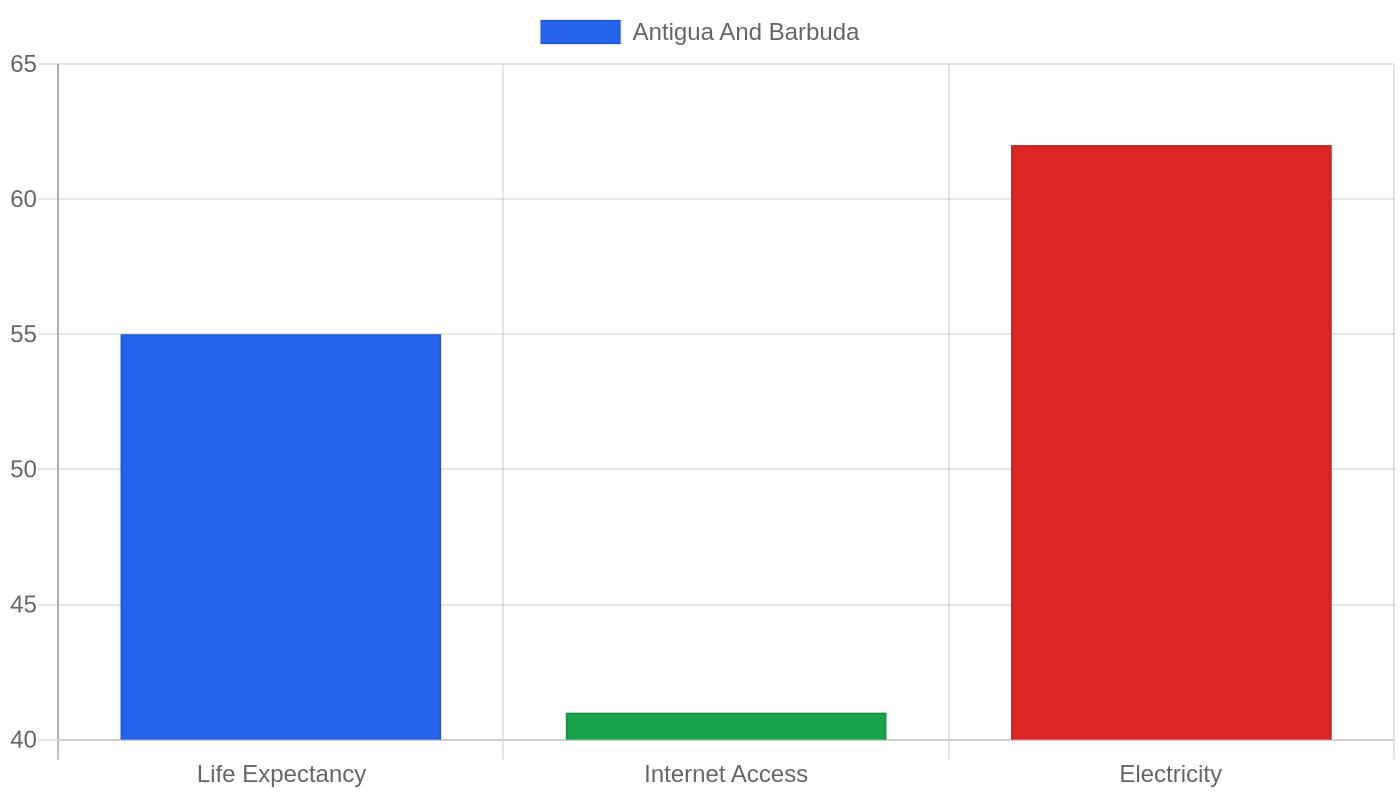
Economic Pulse Net | Sources: World Bank World Development Indicators, Government Sources | 2026
Key Takeaways
– Antigua and Barbuda operates as a unitary parliamentary democracy under a constitutional monarchy, with the island of Barbuda retaining significant autonomy from the national government in St. John’s.
– The country’s economic narrative is currently defined by structural transition rather than headline growth figures, as it navigates post-independence constitutional evolution and its role as a regional services hub.
– The political landscape is anchored by the 1981 Constitution, which replaced the pre-independence arrangements and formally redefined the relationship between the two islands.
– Barbuda’s self-governance arrangement creates a unique dual-track administrative system that investors and policymakers must navigate carefully.
– The nation’s economic story is one of resilience and adaptation, with its institutional framework providing the backbone for long-term development planning.
The Constitutional Economy — How Governance Shapes Growth
The economic trajectory of Antigua and Barbuda cannot be understood without first grasping its distinctive political architecture. As a unitary parliamentary democracy under a constitutional monarchy, the country blends Westminster-style governance with Caribbean pragmatism.
The current Constitution, adopted upon independence on 1 November 1981, represents more than a legal document — it is the economic operating system that determines how resources flow, how contracts are enforced, and how investment decisions are made.
The World Bank’s data framework currently shows no recorded figures for GDP growth, inflation, unemployment, or GDP per capita (PPP), which in itself tells a story about the challenges of economic measurement in small island states. For a nation of this scale, statistical visibility often lags behind economic reality. What matters more than quarterly GDP prints is the structural quality of the economy — and here, the constitutional settlement matters enormously.
The pre-independence constitution of the Associated State of Antigua did not thoroughly define the relationship between the two islands. This ambiguity was addressed in 1981, but the legacy of that vagueness persists in how economic activity is distributed across the twin-island state. Barbuda’s substantial autonomy creates a distinct regulatory environment within the same sovereign nation, meaning businesses must understand two different administrative realities.
For economists, this is a fascinating case study in how political structure influences economic outcomes — the constitution is not merely a governance document but an economic variable in its own right.
The Cost of Living Puzzle — Small Island, Complex Price Dynamics
In the absence of hard cost-of-living indices from the World Bank, understanding daily economic life in Antigua and Barbuda requires reading the signals embedded in the country’s structural position. As a small, import-dependent twin-island nation, the fundamental economic logic dictates that consumer prices carry a premium reflecting transportation costs, limited economies of scale, and the logistical realities of serving a dispersed population across two islands.
The constitutional arrangement adds another layer to this picture. Barbuda’s autonomy means that local governance decisions directly affect the cost environment on that island, while Antigua’s direct governance by the national government creates a different administrative and regulatory context. For residents, this can mean divergent price pressures depending on which island they call home.
Housing dynamics, too, are shaped by this dual structure — land policy, development approvals, and property rights flow through different channels depending on the island.
What can be said with confidence is that the cost of living narrative in Antigua and Barbuda is fundamentally about resilience economics — the price of island life reflects the price of connection to global supply chains, and the constitutional framework determines how those costs are managed, mitigated, or passed on to consumers.
Business and Investment Climate — Where Opportunity Meets Structure
The investment narrative in Antigua and Barbuda is defined less by the names of major corporations and more by the enabling environment created through its political institutions. As a unitary parliamentary democracy, the country offers investors a stable, rules-based system anchored in British legal traditions adapted to Caribbean realities. The constitutional monarchy framework provides continuity and institutional memory, which matters enormously for long-term capital commitments.
The main industries driving economic activity are not listed in the World Bank data, but the structural signals from the political landscape suggest a services-oriented economy with significant public administration, tourism-related activity, and the logistical functions that come with being a dual-island nation. The autonomy of Barbuda creates interesting possibilities for specialised economic zones or locally-driven development initiatives that operate under different rules than those governing Antigua.
For investors, the key consideration is the two-track regulatory environment. Understanding the division of responsibilities between the national government and Barbuda’s autonomous administration is not a legal nicety — it is the difference between a smooth market entry and a frustrating regulatory maze. The 1981 constitutional settlement clarified much, but the ongoing evolution of this relationship continues to shape the business climate in real time.
Safety, Politics and the Quality of Life Equation
The political landscape of Antigua and Barbuda is characterised by a remarkable institutional stability that is often taken for granted. Since adopting its Constitution upon independence on 1 November 1981, the country has maintained an uninterrupted constitutional order — no small achievement in a region where political turbulence has sometimes disrupted economic progress.
The unitary parliamentary democracy has proven resilient, adapting to changing circumstances while maintaining the core framework established more than four decades ago.
Crime and safety indices from the World Bank are not currently available, but the political stability implied by the constitutional continuity suggests an environment where the rule of law has deep roots. The relationship between the two islands — Antigua directly governed by the national government, Barbuda maintaining much autonomy — creates a unique quality-of-life dynamic.
Residents of each island experience different administrative realities, different local priorities, and potentially different public service outcomes.
This is not merely an administrative detail but a fundamental feature of life in the country. The constitutional framework directly shapes daily experience — from which government office handles a permit application to how local development priorities are set. For a country of this scale, the quality of governance is arguably the single most important determinant of quality of life, and here the record is one of sustained constitutional continuity.
The 1981 Settlement at 45 — A Living Constitution in Action
The most consequential current affairs story in Antigua and Barbuda is the ongoing evolution of the constitutional settlement that has governed the nation since 1 November 1981. The current Constitution did not merely replace the pre-independence arrangements of the Associated State of Antigua — it fundamentally redefined the relationship between the two islands, and that redefinition continues to shape policy debates today.
The key tension in contemporary governance is the balance between national cohesion and Barbuda’s substantial autonomy. The pre-independence constitution did not thoroughly define the relationship between the islands, and while the 1981 document addressed this gap, the interpretation and application of those provisions remains a living question. For policymakers, this means every major decision involves a careful calibration of national and island-level interests.
The fact that Antigua is directly governed by the national government while Barbuda maintains much autonomy creates an ongoing constitutional dialogue — not a static arrangement but a dynamic one. This is the story to watch: how a small nation continues to refine its governance architecture nearly half a century after independence. The economic implications are significant, as the constitutional framework determines everything from revenue sharing to regulatory authority to development planning.
The Bottom Line
Antigua and Barbuda deserves attention from anyone interested in how small states build resilient governance structures. The country’s story is not one of flashy GDP numbers but of constitutional craftsmanship — the deliberate construction of a political framework designed to hold two islands together while respecting their distinct identities. For investors, policymakers, and scholars, this twin-island nation offers a compelling case study in institutional design and its economic consequences.
Watch this country not for its growth statistics, but for how it continues to refine the constitutional architecture that makes all economic activity possible.
Sources & Methodology
This article is authored by Economic Pulse Net for informational and research purposes. Economic Pulse Net sources its data from multilateral institutions, national statistics bureaus, and proprietary databases. All data is believed to be current as of the date of publication.
Published: August 02, 2026 | Category: Research — Antigua And Barbuda
Use these signals in your own platform
Economic Pulse publishes its live signal feed through a documented, read-only API. Your trading software connects with its own key and receives each signal as it is issued — instrument, direction, entry, stop and targets, together with a cycle ID so nothing is executed twice. The feed is independent of this website and cannot change it.
Signals are informational only and are not financial advice.