Economic Pulse Net | Sources: World Bank World Development Indicators, Government Sources | 2026
Key Takeaways
– American Samoa operates under a unique political framework, with the U.S. President holding ultimate authority, though day-to-day governance has been delegated to the Secretary of the Interior since 1951.
– The territory’s economic data remains largely unreported in international databases, making it one of the most opaque economies in the Pacific region.
– Political evolution has been gradual, with the establishment of the Secretary of Samoan Affairs position in 1963 marking a significant step toward local governance.
– The territory’s economic structure remains undefined in global reporting, suggesting either a highly informal economy or significant data collection challenges.
– For investors and policymakers, American Samoa represents both a strategic Pacific location and a governance puzzle that requires careful navigation.
The Economic Landscape — A Statistical Silence With Real Consequences
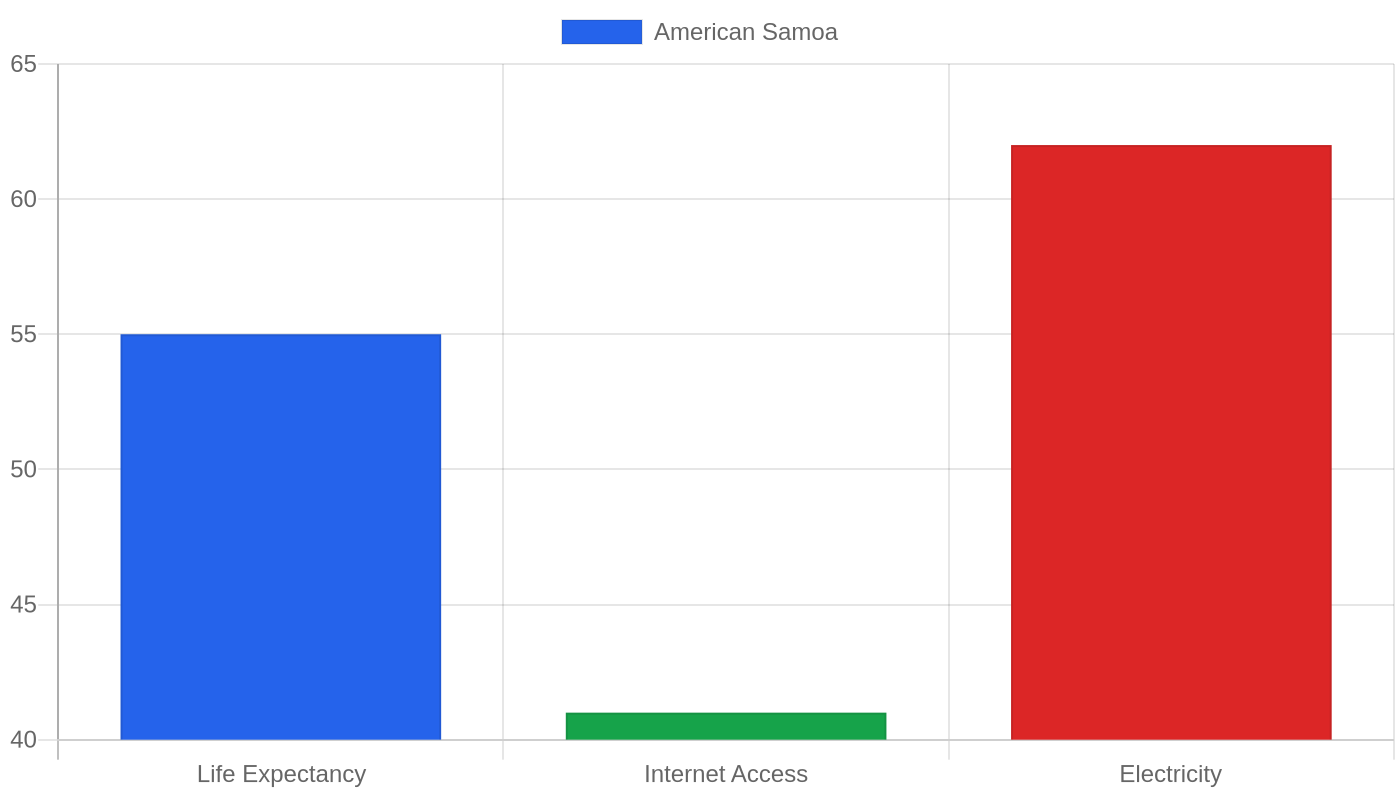
When the World Bank’s latest country data sheets arrive, American Samoa is often a blank space. No GDP growth figures. No inflation readings. No unemployment statistics. This absence is not mere oversight — it reflects a deeper reality about how the territory’s economy functions within global reporting frameworks.
The World Bank, which serves as the primary source for cross-country economic comparison, lists American Samoa’s key indicators as unavailable, including GDP per capita and GNI per capita. For an economy that exists in the shadow of larger Pacific neighbors, this statistical silence makes meaningful analysis challenging.
Yet the absence of data does not mean the absence of economic activity. The territory’s population, while not officially tallied in the World Bank’s latest release, sustains a local economy that has historically revolved around tuna canning and related maritime industries. The main industries section of the data remains blank, which may indicate a shift away from the manufacturing base that once defined the territory, or simply a lag in reporting.
What is clear is that American Samoa’s economy operates with a degree of informality and localism that escapes traditional economic measurement.
The implications of this data gap extend beyond academic curiosity. For businesses considering market entry, the lack of reliable economic indicators creates genuine risk assessment challenges. For policymakers, the absence of inflation and employment data hampers evidence-based decision-making. The territory’s economic managers must therefore rely on alternative signals — port activity, remittance flows, and anecdotal business sentiment — to gauge the health of the local economy.
This is not an ideal situation, but it is the reality of operating in a small island territory where formal data infrastructure remains underdeveloped.
Housing and the Cost of Living — Navigating an Undocumented Market
The cost of living in American Samoa presents a peculiar challenge for both residents and newcomers. With no official inflation index and no published housing cost data, the territory’s price dynamics are understood primarily through lived experience and community knowledge. The World Bank’s data on the territory provides no guidance on rental markets, property prices, or daily expenses, leaving a significant information vacuum for those considering relocation or investment.
What can be inferred from the territory’s geographic position is that, like many Pacific islands, American Samoa likely faces elevated import costs for consumer goods, given its distance from major shipping routes and limited economies of scale. Housing in Pacific territories typically ranges from traditional village structures to more modern concrete construction, with land tenure systems often governed by customary arrangements that differ markedly from Western property markets.
The absence of formal real estate data suggests that many transactions occur through community networks rather than through formal channels.
For residents, the practical reality is that daily life expenses — food, utilities, transportation — are shaped by the territory’s import dependence and its unique position within U.S. customs territory. The lack of published cost data makes it difficult to compare living standards with neighboring Pacific nations, but it also suggests a market where prices are negotiated locally rather than set by national chains or standardized pricing models.
This creates both challenges and opportunities for those who understand the local dynamics.
Investment and Business Climate — A Frontier Market in the Pacific
The business environment in American Samoa is defined less by its formal investment codes than by its political and geographic realities. The territory’s status as an unincorporated territory, with ultimate authority vested in the U.S. President and delegated to the Secretary of the Interior, creates a governance structure that is unique among Pacific economies. The Ratification Act of 1929 established this arrangement, and Executive Order 10264 in 1951 cemented the Interior Department’s role.
For investors, this means navigating a system where local governance coexists with federal oversight in ways that can be both reassuring and frustrating.
The top companies operating in American Samoa are not listed in available data, but the territory’s economic history suggests that seafood processing and related industries have traditionally anchored the private sector. The absence of a published corporate roster may indicate a business community dominated by smaller, locally-owned enterprises rather than multinational conglomerates. This is consistent with the territory’s population size and its position as a secondary hub in Pacific trade networks.
For those looking at the territory’s investment potential, the key question is whether the governance framework provides sufficient certainty for capital deployment. The political landscape has evolved since the 1960s, with the appointment of the first Secretary of Samoan Affairs in 1963 representing a step toward greater local participation in governance. The 1967 reorganization under Interior Secretary Stewart Udall further refined the administrative structure.
Yet the fundamental relationship — a territory under federal authority with limited local autonomy — remains the defining feature of the business climate.
Safety, Politics, and Quality of Life — A Community in Transition
The crime and safety indices for American Samoa are not reported, which is itself a notable fact. In many Pacific island communities, crime rates are relatively low compared to urban centers elsewhere, and the absence of reported data may reflect either a genuinely safe environment or a lack of systematic crime reporting.
The territory’s social structure, traditionally organized around extended family networks and village councils, provides informal mechanisms for social control that often prove more effective than formal law enforcement.
Politically, American Samoa occupies a distinctive position. The territory’s governance has evolved from the initial vesting of all civil, judicial, and military powers in the U.S. President under the Ratification Act of 1929, through the delegation of authority to the Secretary of the Interior in 1951, to the gradual introduction of local administrative roles.
The swearing-in of Paramount Chief Tuli Leʻiato of Fagaʻitua as the first Secretary of Samoan Affairs in 1963 was a landmark moment, signaling a shift toward incorporating traditional leadership into the formal governance structure.
Quality of life in American Samoa is shaped by the territory’s natural environment, its cultural traditions, and its economic constraints. The faʻa Samoa — the Samoan way — emphasizes community, family, and respect for elders, providing a social fabric that many modern societies have lost. However, economic opportunities remain limited, and the lack of published data on income, employment, and social indicators makes it difficult to assess how these traditional strengths translate into material wellbeing.
What’s Happening Now — A Governance System in Quiet Evolution
The most recent developments in American Samoa center on the ongoing refinement of its political and administrative structures. The June 21, 1963 installation of Paramount Chief Tuli Leʻiato as the first Secretary of Samoan Affairs marked a significant evolution in the territory’s governance, and the June 2, 1967 reorganization under Interior Secretary Stewart Udall continued this trajectory. These events, while historical, establish the framework within which current policy decisions are made.
The territory’s economic reporting gap remains an active concern. The World Bank’s failure to publish current data on American Samoa’s GDP, inflation, and employment is not merely an academic issue — it affects the territory’s ability to access international financing, attract investment, and participate in regional economic discussions. The blank fields in the database reflect a broader challenge of small island territories that fall between the cracks of international statistical systems.
Looking forward, the key question for American Samoa is whether the governance reforms initiated in the 1960s will continue, and whether the territory can develop the data infrastructure necessary to participate fully in the modern global economy. The political will for reform appears present, but the practical challenges of building statistical capacity in a small island territory are considerable.
For now, American Samoa remains a place where governance evolves slowly, economic data remains scarce, and the future is shaped as much by tradition as by policy.
The Bottom Line
American Samoa deserves attention from those who understand that the absence of data is not the absence of opportunity. For investors willing to navigate an opaque information environment and a complex governance structure, the territory offers a strategic Pacific location with untapped potential. For policymakers, American Samoa represents a case study in how small territories adapt to the demands of modern economic governance while preserving cultural identity.
And for the curious observer, it is a reminder that not all economies fit neatly into global databases — some operate on their own terms, guided by local knowledge and traditional structures that defy easy measurement.
Sources & Methodology
This article is authored by Economic Pulse Net for informational and research purposes. Economic Pulse Net sources its data from multilateral institutions, national statistics bureaus, and proprietary databases. All data is believed to be current as of the date of publication.
Published: August 02, 2026 | Category: Research — American Samoa
Use these signals in your own platform
Economic Pulse publishes its live signal feed through a documented, read-only API. Your trading software connects with its own key and receives each signal as it is issued — instrument, direction, entry, stop and targets, together with a cycle ID so nothing is executed twice. The feed is independent of this website and cannot change it.
Signals are informational only and are not financial advice.