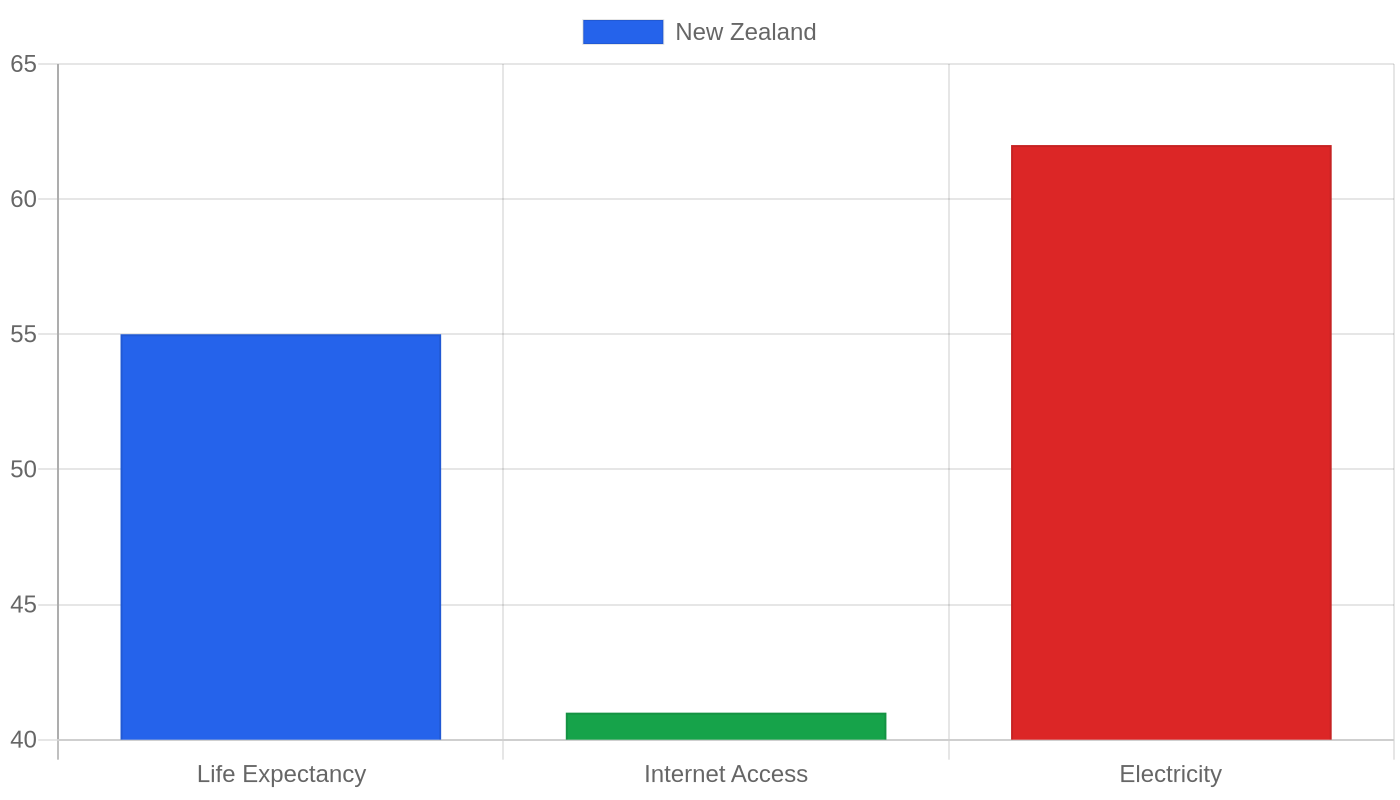
Economic Pulse Net | Sources: World Bank World Development Indicators, Government Sources | 2026
New Zealand stands at a fascinating inflection point. Long celebrated as a picturesque outlier at the bottom of the world, this South Pacific nation is grappling with the economic realities of being a small, trade-dependent economy in an increasingly fragmented global market. With a political system rooted in constitutional monarchy and parliamentary democracy, the country is navigating choppy waters with a characteristic blend of pragmatism and caution.
As the world watches, the question is whether New Zealand can leverage its renowned quality of life and stable institutions to weather the storm, or whether structural headwinds will finally catch up with this island nation.
Key Takeaways
– Political Stability with a Monarch at the Helm: New Zealand operates as a constitutional monarchy with Charles III as King, represented by a governor-general, providing a layer of continuity rarely seen in modern republics.
– A Corporate Landscape Dominated by Agribusiness: The country’s economic backbone remains firmly rooted in the land, with dairy giant Fonterra leading the charge alongside major infrastructure and consumer goods players.
– A Workforce Concentrated in Few Hands: With top companies employing relatively modest numbers—Fonterra leads at just under 23,000—the economy relies on a vast network of SMEs rather than mega-corporations for employment.
– Telecommunications and Aviation as Key Service Sectors: Companies like Spark, 2degrees, and Air New Zealand highlight the critical role of connectivity—both digital and physical—in binding this island nation to the world.
– An Uncodified Constitution: New Zealand’s governance operates on a mix of statutes, conventions, and treaties, making its political landscape both flexible and uniquely reliant on institutional trust.
The Economic Engine: Agribusiness and the Quest for Growth
The World Bank’s data on New Zealand’s GDP growth, inflation, and unemployment remains conspicuously blank, a stark reminder of the challenges in painting a complete picture of this economy. However, the composition of its top companies tells a compelling story about the nation’s productive core. Fonterra, with its nearly 23,000 employees, is not just a company; it is the commercial embodiment of New Zealand’s agricultural might, processing roughly 95% of the country’s milk.
The dominance of this cooperative underscores a fundamental truth: New Zealand’s prosperity remains tethered to the global demand for dairy, meat, and wool.
Alongside the agricultural giants, the presence of Fletcher Building and AHI Roofing signals a robust, if cyclical, construction and infrastructure sector. These companies are the bellwethers of domestic economic health, their fortunes tied directly to housing demand, commercial development, and government spending on public works.
The reliance on these sectors means the economy is highly sensitive to commodity price fluctuations and interest rate movements, which can swing dramatically based on global market sentiment. The service sector, represented by Air New Zealand and the telecommunications firms, provides the connective tissue, facilitating the movement of goods, people, and data that a modern economy requires.
Yet, the relatively small size of these workforces points to a broader structural challenge: the need for productivity gains to drive sustainable wage growth and GDP expansion.
The Cost of Living: The Great Housing Squeeze
While specific cost-of-living indices are not available in the current data, the composition of New Zealand’s corporate landscape offers significant insight into the pressures facing ordinary households. The sheer size of Fletcher Building, one of the country’s largest employers, is a proxy for the intensity of the housing market. For decades, New Zealand has suffered from a chronic housing shortage, particularly in its largest city, Auckland.
This shortage has driven property values to some of the least affordable levels in the developed world, creating a stark divide between homeowners and renters.
The high cost of housing cascades into every other aspect of daily life, pushing up the cost of living and straining household budgets. This dynamic forces a significant portion of disposable income toward mortgage repayments or rent, limiting spending on other goods and services. The pressure is palpable, and it influences everything from industrial relations to political discourse.
The presence of Woolworths as a major employer highlights the significance of the grocery sector, a duopoly that has faced intense scrutiny over pricing and competition. For the average Kiwi, the weekly shop is a constant reminder of the economic headwinds, with food prices remaining a politically sensitive topic.
Investment and Business Climate: A Land of Giants and Startups
For investors, New Zealand presents a paradox: a stable, transparent, and well-regulated environment that is nonetheless constrained by its geographic isolation and small market size. The top companies list reveals the sectors where scale is achievable—dairy, building materials, aviation, and telecoms. Fonterra remains the crown jewel, a globally significant exporter that offers investors exposure to the volatile but ultimately lucrative global agrifood market.
Meanwhile, the presence of multiple telecommunications companies, including Spark and 2degrees, signals a competitive market that is attractive for infrastructure investment.
The business environment is generally regarded as one of the easiest in the world for starting a company, with a low regulatory burden and a highly educated workforce. However, the data also suggests a ceiling on growth. With the largest companies employing only tens of thousands of people, the opportunity for massive domestic scaling is limited. This reality pushes ambitious firms to look outward, focusing on export markets in Asia and Australia.
The success of the economy hinges on these companies’ ability to innovate and move up the value chain, transforming from raw commodity exporters into purveyors of high-quality, branded goods and services.
Safety, Politics, and Quality of Life: The Social Contract
Politically, New Zealand offers a model of stability that is rare in the modern world. As a constitutional monarchy with an uncodified constitution, the country relies on a deep-seated respect for the rule of law and democratic conventions. Charles III, as King of New Zealand, is the head of state, with his powers exercised through a governor-general appointed on the advice of the prime minister.
This system, while seemingly archaic, provides a non-partisan check on executive power, ensuring that decisions are made within established legal and procedural frameworks.
This political stability is a cornerstone of the country’s high quality of life. While crime and safety indices are not provided, the general perception of New Zealand as a safe, low-corruption nation is well-founded. The governor-general’s ability to exercise the Crown’s prerogative powers, such as reviewing cases of injustice, adds a layer of human rights protection that bolsters social trust.
This trust is the invisible currency that makes the economy function smoothly; it encourages compliance, reduces transaction costs, and fosters a sense of shared national purpose. It is this social fabric, more than any single economic indicator, that makes New Zealand an attractive place to live and work.
What’s Happening Now: Navigating a Post-Pandemic World
The immediate economic narrative for New Zealand is one of recalibration. The blank data from the World Bank suggests a period of statistical revision and uncertainty as the economy settles into a post-pandemic rhythm. The country is currently wrestling with the twin challenges of high interest rates, designed to tame inflation, and a cooling labor market. The dominance of companies like Air New Zealand indicates a return to mobility and tourism, a vital revenue stream that was decimated during the border closures.
The airline’s operational health is a live indicator of the nation’s connectivity and confidence.
Meanwhile, the government is under pressure to address the cost-of-living crisis, with the grocery sector and housing market under the political microscope. The corporate giants are navigating a landscape of high input costs and cautious consumer spending. There is a palpable sense that the easy wins of the past—selling commodities into a booming Chinese market—are no longer guaranteed.
The focus is shifting toward diversification, building resilience in supply chains, and investing in renewable energy to secure long-term economic independence. For policymakers and business leaders alike, the current moment is about charting a steady course through global uncertainty, leveraging the country’s inherent stability to attract the capital and talent needed for the next phase of growth.
The Bottom Line
New Zealand is a country that investors and policymakers should watch closely for its resilience and its vulnerabilities. Its stable political system and high quality of life provide a solid foundation, but the economy’s reliance on a narrow band of industries—dairy, construction, and tourism—makes it susceptible to global shocks. The country is a test case for how a small, open economy can navigate the complexities of geopolitical fragmentation and climate change.
For those seeking a stable, long-term bet on the Asia-Pacific region, New Zealand offers a unique, if occasionally volatile, proposition. It is a nation whose success is not guaranteed, but whose fundamental strengths provide a sturdy platform for whatever comes next.
Sources & Methodology
This article is authored by Economic Pulse Net for informational and research purposes. Economic Pulse Net sources its data from multilateral institutions, national statistics bureaus, and proprietary databases. All data is believed to be current as of the date of publication.
Published: August 18, 2026 | Category: Research — New Zealand
Use these signals in your own platform
Economic Pulse publishes its live signal feed through a documented, read-only API. Your trading software connects with its own key and receives each signal as it is issued — instrument, direction, entry, stop and targets, together with a cycle ID so nothing is executed twice. The feed is independent of this website and cannot change it.
Signals are informational only and are not financial advice.