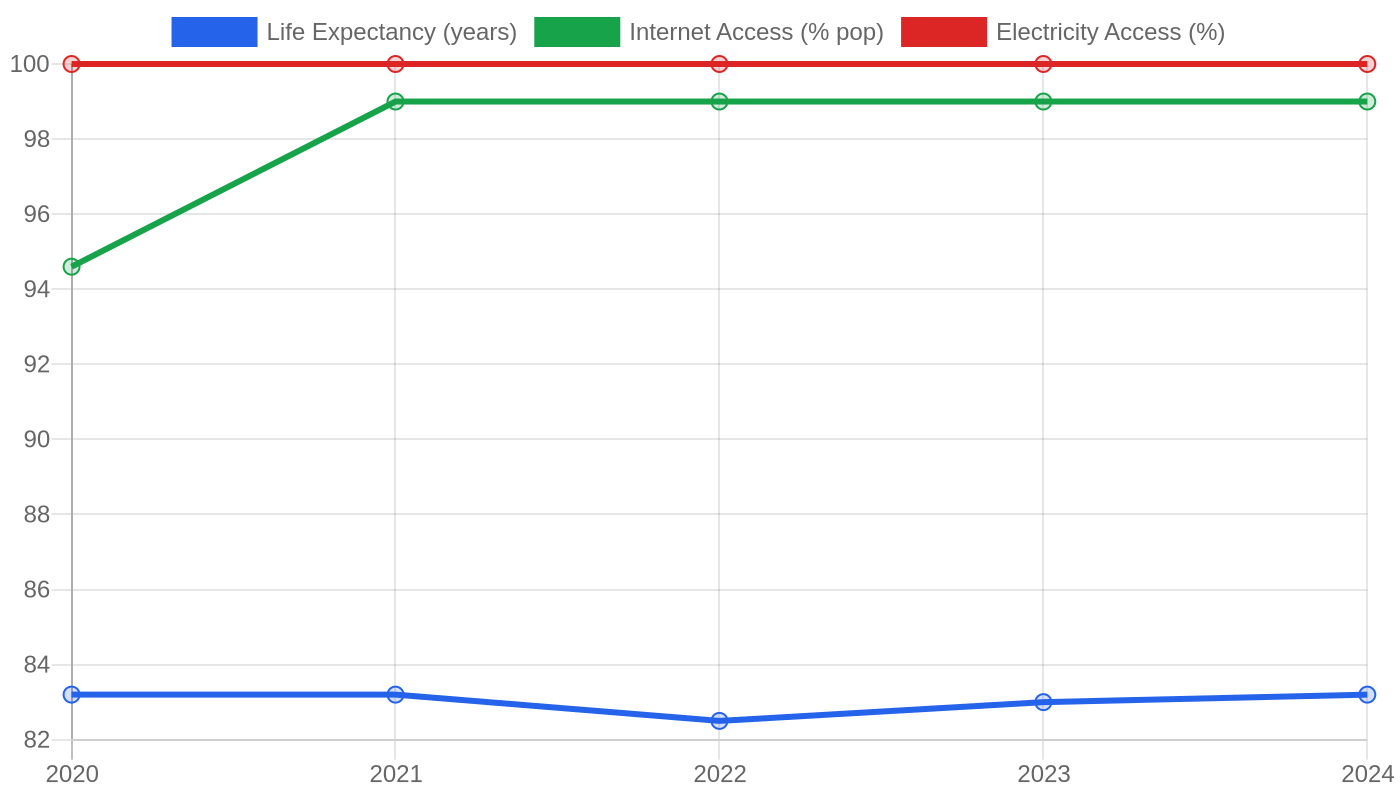
Economic Pulse Net | Sources: World Bank World Development Indicators, Government Sources | 2026
Tucked in the heart of the Balkans, North Macedonia is a country that has spent three decades redefining its identity, its alliances, and its economic model.
Once the southernmost republic of Yugoslavia, this landlocked nation of two million has become a quiet test case for how a small, open economy can thread the needle between East and West, between old industries and new technologies, and between the promise of European Union membership and the grinding reality of domestic reform.
As of the latest data, the World Bank reports that key economic indicators such as GDP growth, inflation, and unemployment are currently unavailable, but that absence of fresh numbers tells its own story: a country in transition, where the statistical picture is often as fluid as the political landscape.
The companies that anchor the economy—from Alkaloid in healthcare to Komercijalna banka in finance—are regional players with deep roots, yet they operate in a market that remains vulnerable to external shocks and internal bottlenecks.
Key Takeaways
- A Parliamentary Democracy in Flux: North Macedonia operates as a parliamentary democracy with a coalition government, a mostly ceremonial president, and a prime minister who holds real executive power—a structure that has produced both stability and gridlock.
- Diversified Economic Anchors: The corporate landscape spans utilities (ESM, EVN AD Skopje), finance (Alpha Bank, Komercijalna banka), healthcare (Alkaloid), and industrials (FAS Sanos), offering a broader base than many regional peers.
- Data Gaps Signal Transition: With the World Bank’s latest growth, inflation, and unemployment figures unavailable, analysts are flying partially blind—yet the existing industrial mix suggests resilience amid uncertainty.
- Strategic Geopolitical Positioning: The country’s ongoing negotiations and political maneuvering around EU accession continue to shape investor sentiment and economic policy.
- A Quality-of-Life Question Mark: With crime and safety indices also unavailable, the lived experience of North Macedonians remains underreported, leaving room for both optimism and caution.
The Economic Engine — Growth, Inflation, and the Weight of Transition
The economic narrative of North Macedonia is one of steady, unspectacular progress punctuated by periodic crises.
According to the World Bank, the latest figures for GDP growth, inflation, and unemployment are not currently available, which is itself a notable data gap for a country that has historically been keen to showcase its macroeconomic stability.
What is clear, however, is that the economy is not a one-trick pony.
The presence of major players like ESM and EVN AD Skopje in utilities indicates a state-private mix that ensures energy security, while Komercijalna banka and Alpha Bank anchor a financial sector that has remained relatively insulated from the kind of banking crises seen elsewhere in Europe.
Alkaloid, a pharmaceutical giant, is a rare example of a Balkan company that competes in Western European markets, bringing in hard currency and technical expertise.
Meanwhile, Aktiva in basic materials and Eurovia DOOEL in construction point to an economy that still relies heavily on physical infrastructure and raw inputs.
Inflation, where it has been measured in recent years, has been a concern for households, particularly food and energy prices, but the lack of current World Bank data makes it difficult to assess whether price pressures have abated or intensified.
Unemployment, historically one of the highest in Europe, has been on a slow downward trend over the past decade, but again, the most recent figures are missing.
What economists can infer is that North Macedonia’s growth model—export-oriented but import-dependent—leaves it sensitive to the health of the European Union, which absorbs the majority of its exports.
The country’s GDP per capita on a purchasing power parity basis remains well below the EU average, a reminder that convergence is a marathon, not a sprint.
For the average citizen, the economic reality is one of modest wages, rising expectations, and a persistent gap between the formal economy and a large informal sector that operates beneath the statistical radar.
The Cost of Living — Housing, Daily Expenses, and the Urban-Rural Divide
In Skopje, the capital, the cost of living tells a story of a city caught between its Ottoman past and its European future.
While the World Bank data does not provide specific figures for housing costs, regional comparisons suggest that North Macedonia remains one of the more affordable countries in Southeast Europe, particularly when compared to neighbors like Greece or even Serbia.
Rent in Skopje’s city center has been climbing in recent years, driven by a construction boom led by companies like Eurovia DOOEL, but it still remains a fraction of what one would pay in Vienna or Munich.
The real estate market is bifurcated: newer, Western-style apartments in complexes near the Vardar River command premium prices, while older Yugoslav-era blocks in the suburbs offer cheaper, though often less energy-efficient, alternatives.
For young professionals, the dream of homeownership is still alive, but it requires a dual income and a willingness to take on long-term debt—a significant commitment in a country where the average salary hovers at levels that make saving a slow process.
Daily expenses, from groceries to transportation, are generally lower than the EU average, but they have been rising in line with global food and energy prices.
Markets like the Bit Pazar in Skopje’s Old Bazaar offer fresh produce at bargain prices, while Western-style supermarkets like DON Market, one of the country’s top companies, cater to those willing to pay a premium for convenience and imported goods.
Utilities, provided by the likes of ESM and EVN AD Skopje, are a significant line item in any household budget, with electricity costs that are moderate by European standards but still burdensome for low-income families.
The urban-rural divide is stark: while Skopje enjoys a semblance of cosmopolitan living with cafes, restaurants, and international retail chains, rural areas face higher relative costs for transport and fewer employment opportunities, pushing many young people to migrate to the capital or abroad.
For expatriates and foreign workers, North Macedonia offers a high quality of life at a low price, but for locals, the equation is more complex, balancing modest incomes against a slowly modernizing cost structure.
Investment & Business Climate — Where the Opportunities Lie
For investors looking at North Macedonia, the landscape is defined by a handful of dominant players and a government that has, at various times, promised to cut red tape and attract foreign direct investment.
The financial sector is the most visible entry point, with Komercijalna banka Skopje and Alpha Bank providing the kind of stability that foreign investors seek when entering a new market.
These banks have been instrumental in financing the country’s construction boom and supporting the SME sector, which forms the backbone of the economy.
In healthcare, Alkaloid stands out as a regional champion, with a portfolio of generic drugs and over-the-counter products that compete across the Balkans and beyond.
The company’s success demonstrates that North Macedonian firms can be competitive on a larger stage, provided they have the capital and managerial expertise to scale.
The utilities sector, anchored by ESM (the state-owned energy company) and EVN AD Skopje (the Austrian-owned electricity distributor), is both an opportunity and a challenge.
On one hand, the country has significant potential for renewable energy, particularly solar and wind, and the government has signaled interest in attracting private investment in this area.
On the other hand, the legacy of state control and cross-subsidization makes tariff reform politically sensitive.
The oil and gas sector, represented by Lukoil Macedonia, is a reminder of the country’s dependence on imported hydrocarbons, a vulnerability that energy diversification efforts aim to address.
For new entrants, the business climate is improving but still marked by bureaucratic hurdles, inconsistent enforcement of contracts, and a judicial system that, while constitutionally independent, is often slow.
The presence of Eurovia DOOEL in construction and FAS Sanos in industrials indicates that infrastructure spending will remain a key driver of economic activity, particularly if EU accession funds begin to flow more freely.
Overall, the message for investors is one of cautious optimism: the fundamentals are sound, the market is open, but success requires patience and local knowledge.
Safety, Politics & Quality of Life — The Fragile Balance of a Young Democracy
North Macedonia’s political system, as described in the available data, is a parliamentary democracy with an executive government composed of a coalition of parties from the 120-seat Assembly, known as the Sobranie.
The president’s role is largely ceremonial, though they serve as commander-in-chief of the armed forces, while the prime minister holds the real reins of power.
This structure has produced a political culture that is vibrant but fractious, with coalition governments that are often fragile and subject to the whims of smaller parties.
The country’s journey to NATO membership and its ongoing, fraught negotiations with the European Union have been defining features of its recent political history, with the Prespa Agreement with Greece—which resolved the long-standing name dispute—standing as a landmark achievement that unlocked the path to Euro-Atlantic integration.
However, the political landscape remains polarized, with debates over national identity, language rights, and the pace of reform frequently dominating the agenda.
On safety and quality of life, the World Bank data provides no specific crime or safety indices, leaving observers to rely on anecdotal reports and regional comparisons.
Generally, North Macedonia is considered a safe country by European standards, with low rates of violent crime and a visible police presence in urban centers.
Petty crime, such as pickpocketing in tourist areas, exists but is not rampant.
The larger quality-of-life concerns are economic: unemployment, particularly among youth, remains a persistent issue, and the lack of recent data makes it difficult to assess whether conditions are improving.
The healthcare system, while universal, is underfunded and often forces patients to seek private care, and the education system is in need of modernization to better align with labor market needs.
For all its challenges, however, North Macedonia offers a quality of life that is rich in culture, community, and natural beauty—from the vineyards of Tikveš to the mountains of Šar Planina—and for many citizens, these intangible assets compensate for the material shortcomings.
The country’s happiness levels, while not formally measured in the available data, are likely a mixed bag: pride in the nation’s resilience tempered by frustration at the slow pace of change.
Current Affairs — The Fresh Pulse of a Nation in Motion
Right now, North Macedonia is at a critical juncture, with the reverberations of the EU accession process and regional geopolitical shifts shaping daily life.
The coalition government, led by the prime minister, is navigating a delicate balancing act between pro-Western reforms and the demands of nationalist constituencies, all while managing the fallout from regional energy price shocks and inflation that, while not officially recorded in the latest World Bank data, is being felt in households across the country.
The ongoing war in Ukraine has refocused attention on the Western Balkans as a strategic buffer zone, and North Macedonia has positioned itself as a reliable NATO ally, hosting allied troops and participating in joint exercises.
Domestically, the government has been pushing a series of reforms aimed at improving the business environment, including digitalization of public services and efforts to reduce the informal economy, though progress has been slower than many international observers would like.
In the corporate sector, there is a sense of cautious dynamism.
The energy transition is moving from rhetoric to reality, with ESM and EVN AD Skopje exploring new investments in renewable capacity, while companies like Alkaloid are expanding their export footprints despite global supply chain disruptions.
The construction sector, led by Eurovia DOOEL, continues to benefit from infrastructure projects funded by international lenders, and there is growing interest from foreign investors in the country’s IT and outsourcing sectors, which are not yet fully reflected in the data but are buzzing with activity.
At the same time, the political calendar is never dull: local elections, coalition negotiations, and the ever-present question of when—or if—the EU will formally open accession talks with the country’s broader neighborhood keep the news cycle active.
For the average citizen, the most pressing concerns remain the cost of living and the availability of well-paying jobs, and the government’s ability to deliver on these fronts will likely determine its political fortunes in the coming months.
The atmosphere is one of wait-and-see: hopeful but wary, ambitious but constrained by the realities of a small, open economy in a volatile region.
The Bottom Line
North Macedonia is a country that deserves the attention of investors, policymakers, and anyone interested in the future of Southeast Europe.
It is a test case for whether a small, multi-ethnic state can successfully navigate the path to Euro-Atlantic integration while managing the internal pressures of nationalism, economic inequality, and institutional weakness.
The corporate landscape, from Alkaloid to EVN AD Skopje, demonstrates that the country has the talent and the assets to compete, but the missing World Bank data serves as a reminder that transparency and statistical capacity remain work in progress.
For investors, the window of opportunity is open, but it requires a long-term perspective and a willingness to engage with a complex political environment.
For citizens, the promise of a better life rests on the government’s ability to deliver on reforms and to maintain the fragile coalition that holds the country together.
Watch this space: the next few years will be decisive.
Sources & Methodology
This article is authored by Economic Pulse Net for informational and research purposes.
Economic Pulse Net sources its data from multilateral institutions, national statistics bureaus, and proprietary databases.
All data is believed to be current as of the date of publication. Published: August 29, 2026 |
Category: Research — North Macedonia
Use these signals in your own platform
Economic Pulse publishes its live signal feed through a documented, read-only API. Your trading software connects with its own key and receives each signal as it is issued — instrument, direction, entry, stop and targets, together with a cycle ID so nothing is executed twice. The feed is independent of this website and cannot change it.
Signals are informational only and are not financial advice.