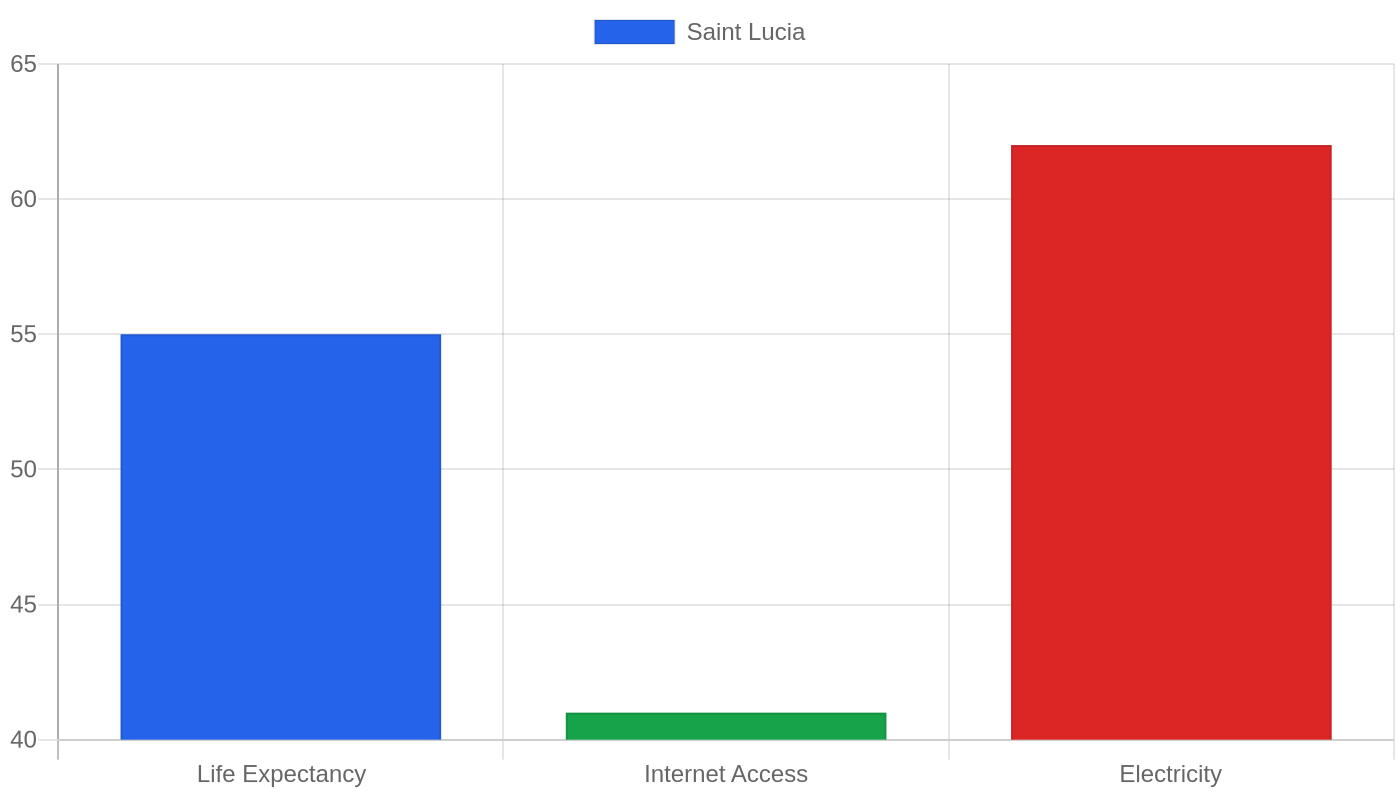
Economic Pulse Net | Sources: World Bank World Development Indicators, Government Sources | 2026
Key Takeaways
– Saint Lucia’s economy is navigating a delicate balance between its traditional tourism and agricultural foundations and the growing influence of its financial services sector, with the island’s four largest companies all anchored in finance and utilities.
– The political system remains remarkably stable, operating as a Commonwealth realm under a parliamentary democracy with 17 elected seats in the House of Assembly, currently led by Prime Minister Philip J. Pierre.
– Financial services dominate the corporate landscape, with the 1st National Bank of St Lucia, Bank of Saint Lucia, and Eastern Caribbean Financial Holding Company forming the backbone of the private sector.
– The island’s utility infrastructure is a critical economic driver, with St. Lucia Electricity Services holding a pivotal position in the country’s development trajectory.
– As a small island developing state, Saint Lucia’s economic fortunes remain closely tied to external factors, including global tourism flows and international financial regulations, making adaptability its greatest asset.
The Economic Engine — Services, Stability, and the Search for Growth
The World Bank’s most recent data on Saint Lucia presents an incomplete statistical portrait, with GDP growth figures, inflation rates, and unemployment numbers all currently unavailable. Yet the absence of fresh data points does not diminish the island’s economic significance within the Eastern Caribbean region. Saint Lucia’s economy has traditionally rested on three pillars: tourism, banana exports, and more recently, financial services.
The tourism sector has long been the primary foreign exchange earner, drawing visitors to the island’s famous Pitons and its reputation for luxury hospitality. The agricultural sector, while diminished from its historical peak, continues to provide employment in rural communities.
What the available data does reveal is the structural composition of Saint Lucia’s corporate economy. The financial sector clearly dominates, with three of the four largest companies operating in banking and financial services. This concentration suggests a sophisticated financial infrastructure for a nation of its size, with the 1st National Bank of St Lucia and Bank of Saint Lucia serving as the primary pillars of the domestic banking system.
The Eastern Caribbean Financial Holding Company’s prominence further underscores the regional integration of Saint Lucian finance, connecting the island to the broader Eastern Caribbean Currency Union.
The utility sector, represented by St. Lucia Electricity Services, points to the critical infrastructure investments that will shape the island’s future economic trajectory. Energy costs remain a significant consideration for Caribbean economies, and the efficiency and reliability of electricity provision directly impact competitiveness across all sectors. For investors and policymakers alike, the performance of this utility will be a bellwether for the broader economy’s health.
The World Bank’s engagement with Saint Lucia, as with other Caribbean nations, has consistently emphasised the importance of infrastructure resilience, particularly given the region’s vulnerability to climate-related shocks.
Housing and the Cost of Living — The Price of Paradise
Comprehensive cost of living data for Saint Lucia remains elusive in the current dataset, but the structural factors affecting household finances are clear. As a small island economy heavily dependent on imports, Saint Lucia faces inherent cost pressures that shape the daily economic reality for its citizens. Food, fuel, and manufactured goods must all be shipped in, and those transportation costs inevitably translate into higher consumer prices.
The tourism sector’s dominance further influences local price levels, as demand from visitors supports higher prices in popular areas, particularly around the capital, Castries, and the tourist hubs of Rodney Bay and Soufrière.
Housing dynamics in Saint Lucia reflect the broader Caribbean pattern, with significant variation between urban and rural areas. The rental market in tourist-frequented zones commands premium rates, while homeownership remains an aspiration for many middle-class families. The financial sector’s strength suggests that mortgage products and banking services are accessible to qualified borrowers, though affordability remains a challenge for younger residents and those employed in lower-wage sectors.
The government’s commitment to infrastructure development, evidenced by the utility sector’s prominence, will be crucial in managing the cost pressures that affect both businesses and households.
Investment and Business Climate — Finance Leads the Way
For investors eyeing the Eastern Caribbean, Saint Lucia presents a compelling if nuanced opportunity. The dominance of financial services companies among the island’s largest enterprises signals a mature, regulated banking environment that has successfully integrated with the broader Eastern Caribbean financial system. The Eastern Caribbean Financial Holding Company’s presence indicates cross-border opportunities and the potential for regional expansion.
The utility sector offers another avenue for investment, particularly as the island seeks to modernise its energy infrastructure and explore renewable alternatives.
The business environment is shaped by Saint Lucia’s status as a Commonwealth realm, which provides a familiar legal framework based on English common law traditions. This institutional stability is a significant advantage for foreign investors seeking predictable regulatory environments. The government’s commitment to maintaining strong ties with international financial institutions and regional partners suggests a pragmatic approach to economic development.
For financial services firms, Saint Lucia offers a gateway to the wider Caribbean market, while the tourism sector continues to attract hospitality investment from international hotel groups and resort developers.
Safety, Politics, and the Quality of Life
Saint Lucia’s political landscape is defined by its constitutional stability. As a Commonwealth realm, the island recognises King Charles III as its head of state, represented locally by Governor-General Errol Charles. Executive power rests with Prime Minister Philip J. Pierre, who leads the cabinet and commands the largest party in the 17-seat House of Assembly.
This Westminster-style parliamentary system has provided Saint Lucia with decades of democratic continuity, a factor that contributes significantly to the country’s social stability and investment appeal.
The parliamentary system’s plurality electoral mechanism ensures that representation is tied directly to constituency preferences, with each of the 17 seats determined by majority vote. This arrangement has historically produced a two-party system, with power alternating between the United Workers Party and the Saint Lucia Labour Party. The current government, led by Pierre, operates within this established framework, pursuing its policy agenda through parliamentary processes.
For residents, the quality of life is shaped by the island’s natural beauty, cultural richness, and community-oriented social structures, though economic opportunities remain concentrated in the tourism and financial sectors.
What’s Happening Now — Navigating Global Currents
The current moment finds Saint Lucia positioning itself within a rapidly evolving global economic landscape. The financial services sector faces ongoing international scrutiny, as global standards for tax transparency and regulatory oversight continue to tighten. The island’s response to these pressures will determine its ability to maintain and grow its financial services industry.
Meanwhile, the tourism sector is adapting to changing travel patterns, with a growing emphasis on sustainable and experiential travel that aligns with Saint Lucia’s natural assets.
The government’s focus on infrastructure modernisation, particularly in the energy sector, signals a forward-looking approach to economic development. The prominence of St. Lucia Electricity Services among the island’s largest companies highlights the strategic importance of reliable, affordable power for economic competitiveness.
As the Caribbean region grapples with the impacts of climate change, Saint Lucia’s investments in resilience and sustainability will be crucial determinants of its long-term economic prospects. The island’s political stability, combined with its established financial infrastructure and tourism appeal, provides a solid foundation for navigating these challenges.
The Bottom Line
Saint Lucia represents a study in Caribbean resilience — a small island nation leveraging political stability, financial sophistication, and natural beauty to carve out a distinctive economic path. Investors should watch the financial services sector’s response to global regulatory pressures and the modernisation of utility infrastructure as key indicators of future growth.
For those seeking exposure to the Eastern Caribbean economy, Saint Lucia offers a stable, well-regulated entry point with significant tourism and financial sector potential. The island’s ability to balance its traditional economic pillars with emerging opportunities will determine its trajectory in the years ahead.
Sources & Methodology
This article is authored by Economic Pulse Net for informational and research purposes. Economic Pulse Net sources its data from multilateral institutions, national statistics bureaus, and proprietary databases. All data is believed to be current as of the date of publication.
Published: August 21, 2026 | Category: Research — Saint Lucia
Use these signals in your own platform
Economic Pulse publishes its live signal feed through a documented, read-only API. Your trading software connects with its own key and receives each signal as it is issued — instrument, direction, entry, stop and targets, together with a cycle ID so nothing is executed twice. The feed is independent of this website and cannot change it.
Signals are informational only and are not financial advice.