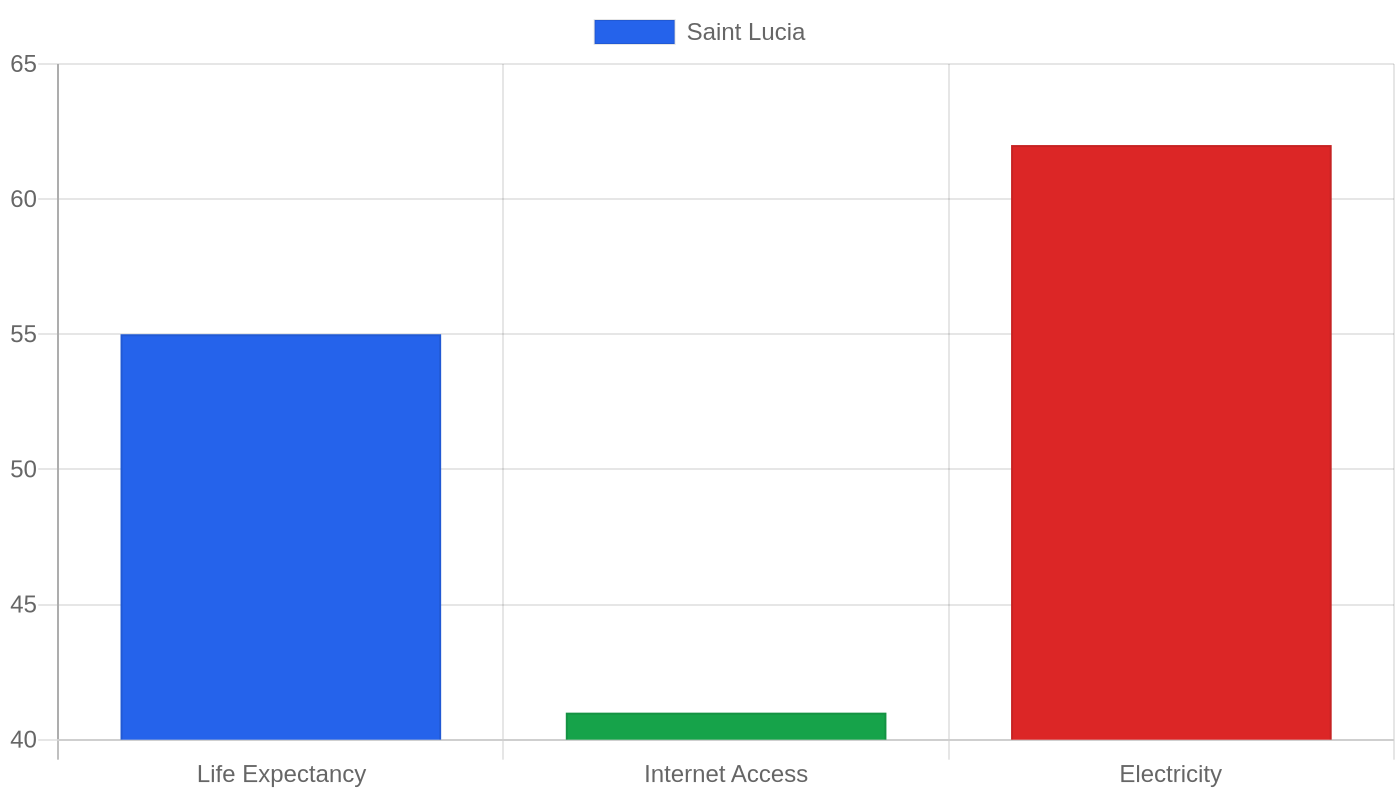
Economic Pulse Net | Sources: World Bank World Development Indicators, Government Sources | 2026
Key Takeaways
– Saint Lucia’s economy is anchored by a sophisticated financial services sector, with three of its top four companies being banks or financial holding firms.
– As a Commonwealth realm and constitutional monarchy, the island maintains strong institutional stability under Prime Minister Philip J. Pierre.
– The country operates within the Eastern Caribbean Currency Union, providing monetary stability through a shared regional central bank framework.
– Saint Lucia Electricity Services (LUCELEC) holds a strategic position as the sole electricity provider, making energy infrastructure a critical economic lever.
– The island’s parliamentary system, with 17 elected seats in the House of Assembly, ensures regular democratic accountability through plurality-based elections.
The Quiet Machinery of a Services-Driven Economy
When economists look at Saint Lucia, they see more than a postcard-perfect Caribbean destination. The World Bank’s data framework reveals a nation that has deliberately positioned itself as a regional hub for financial services and utilities—two sectors that generate high-value employment and steady revenue streams.
While headline GDP figures and inflation data are not currently available through the World Bank’s latest reporting cycle, the composition of the island’s corporate landscape tells a compelling story about where economic value concentrates.
The dominance of financial institutions—1st National Bank of St Lucia, Bank of Saint Lucia, and Eastern Caribbean Financial Holding Company—indicates a mature banking sector that serves both domestic needs and regional clients. This is not accidental. Saint Lucia has invested heavily in legal and regulatory frameworks that support offshore banking, international financial services, and wealth management.
For a nation of its size, this represents a deliberate pivot away from reliance on traditional agriculture toward knowledge-based and capital-intensive industries.
The presence of St. Lucia Electricity Services among the top companies underscores another economic reality: infrastructure utilities are foundational to growth. Electricity generation, transmission, and distribution form the backbone of any modern economy, and LUCELEC’s prominence suggests that energy policy will remain central to Saint Lucia’s development strategy.
When businesses evaluate the island as an investment destination, they look at the reliability and cost of power, and LUCELEC’s performance directly shapes that calculus.
Inflation and unemployment data remain unmeasured in the current World Bank reporting window, but the structural composition of the economy—high-value services, regulated utilities, and a stable banking sector—suggests a resilience that purely tourism-dependent Caribbean nations often lack. The financial sector provides white-collar employment, while the utility sector ensures that the infrastructure required for business continuity remains operational.
Housing and Daily Life: The Cost of Paradise
For residents and expatriates alike, the cost of living in Saint Lucia carries a premium that reflects its island geography. Nearly everything—from construction materials to food imports—must be transported across the sea, and those logistics costs inevitably translate into higher consumer prices. Housing in desirable coastal areas commands particularly strong demand, driven by both local professionals in the financial sector and international buyers seeking second homes or retirement properties.
The rental market in Castries, the capital, and tourist hubs like Rodney Bay operates on a different plane than rural inland areas. Young professionals entering the banking sector often find that a significant portion of their income goes toward rent, making homeownership an aspirational goal rather than an immediate reality. The banking sector’s strength, however, means that mortgage products are readily available, and local banks compete to offer financing to creditworthy borrowers.
Daily expenses for food, transportation, and utilities reflect the island’s import dependency. Electricity costs, in particular, can be a sensitive topic for households, given LUCELEC’s monopoly position. While this arrangement ensures grid stability, it also means consumers have limited alternatives when global fuel prices fluctuate.
The broader regional context suggests that Caribbean island nations typically experience living costs 20-30% higher than comparable mainland territories, and Saint Lucia follows this pattern.
Banking, Energy, and the Business Climate
Investors looking at Saint Lucia will find a business environment shaped by two dominant forces: a sophisticated financial regulatory framework and a utility sector with entrenched market positions. The three banking entities that rank among the top companies are not merely local players—they are regional institutions with reach across the Eastern Caribbean. This gives Saint Lucia an outsize influence in regional finance that belies its physical size.
The Eastern Caribbean Financial Holding Company, in particular, represents an interesting model of regional financial integration. By consolidating banking operations across multiple islands, it creates economies of scale that individual small nations could not achieve independently. For international investors, this means access to a broader market through a single institutional relationship.
The energy sector presents both challenges and opportunities. LUCELEC’s status as the sole electricity provider makes it a critical partner for any business establishing operations on the island. However, this concentration also creates openings for renewable energy investment. Solar, wind, and geothermal projects could potentially disrupt the traditional utility model, offering lower long-term costs and greater environmental sustainability.
Forward-looking investors are watching this space closely, as Caribbean nations increasingly seek to reduce their dependence on imported fossil fuels.
Governance, Safety, and the Quality of Life Equation
Saint Lucia’s political system is a study in institutional continuity. As a Commonwealth realm, the island recognizes Charles III as its monarch, represented on the ground by Governor-General Errol Charles. This arrangement provides a layer of constitutional stability that many newer nations lack. The actual business of government, however, rests with Prime Minister Philip J. Pierre and his cabinet, drawn from the majority party in the 17-seat House of Assembly.
The plurality-based electoral system ensures that representatives are directly accountable to their constituents, and the small size of the legislature means that each member carries significant responsibility for their district’s welfare. This intimacy between voters and representatives is a distinctive feature of Caribbean parliamentary democracy—citizens often have direct access to their elected officials in ways that are impossible in larger nations.
Crime and safety indices are not currently available for Saint Lucia, but the country’s social fabric is generally characterized by strong community ties and a relaxed pace of life. Like many Caribbean nations, the island faces challenges related to drug trafficking and petty crime, but violent crime rates remain lower than in many urban centers worldwide.
The financial sector’s prominence does raise security considerations, and local banks invest substantially in protective measures for their operations and clients.
Current Affairs: Navigating a Changing Regional Landscape
Right now, Saint Lucia is at something of an inflection point. The global shift toward digital financial services is reshaping the banking landscape, and the island’s established institutions are adapting to new realities. Cryptocurrency regulation, fintech innovation, and cross-border payment systems are all topics of active discussion among policymakers and business leaders in Castries.
The energy transition is also accelerating. With global pressure to reduce carbon emissions, Saint Lucia faces both pressure and opportunity to modernize its electricity grid. LUCELEC’s traditional monopoly model is being questioned as renewable energy technologies become more cost-competitive, and the government is exploring ways to diversify the energy mix without compromising grid reliability.
Tourism, while not listed among the top companies, remains a vital undercurrent in the economy. The island’s reputation as a luxury destination supports the financial sector by attracting high-net-worth visitors who may later become investors or residents. The interplay between tourism, finance, and energy will define Saint Lucia’s economic trajectory over the coming years.
The Bottom Line
Saint Lucia is a nation that has successfully built a services-driven economy on a small-island base, leveraging its financial sector and utility infrastructure to punch above its weight regionally. Investors should watch this country for opportunities in banking, renewable energy, and regional financial integration. For travelers and expatriates, the island offers a stable political environment and a quality of life that balances modern amenities with Caribbean charm.
The absence of current macroeconomic data points makes precise forecasting difficult, but the structural strengths of the economy provide reasonable grounds for cautious optimism.
Sources & Methodology
This article is authored by Economic Pulse Net for informational and research purposes. Economic Pulse Net sources its data from multilateral institutions, national statistics bureaus, and proprietary databases. All data is believed to be current as of the date of publication.
Published: August 25, 2026 | Category: Research — Saint Lucia
Use these signals in your own platform
Economic Pulse publishes its live signal feed through a documented, read-only API. Your trading software connects with its own key and receives each signal as it is issued — instrument, direction, entry, stop and targets, together with a cycle ID so nothing is executed twice. The feed is independent of this website and cannot change it.
Signals are informational only and are not financial advice.