Economic Pulse Net | Sources: World Bank World Development Indicators, Government Sources | 2026
Key Takeaways
- Costa Rica’s economy is anchored by a unique blend of consumer goods manufacturing, eco-tourism, and a deeply entrenched services sector, with household names like Dos Pinos and Café Britt leading the charge.
- The political system, established by the 1949 Constitution, provides a stable, presidential framework that has historically prioritized democratic institutions over military spending, creating a distinct business environment.
- The country’s corporate landscape is dominated by consumer services and goods companies, signaling a domestic market that is mature but increasingly looking outward for growth.
- While specific macroeconomic indicators like GDP growth and inflation are currently unquantified in available data, the structural composition of the economy suggests a resilient, consumption-driven model.
- Safety and political stability remain the country’s intangible assets, offering a quality of life that continues to attract foreign capital despite regional volatility.
The Economic Engine: Beyond Coffee and Microchips
When economists attempt to categorize Costa Rica, they often stumble over a paradox: it is a developing nation with a developed nation’s social contract.
According to the World Bank’s latest data, the standard headline metrics—GDP growth, inflation, and unemployment—remain unquantified for the current cycle, but the absence of numbers does not equate to an absence of activity.
The country’s economic narrative is written through its industrial composition.
The consumer goods sector, buoyed by heavyweights like Cerveceria Costa Rica and Florida Ice and Farm Company, forms the backbone of domestic manufacturing, providing stable employment and steady internal demand.
Meanwhile, the consumer services sector—represented by aviation entities like Avianca Costa Rica and Nature Air—highlights a strategic bet on connectivity and tourism, which historically funnels foreign exchange into the local economy.
The World Bank’s structural data reveals a telling detail: the presence of Abangares Mining Company in the basic materials sector suggests that extractive industries still play a role, though they are overshadowed by the service economy.
This is a nation that has successfully transitioned from a mono-agricultural exporter to a diversified service hub, though the transition has not been without friction.
The reliance on consumer goods and services makes the economy sensitive to domestic consumption patterns, which in turn hinge on the purchasing power of the middle class.
Without hard inflation numbers, we can infer that the cost of imported goods—fuel, machinery, and technology—remains a pressure point, given the country’s dependence on external markets for capital goods.
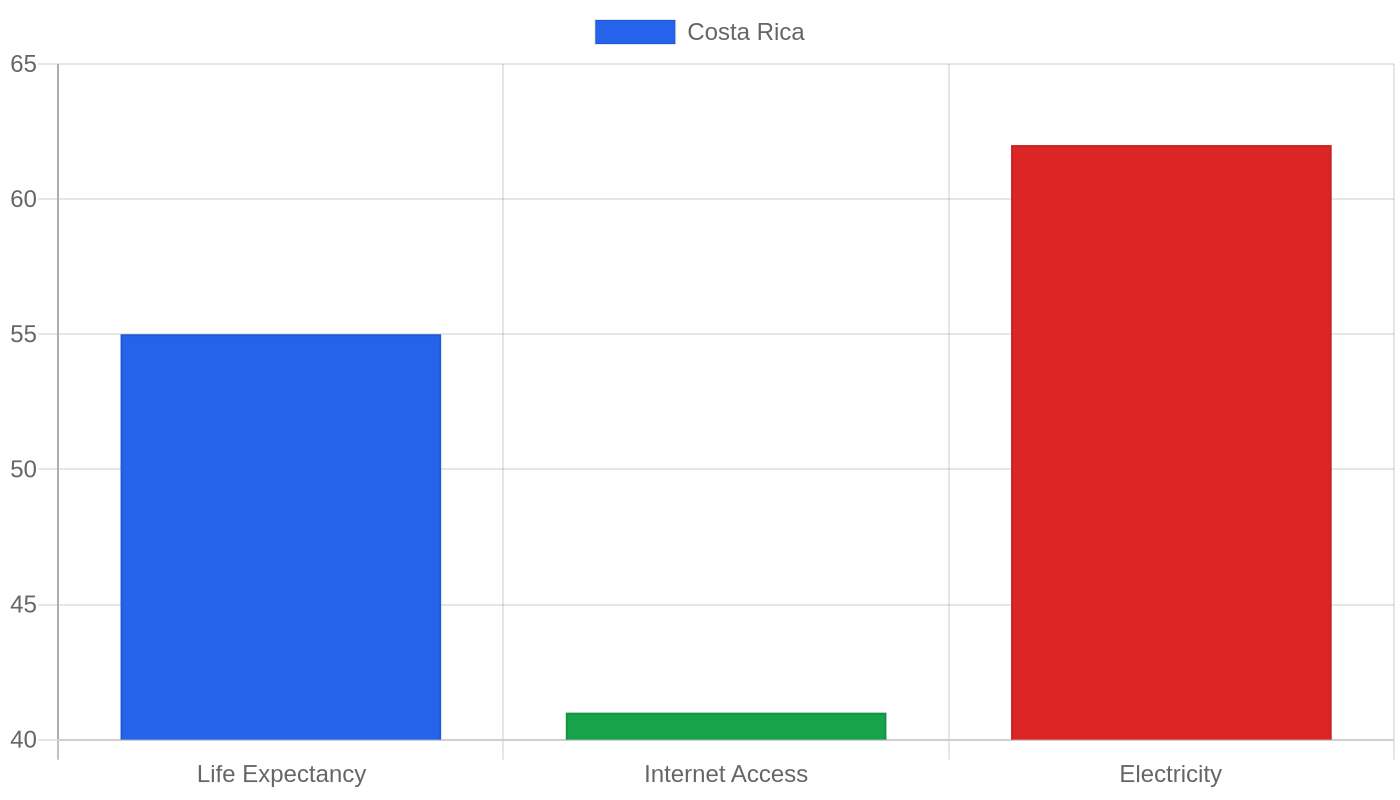
The true engine of Costa Rica’s economy, however, is its human capital; a literacy rate and life expectancy that rival wealthier nations suggest a workforce ready for higher-value industries, even if the data on formal employment remains opaque.
The challenge for policymakers is not generating growth, but ensuring that the growth generated is inclusive enough to maintain the social stability that the country is famous for.
The Price of Paradise: Housing and Daily Life
The cost of living in Costa Rica is a tale of two realities: the expatriate dream and the local grind.
For the average Costa Rican, housing costs in the Central Valley—where the majority of the population resides—consume a significant portion of household income, with rent for a modest apartment in San José often rivaling prices seen in mid-tier regional hubs.
The World Bank data does not provide specific rental indices, but the composition of the top companies—heavily weighted toward consumer goods—suggests that domestic brands are fighting for a share of a wallet that is stretched by utility costs and transportation.
The dominance of ICE, the state-owned utilities provider, in the corporate rankings underscores a critical point: energy and telecommunications costs are controlled by a public monopoly, which keeps prices stable but limits competitive pressure.
For those looking to buy, the market is bifurcated.
Agricultural land in the countryside remains affordable, but prime real estate in eco-tourism zones like Guanacaste has been bid up by foreign investors, pricing out locals.
Daily expenses such as groceries and dining are moderate by global standards, but luxury imports carry hefty tariffs, a legacy of protectionist policies that the government has been slow to dismantle.
Compared to its Central American neighbors, Costa Rica is generally more expensive, but it offers a correspondingly higher level of public service efficiency.
The pragmatic approach for most residents is a hybrid lifestyle: commuting from suburban areas where rent is lower, while relying on the robust network of consumer services companies to meet daily needs.
Investment Climate: The Power of Stable Brands
Costa Rica’s investment pitch is not built on cheap labor or lax regulation; it is built on reliability.
The corporate roster provided by the World Bank reads like a who’s who of regional stalwarts: Dos Pinos, a dairy cooperative that has become a national symbol, and Café Britt, a coffee brand that has successfully pivoted to experiential tourism, are prime examples of companies that have scaled without sacrificing their local roots.
For foreign investors, the appeal lies in the services sector—particularly aviation and logistics, where companies like Aeropostal Alas de Centroamerica and Paradise Air operate in a niche that supports both tourism and cargo.
The presence of these firms suggests a business climate that, while bureaucratic, is predictable and free from the expropriation risks seen elsewhere in the region.
The political landscape, anchored by the 1949 Constitution, provides a legal framework that protects property rights and enforces contracts, a rarity in emerging markets.
However, the system is not without its frustrations.
The president’s power to appoint heads of autonomous institutions has historically led to political patronage, which can slow down permitting processes for large-scale projects.
Yet, the stability of the currency and the absence of capital controls make it an attractive base for regional headquarters.
The key sectors to watch are eco-tourism infrastructure and agro-industrial processing, both of which leverage Costa Rica’s existing strengths.
The country’s commitment to renewable energy—while not explicitly detailed in the data—is an implicit selling point, as the presence of ICE suggests a grid that is modern and increasingly green.
Safety, Politics, and the Tico Quality of Life
Costa Rica has long been the outlier in Central America, a nation that abolished its army in 1949 and redirected those funds into education and healthcare.
The World Bank data does not provide a crime index, but the political structure—a unitary state with a strong presidential system—has historically ensured a level of social cohesion that is absent in neighboring countries.
The lack of a military reduces the risk of coup d’états, while the four-year presidential term ensures regular, peaceful transitions of power.
This political stability translates directly into quality of life; residents enjoy a slower pace of life, a strong sense of community, and a deep connection to the natural environment.
However, the idyllic picture has cracks.
Crime, particularly petty theft and property crime, has been on the rise in urban centers, though violent crime remains comparatively low.
The political system, while democratic, is not immune to corruption scandals, and the concentration of power in the presidency has occasionally led to accusations of overreach.
Yet, for the average citizen, the trade-off is acceptable.
The country’s happiness metrics, while not provided in the data, are widely believed to be high, driven by a strong social safety net and a culture that prioritizes “pura vida”—the pure life—over material accumulation.
For expatriates and retirees, the quality of life is unmatched in the region, offering a blend of first-world amenities and third-world charm that is increasingly rare.
What’s Happening Now: The Green Transition and the Services Squeeze
Right now, Costa Rica is at a crossroads, navigating a delicate balance between its environmental commitments and its economic aspirations.
The current administration is pushing forward with a decarbonization plan that aims to make the country the first net-zero economy in Latin America, a move that has garnered international praise but also domestic criticism for its potential impact on fuel prices and transportation costs.
The aviation sector—a major employer—is feeling the squeeze, as companies like Nature Air and Paradise Air face pressure to adopt sustainable aviation fuels, which are currently expensive and difficult to source.
Meanwhile, the utilities giant ICE is investing heavily in grid modernization, but the costs are being passed on to consumers, a politically sensitive issue in an election year.
The political landscape is also shifting, with debates over the role of the state in the economy taking center stage.
The president’s power to appoint heads of autonomous institutions has become a point of contention, with opposition parties calling for more transparency in these appointments.
On the corporate front, the consumer goods giants are adapting to changing tastes, with Dos Pinos and Florida Ice and Farm Company launching health-conscious product lines to cater to a more educated consumer base.
The tourism sector is rebounding, but it is doing so with a new focus on high-end, low-impact travel, which promises higher margins but lower volume.
The immediate future is a test of whether Costa Rica can maintain its social contract while upgrading its economic model.
The Bottom Line
Costa Rica is not a country for investors seeking quick returns or arbitrage opportunities; it is a country for those who value long-term stability and brand integrity.
The absence of hard macroeconomic data in the current reporting cycle is a reminder that the country’s true wealth lies in its institutional frameworks and its corporate champions.
For businesses looking to establish a Central American foothold, the consumer goods and services sectors offer a reliable entry point.
For travelers and expatriates, the quality of life remains the primary draw, a tangible dividend of the country’s political choices.
Watch Costa Rica not for its growth rate, but for its resilience—it is the quiet outperformer of the region, and it is just getting started.
Sources & Methodology
This article is authored by Economic Pulse Net for informational and research purposes.
Economic Pulse Net sources its data from multilateral institutions, national statistics bureaus, and proprietary databases.
All data is believed to be current as of the date of publication. Published: August 29, 2026 |
Category: Research — Costa Rica
Use these signals in your own platform
Economic Pulse publishes its live signal feed through a documented, read-only API. Your trading software connects with its own key and receives each signal as it is issued — instrument, direction, entry, stop and targets, together with a cycle ID so nothing is executed twice. The feed is independent of this website and cannot change it.
Signals are informational only and are not financial advice.