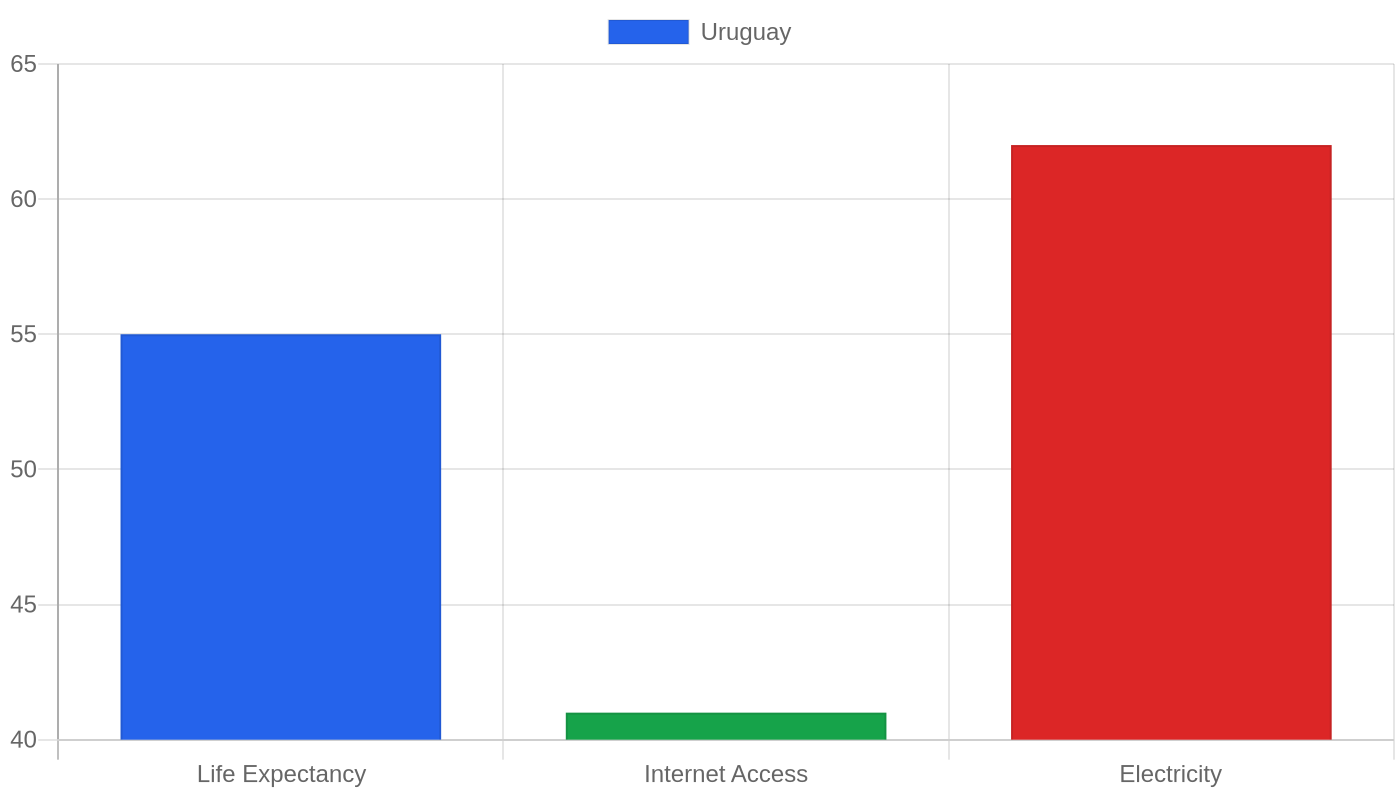
Economic Pulse Net | Sources: World Bank World Development Indicators, Government Sources | 2026
Key Takeaways
– Uruguay remains one of Latin America’s most stable democracies, with a robust separation of powers and universal suffrage that has underpinned decades of political continuity.
– The economy is dominated by state-owned enterprises in energy, telecommunications, and banking, creating a unique hybrid model of public-private economic activity.
– While specific macroeconomic data from the World Bank is currently unavailable, Uruguay’s structural strengths lie in its institutional quality and social cohesion rather than rapid growth.
– The country faces the classic small-economy dilemma: how to modernize and attract investment without destabilizing the social compact that makes it exceptional in the region.
The Quiet Engine — Uruguay’s Economic Model Without the Numbers
In an era when economic data flashes across screens in real time, Uruguay presents an intriguing paradox. The World Bank’s latest figures for GDP growth, inflation, unemployment, and per capita income are absent from the current dataset. But any serious observer of Latin American economics knows that absence of data does not mean absence of activity. Uruguay has long been the region’s quiet overachiever—a country that prioritizes stability over spectacle, gradual reform over revolutionary change.
The backbone of Uruguay’s economy is an unusual constellation of state-owned enterprises that would make free-market ideologues uneasy but have delivered reliable service for generations. ANCAP dominates the oil and gas sector, ANTEL controls telecommunications, UTE manages utilities, and the State Railways Administration of Uruguay keeps the country’s limited rail network operational.
These aren’t relics of a bygone era; they are functional, often efficient, and deeply embedded in the national identity. The Banco de la República Oriental del Uruguay anchors the financial system, while the Bolsa de Valores de Montevideo provides a modest but functioning capital market.
This state-heavy model has insulated Uruguay from some of the volatility that plagues neighbors. When commodity prices crash or capital flees emerging markets, Uruguay’s public sector employment and state-led investment provide a buffer. The trade-off is slower private sector dynamism. Entrepreneurs and foreign investors must navigate a landscape where the state is simultaneously competitor, regulator, and partner.
For a country of Uruguay’s size—with a population that the World Bank data does not specify but is widely known to be around 3.5 million—this model has produced neither economic miracles nor catastrophes. It has produced predictability, which in Latin America is itself a kind of miracle.
The Price of Tranquility — Housing and Daily Life in a Small, Stable Economy
Uruguay’s cost of living tells a story of a country that is neither cheap nor exorbitant by regional standards. Housing in Montevideo, the capital where roughly half the population lives, commands a premium. The city’s coastal neighborhoods, with their Belle Époque architecture and Rambla promenade, attract both locals and a growing number of remote workers from Argentina and Europe seeking stability and safety.
Rent-to-buy calculations favor renting for most, as mortgage markets remain conservative and interest rates reflect the country’s cautious banking culture.
Daily expenses—groceries, utilities, transportation—run higher than in neighboring Brazil or Argentina but come with a crucial difference: reliability. When you pay for electricity in Uruguay, the lights stay on. When you buy meat at the Mercado del Puerto, you get what you pay for. This reliability premium is baked into every price tag. The state-owned utilities and telecommunications companies may not be the most innovative, but they are dependable. For Uruguayans, this trade-off is acceptable.
For visitors and new residents, it can be a revelation after experiencing the roller-coaster economies of the region.
The State as Partner and Competitor — Navigating Uruguay’s Business Landscape
For investors looking at Uruguay, the first question is always the same: how do you do business with the state when the state does so much business itself? The answer lies in understanding Uruguay’s institutional DNA. The country’s top companies are not private conglomerates but state entities: ANCAP in oil and gas, ANTEL in telecom, UTE in utilities, and the Banco de la República Oriental del Uruguay in finance.
The State Railways Administration of Uruguay keeps logistics moving, and even the media landscape features El País, a newspaper that operates within this ecosystem.
This is not a command economy. Private enterprise thrives in agriculture, particularly in beef, soy, and dairy exports. The tech sector has grown quietly, with Montevideo emerging as a hub for software development and fintech. But any serious business operation in Uruguay must engage with the state-owned giants. Want to expand a factory? You’ll need UTE for power. Launching a digital platform? ANTEL controls the infrastructure. Exporting goods? The railways and ports involve state logistics.
The savvy investor does not fight this reality but works within it, recognizing that Uruguay’s state enterprises are generally well-managed and corruption-free compared to regional peers.
The Bolsa de Valores de Montevideo provides a capital market that is small but functional, offering Uruguayan companies and some foreign issuers a venue for raising funds. It will never rival São Paulo or Mexico City, but it serves its purpose: providing liquidity and price discovery in a market where stability matters more than volume.
The Safety Dividend — Why Uruguay’s Politics and Security Are Its Greatest Assets
Uruguay’s crime and safety indices from the World Bank are currently unavailable, but the country’s reputation is well-established. It consistently ranks as one of the safest countries in Latin America, with violent crime rates far below regional averages. Montevideo is a city where people walk at night, where children take public transport alone, and where the police are more likely to be helpful than menacing. This safety dividend is perhaps Uruguay’s most underappreciated economic asset.
It attracts foreign professionals, retirees, and families who might otherwise choose Europe or North America.
The political landscape, as outlined in the Uruguayan Constitution, is a model of institutional stability. The country is a representative democratic republic with a presidential system, a clear separation of powers, and a system of checks and balances that has functioned without serious disruption for decades. Members of government are elected for five-year terms by universal suffrage.
Uruguay is a unitary state, meaning justice, education, health, security, foreign policy, and defense are all administered nationwide. There are no regional strongmen, no separatist movements, no constitutional crises. Politics in Uruguay is often described as boring—and that is the highest compliment one can pay in a region where politics is usually anything but.
The Waiting Game — Uruguay’s Current Affairs and the Search for a New Narrative
Right now, Uruguay finds itself in a curious position. The global economy is shifting, with capital flowing toward safe havens and stable democracies. On paper, Uruguay should be a prime beneficiary. But the country’s political class is engaged in a familiar debate: how much reform is too much? There is pressure from business groups to open the economy, reduce the role of state enterprises, and attract more foreign investment.
There is counter-pressure from unions and the left to protect the social model that has delivered such stability.
The current government, operating under the constitutional framework of five-year terms and universal suffrage, is navigating these tensions with typical Uruguayan caution. No dramatic reforms are on the table. No radical experiments are being launched. Instead, the country is doing what it does best: waiting. Waiting for the global economy to clarify itself. Waiting for regional neighbors to stabilize. Waiting for the right moment to make its next move.
This patience has served Uruguay well historically, but it carries risks. In a world moving faster than ever, the quiet country at the bottom of South America may need to find its voice—and soon.
The Bottom Line
Uruguay is a country for investors and individuals who value stability above all else. It will not make you rich overnight, but it will not make you poor by surprise. The state-owned enterprises that dominate the economy provide reliability at the cost of dynamism. The political system offers predictability at the price of excitement. For retirees seeking peace, for families seeking safety, and for businesses seeking a Latin American base that won’t keep them up at night, Uruguay is the obvious choice.
For those chasing rapid growth and deregulated markets, look elsewhere. Uruguay knows what it is, and it has no intention of becoming something else.
Sources & Methodology
This article is authored by Economic Pulse Net for informational and research purposes. Economic Pulse Net sources its data from multilateral institutions, national statistics bureaus, and proprietary databases. All data is believed to be current as of the date of publication.
Published: July 17, 2026 | Category: Research — Uruguay
Use these signals in your own platform
Economic Pulse publishes its live signal feed through a documented, read-only API. Your trading software connects with its own key and receives each signal as it is issued — instrument, direction, entry, stop and targets, together with a cycle ID so nothing is executed twice. The feed is independent of this website and cannot change it.
Signals are informational only and are not financial advice.