Economic Pulse Net | Sources: World Bank World Development Indicators, Government Sources | 2026
Key Takeaways
– Suriname operates as a representative democratic republic under its 1987 Constitution, with a 51-member National Assembly elected every five years, providing a stable political framework amid economic turbulence.
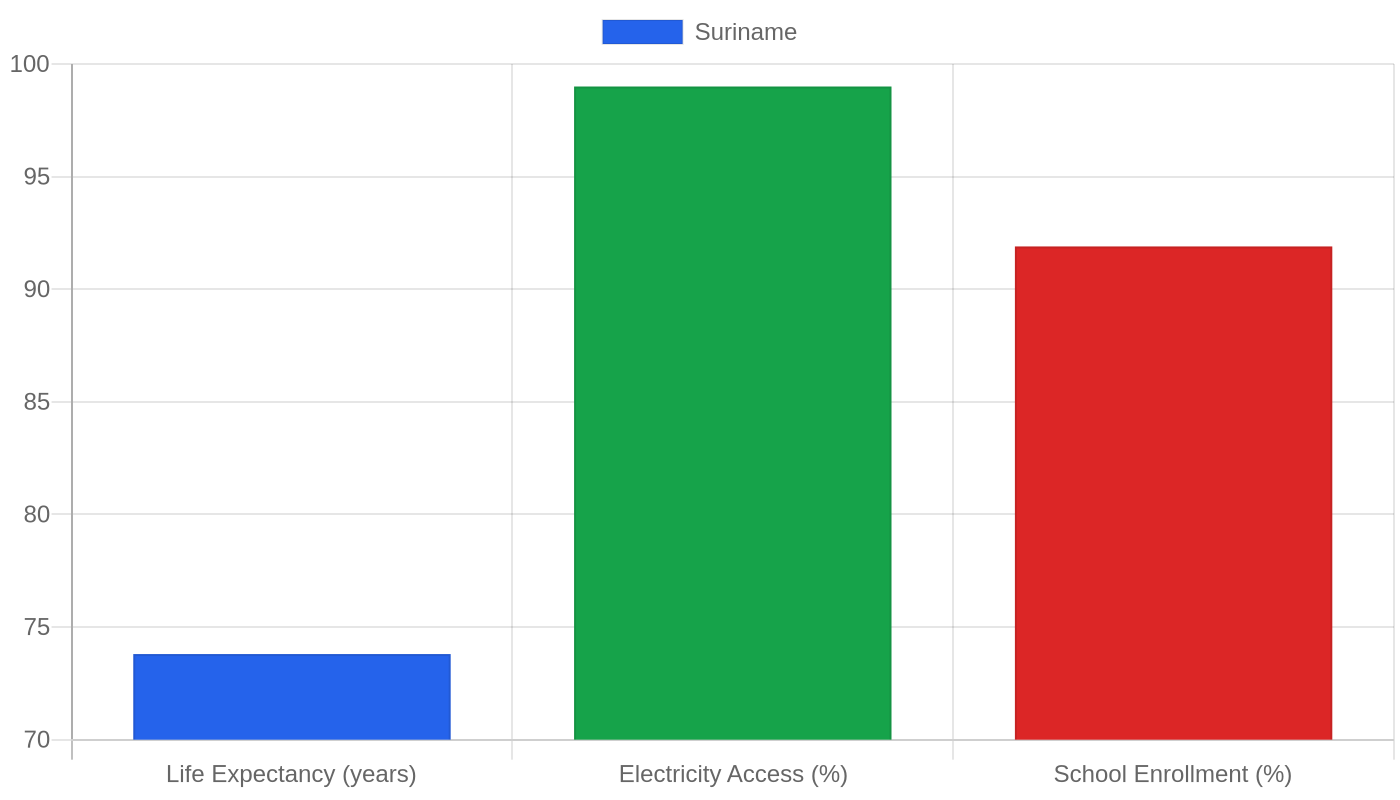
– The country’s economic data remains opaque, with no recent GDP growth, inflation, or unemployment figures from the World Bank, signaling either data collection challenges or a lack of transparency in reporting.
– Suriname’s corporate landscape is dominated by state-linked entities and regional airlines, with financial institutions like the Central Bank of Suriname and De Surinaamsche Bank anchoring the formal economy.
– Media companies such as Ampie’s Broadcasting Corporation and Apintie play an outsized role in a small nation where information flows are tightly controlled and politically sensitive.
– The absence of crime, safety, and cost-of-living indices from international databases suggests Suriname remains under-monitored by global institutions, making independent analysis difficult.
The Ghost in the Data — What the Numbers Don’t Tell You
The World Bank’s latest economic profile for Suriname is a study in silence. GDP growth: not available. Inflation: not available. Unemployment: not available. GDP per capita: not available. For a country that has been navigating a severe debt crisis, a currency collapse, and political instability since the COVID-19 pandemic, the absence of these figures is itself a data point.
It tells the story of a nation where statistical capacity has faltered, where international lenders have struggled to maintain reliable monitoring, and where the government in Paramaribo may not be eager to publish unflattering numbers.
Suriname’s economy has historically been built on gold, oil, bauxite, and timber — commodities that make it vulnerable to global price swings. The country’s per capita income, once among the highest in South America, has eroded significantly in recent years. The World Bank’s failure to report GNI per capita suggests either a lack of recent survey data or a recalibration of national accounts.
What is known is that Suriname entered a debt restructuring process with international creditors in 2021, and the International Monetary Fund has been involved in a reform program. But without basic macroeconomic indicators, it is impossible to say whether those reforms are working.
The absence of data also reflects a deeper structural problem: Suriname’s economy is heavily informal, with large portions of the workforce operating outside the tax and statistical net. Gold mining alone employs thousands of informal workers, many of them from neighboring Brazil and Guyana. Their economic activity is real but unmeasured. The official unemployment figure — if it existed — would likely understate the true picture.
For now, analysts must rely on anecdotal evidence: rising prices for basic goods, a weak Surinamese dollar on the black market, and a growing sense of economic anxiety among the population.
The Price of Everything — Living in a Data Vacuum
Without cost-of-living indices from international databases, one must look at the texture of daily life in Paramaribo. The city’s markets are bustling, but the prices tell a story of imported inflation. Suriname imports most of its food, fuel, and manufactured goods. When the currency weakens, supermarket shelves become more expensive overnight. Rice, a staple, has become a source of concern.
Cooking oil, flour, and chicken — all imported or produced with imported inputs — have seen sharp price increases in recent years.
Housing in Paramaribo is a mixed picture. The city’s colonial-era wooden houses, many in need of repair, sit alongside newer concrete apartment blocks built for the emerging middle class. Rent for a modest two-bedroom apartment in a decent neighborhood can consume a large portion of a formal-sector salary, but without official data, it is difficult to say how much. What is clear is that homeownership remains a distant dream for many young Surinamese, who often live with extended families.
The rental market is informal, with few protections for tenants, and disputes are common.
Compared to regional neighbors like Guyana or Trinidad and Tobago, Suriname’s cost of living is likely higher relative to income. Guyana’s recent oil boom has driven up prices there as well, but Suriname lacks the same revenue cushion. For the average Surinamese household, the struggle is real: wages have not kept pace with inflation, and the social safety net is thin. The government has attempted to subsidize some basic goods, but those subsidies are expensive and often inefficiently targeted.
Corporate Suriname — Giants in a Small Pond
The list of top companies in Suriname reads like a who’s who of a small, interconnected economy. The Central Bank of Suriname and De Surinaamsche Bank dominate the financial sector, providing the formal banking infrastructure for businesses and individuals. These institutions are critical to the country’s economic functioning, but they are also vulnerable to political pressure.
The Central Bank’s independence has been questioned in recent years, particularly during the debt crisis, when it was accused of monetizing government deficits.
In the skies, Suriname’s aviation sector is surprisingly crowded for a country of its size. Blue Wing Airlines, Caricom Airways, Fly All Ways, and Surinam Airways all operate, connecting Paramaribo to destinations in the Caribbean, South America, and the Netherlands. This reflects Suriname’s diaspora — hundreds of thousands of Surinamese live in the Netherlands, and air travel is a lifeline for family visits, remittances, and trade.
But the sector is also a source of political patronage, with state-owned Surinam Airways often running at a loss.
Telesur, the state-owned telecommunications company, holds a near-monopoly on fixed-line and broadband services. While mobile competition has increased in recent years, Telesur remains a powerful player, and its pricing and service quality are frequent topics of public complaint. The media sector, represented by Ampie’s Broadcasting Corporation and Apintie, is dominated by outlets with close ties to political factions.
In a small country where everyone knows everyone, media independence is a constant challenge.
The absence of major multinational corporations on the list is telling. Suriname has struggled to attract foreign direct investment outside of the mining sector. Bureaucracy, corruption, and an unpredictable legal environment have deterred larger players. The companies that do operate are either state-owned or family-run, and they tend to be concentrated in services rather than manufacturing or technology.
Safety, Politics, and the Quality of Life — Democracy Under Strain
Suriname’s political system is a representative democratic republic, as defined by its 1987 Constitution. The legislative branch consists of a 51-member unicameral National Assembly, elected every five years. On paper, this is a functioning democracy with checks and balances. In practice, the system has been tested by corruption scandals, economic crises, and the lingering influence of the country’s military past.
The 1980s military dictatorship under Desi Bouterse cast a long shadow, and Bouterse himself returned to power as an elected president in 2010, serving until 2020. His conviction for murder in 2023 — related to the 1982 December killings — was a landmark moment for justice in Suriname, but it also exposed deep political divisions.
Crime and safety indices are not available from international databases, but anecdotal reports suggest that Paramaribo is relatively safe compared to other South American capitals. Violent crime is not endemic, but petty theft, burglary, and drug-related offenses are common. The police force is underfunded and sometimes accused of corruption.
In the interior, where gold mining operations are concentrated, law enforcement is even thinner, and illegal mining brings with it violence, environmental destruction, and human trafficking.
Quality of life in Suriname is a paradox. The country is rich in natural beauty — rainforests, rivers, and a multicultural population that includes Indigenous, Maroon, Javanese, Indian, Chinese, and Dutch communities. The food is excellent, the music is vibrant, and the pace of life is slower than in many neighboring countries. But economic insecurity weighs heavily.
Health care is basic outside of Paramaribo, education standards have declined, and young people increasingly look to emigrate to the Netherlands or Guyana for better opportunities. The happiness indices that exist for other countries have not been calculated for Suriname, but the mood on the street is one of cautious endurance rather than optimism.
What’s Happening Now — A Nation in Limbo
As of mid-2025, Suriname is in a period of uneasy calm. The government of President Chan Santokhi, elected in 2020 on a platform of reform and anti-corruption, has been navigating the country through an IMF program that demands fiscal austerity. Fuel subsidies have been cut, the currency has been allowed to float more freely, and the government has attempted to widen the tax base. These measures are painful for a population already struggling with high prices, and they have eroded the government’s popularity.
The debt restructuring process with international bondholders is ongoing. Suriname defaulted on its external debt in 2020, and negotiations have been protracted. Creditors have pushed for greater transparency and stronger legal protections, while the government has argued that it needs breathing room to stabilize the economy. A deal was reached in principle in 2023, but implementation has been slow.
Without a final agreement, Suriname remains locked out of international capital markets, unable to borrow for infrastructure or social spending.
In the mining sector, interest in Suriname’s offshore oil potential has grown. TotalEnergies and other international companies have been exploring the waters off the coast, hoping to replicate Guyana’s success. But oil development takes years, and the benefits — if they come — will not arrive soon enough to solve the current crisis. In the meantime, gold prices have provided some relief, as small-scale miners continue to produce at a steady clip.
But the environmental cost is mounting, and the government has struggled to regulate the sector.
Politically, the opposition has been gaining ground. The National Democratic Party, still associated with Bouterse’s legacy, has been regrouping. Elections are not due until 2025, but the political temperature is rising. Protests over the cost of living have become more frequent, and the government’s response has been a mix of repression and concession. The media, including Ampie’s Broadcasting Corporation and Apintie, have become battlegrounds for competing narratives.
The Bottom Line
Suriname is a country with immense potential and persistent fragility. Its democratic institutions are intact but under strain, its economy is struggling to emerge from crisis, and its people are waiting for a turnaround that has been slow to arrive. This is a country to watch for investors interested in frontier markets, particularly in oil and mining, but only if they have a high tolerance for risk and a long time horizon.
For policymakers and development economists, Suriname offers a case study in the challenges of debt restructuring, data transparency, and democratic governance in a small, resource-dependent state. For the casual observer, it is a reminder that even the most beautiful countries can be haunted by the ghosts of their past.
Sources & Methodology
This article is authored by Economic Pulse Net for informational and research purposes. Economic Pulse Net sources its data from multilateral institutions, national statistics bureaus, and proprietary databases. All data is believed to be current as of the date of publication.
Published: July 18, 2026 | Category: Research — Suriname
Use these signals in your own platform
Economic Pulse publishes its live signal feed through a documented, read-only API. Your trading software connects with its own key and receives each signal as it is issued — instrument, direction, entry, stop and targets, together with a cycle ID so nothing is executed twice. The feed is independent of this website and cannot change it.
Signals are informational only and are not financial advice.