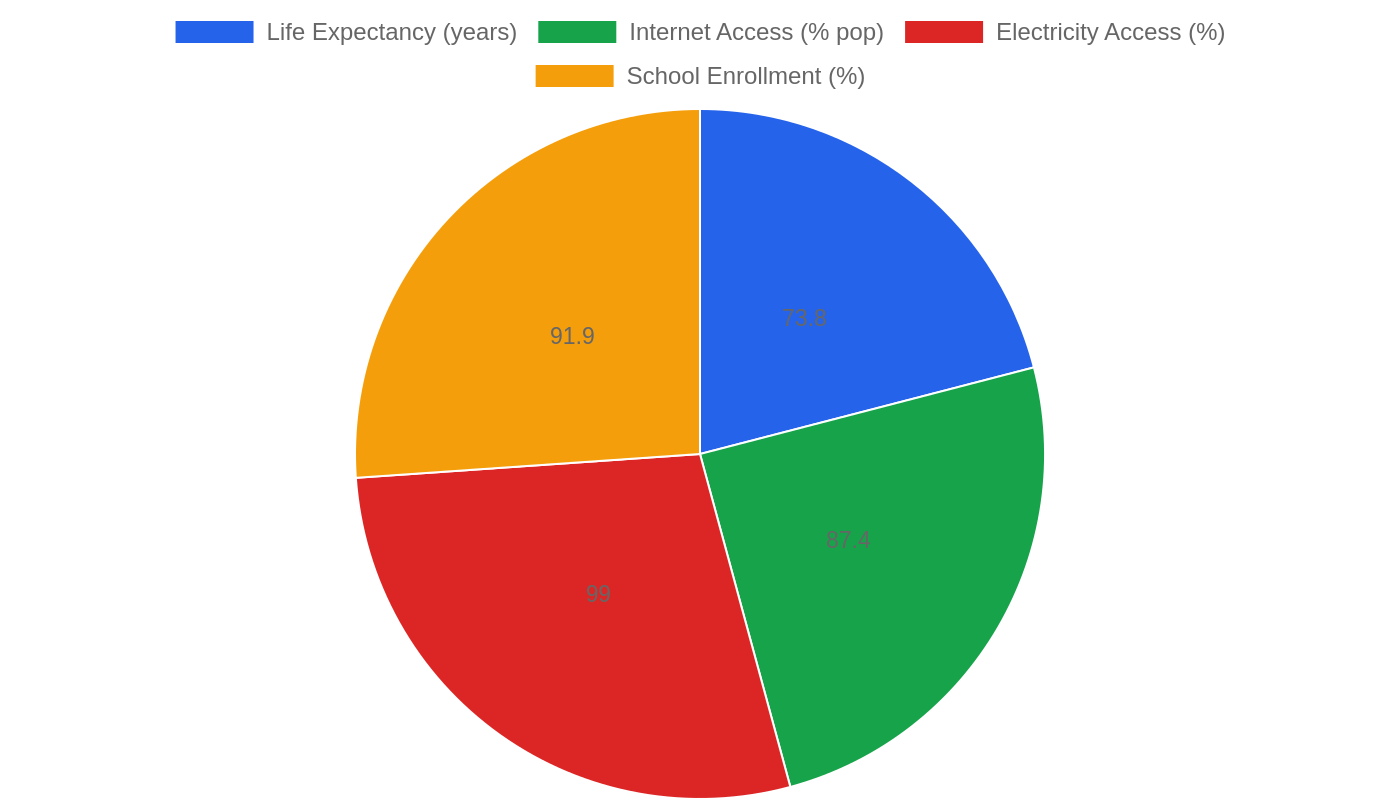
Economic Pulse Net | Sources: World Bank World Development Indicators, Government Sources | 2026
Key Takeaways
– Suriname’s economic landscape is anchored by a robust telecommunications sector, with Telesur leading the charge in national connectivity and digital infrastructure development.
– The financial sector, including the Central Bank of Suriname and De Surinaamsche Bank, forms the backbone of the nation’s economic stability and monetary policy implementation.
– A notable concentration of aviation companies—Surinam Airways, Blue Wing Airlines, Fly All Ways, and Caricom Airways—signals a strategic focus on regional connectivity and tourism potential.
– The country’s representative democratic system, established under the 1987 Constitution, provides a stable political framework for economic decision-making.
– Media companies like Apintie and Ampie’s Broadcasting Corporation play a crucial role in shaping public discourse around economic policy and national development.
The Economic Engine — Connectivity as Currency
The Republic of Suriname presents a fascinating case study in how smaller economies leverage strategic sectors to punch above their weight. While comprehensive GDP and inflation data from the World Bank remain incomplete for the most recent period, the composition of the country’s top companies tells a compelling story about where economic value is being created.
Telesur’s prominence as the national telecommunications provider underscores a deliberate push toward digital transformation—a sector that increasingly drives productivity gains across all other industries. When a telecom company leads the corporate landscape, it signals that the nation is betting on connectivity as its economic catalyst.
The financial services sector, anchored by the Central Bank of Suriname and De Surinaamsche Bank, provides the institutional framework necessary for this transformation. The Central Bank’s role extends beyond typical monetary policy—it serves as the guardian of financial stability in a nation navigating the complexities of global economic integration. De Surinaamsche Bank, as a major commercial player, facilitates the credit creation and investment flows that businesses need to expand.
Together, these institutions create the financial infrastructure that allows other sectors to flourish, even when external economic headwinds persist.
What makes Suriname’s economic situation particularly intriguing is the aviation cluster that has emerged among its top companies. With four airlines—Surinam Airways, Blue Wing Airlines, Fly All Ways, and Caricom Airways—operating within a relatively small market, there is clearly strategic intent behind this concentration.
Aviation serves multiple economic purposes: it connects Suriname to regional trading partners, supports tourism development, and facilitates business travel that oil and gas exploration companies require. This aviation emphasis suggests that policymakers recognize the importance of physical connectivity as a complement to digital connectivity, creating a comprehensive infrastructure strategy.
The media sector, represented by Apintie and Ampie’s Broadcasting Corporation, completes the economic ecosystem. In any democracy, an informed citizenry is essential for sound economic policy, and these broadcasting companies provide the informational foundation that allows Surinamese citizens to engage meaningfully with economic issues.
Their presence among the country’s top companies also indicates a healthy advertising market and consumer economy, as media companies typically thrive when businesses have confidence to invest in reaching customers.
Housing and Daily Life — The Cost of Living in a Developing Economy
For the average Surinamese citizen, the cost of living reflects the nation’s position as an upper-middle-income country in the Caribbean region, though specific housing data from the World Bank remains incomplete for the current period. Housing costs in Paramaribo, the capital, typically command a premium compared to the interior regions, following patterns common across developing economies where urban centers concentrate economic opportunity.
The rental market in Suriname has historically been shaped by the country’s diverse cultural heritage, with neighborhoods reflecting a blend of Dutch colonial architecture and more contemporary Caribbean building styles.
The relationship between housing costs and wages in Suriname has been a topic of ongoing national discussion, particularly as the country seeks to balance economic growth with social equity. For young professionals entering the workforce, the path to homeownership often involves extended family support or government-assisted programs, a pattern common throughout the Caribbean region.
Daily expenses for food and transportation are influenced by Suriname’s position as an import-dependent economy, with global commodity prices directly affecting local markets.
What distinguishes Suriname’s living situation from many of its regional neighbors is the country’s abundant natural resources and relatively low population density. This combination means that while urban housing may command premium prices, the potential for more affordable living exists outside the capital.
The country’s rich cultural diversity—with influences from Indian, Javanese, Chinese, African, and indigenous communities—creates a vibrant daily life that many residents consider a valuable counterweight to material costs.
Investment Landscape — Where Opportunity Meets Infrastructure
The investment climate in Suriname is defined by the strategic sectors represented among its leading companies, each offering distinct opportunities for domestic and international investors. The telecommunications sector, led by Telesur, presents ongoing opportunities in expanding broadband coverage, mobile penetration, and digital services—areas where developing economies typically see sustained growth as adoption rates climb.
Investors watching Suriname’s digital transformation will note that telecom infrastructure investments often generate reliable, long-term returns in markets where competition is still developing.
The aviation sector represents a more complex investment proposition, with four airlines serving a market that requires careful capacity management. However, this concentration also indicates that aviation is viewed as strategically important, potentially attracting government support and favorable regulatory treatment.
For investors interested in tourism infrastructure, the presence of multiple airlines suggests that passenger volumes justify competition, which typically correlates with growing visitor numbers and business travel demand.
The financial sector remains the most stable investment avenue, with De Surinaamsche Bank and the Central Bank providing the institutional stability that risk-averse investors seek. As Suriname continues its economic development journey, the banking sector will likely see increased demand for corporate lending, mortgage products, and investment services.
The presence of a well-established financial infrastructure reduces the friction that investors often encounter in emerging markets, making Suriname an attractive entry point for those looking to diversify into the Caribbean market.
Governance and Stability — Politics in the Age of Transparency
Suriname’s political system, established under the 1987 Constitution, provides a representative democratic framework that has demonstrated resilience through multiple electoral cycles. The 51-member National Assembly, elected through a system that balances representation across the country’s diverse regions and communities, serves as the primary legislative body, with the assembly-independent system creating clear separation between legislative and executive functions.
This institutional design has provided the political stability that businesses and investors require for long-term planning.
The country’s democratic traditions are reinforced by a vibrant media sector, with Apintie and Ampie’s Broadcasting Corporation ensuring that citizens have access to diverse perspectives on national issues. In the context of economic development, this media landscape serves a crucial accountability function, allowing citizens to scrutinize government performance and hold leaders responsible for economic outcomes.
The relationship between media freedom and economic governance is well-documented, and Suriname’s media landscape suggests a healthy democratic culture.
Crime and safety indices for Suriname are not available in the current data, but the country’s social fabric—characterized by its multicultural composition and relatively small population—has historically contributed to community cohesion and social stability. Like all nations, Suriname faces governance challenges, but its democratic institutions provide mechanisms for addressing these issues through peaceful, constitutional means.
The stability that emerges from this political framework creates an environment where economic actors can make decisions with reasonable confidence about the future policy direction.
Current Affairs — Navigating the Present Moment
Suriname is currently navigating a period of significant economic transition, with the government focused on attracting investment while managing the expectations of a population that seeks tangible improvements in living standards. The prominence of telecommunications and aviation companies among the nation’s corporate leaders reflects current policy priorities around connectivity, both digital and physical.
These sectors are likely receiving policy attention and investment incentives as the government seeks to build on existing strengths rather than starting from scratch in unfamiliar industries.
The financial sector’s stability, anchored by the Central Bank of Suriname, provides the foundation for current economic management, with monetary policy focused on maintaining confidence in the national currency and financial system. The presence of multiple airlines operating in the market suggests that current demand for air travel remains sufficient to support competition, even as global aviation faces headwinds from fuel prices and economic uncertainty.
For Suriname, maintaining this aviation capacity is essential for supporting the business travel, trade, and tourism that drive economic diversification.
Media companies are actively engaged in covering these developments, with Apintie and Ampie’s Broadcasting Corporation providing platforms for public debate about economic policy and national direction. The democratic discourse that emerges from this media coverage is itself an economic asset, creating the predictability and accountability that investors value.
As Suriname continues its development trajectory, the interplay between its political institutions, media landscape, and economic sectors will determine whether the nation can translate its natural advantages into sustained prosperity.
The Bottom Line
Suriname represents a compelling opportunity for investors and observers interested in a small nation with clear strategic focus. The concentration of companies in telecommunications, aviation, and financial services reveals a deliberate economic strategy centered on connectivity—both digital and physical—as the foundation for future growth.
For those watching the Caribbean region, Suriname offers a case study in how democratic governance, media freedom, and strategic infrastructure investment can create an environment conducive to sustainable development. While comprehensive economic data remains incomplete, the composition of the nation’s corporate landscape speaks volumes about where its future lies.
Sources & Methodology
This article is authored by Economic Pulse Net for informational and research purposes. Economic Pulse Net sources its data from multilateral institutions, national statistics bureaus, and proprietary databases. All data is believed to be current as of the date of publication.
Published: August 02, 2026 | Category: Research — Suriname
Use these signals in your own platform
Economic Pulse publishes its live signal feed through a documented, read-only API. Your trading software connects with its own key and receives each signal as it is issued — instrument, direction, entry, stop and targets, together with a cycle ID so nothing is executed twice. The feed is independent of this website and cannot change it.
Signals are informational only and are not financial advice.