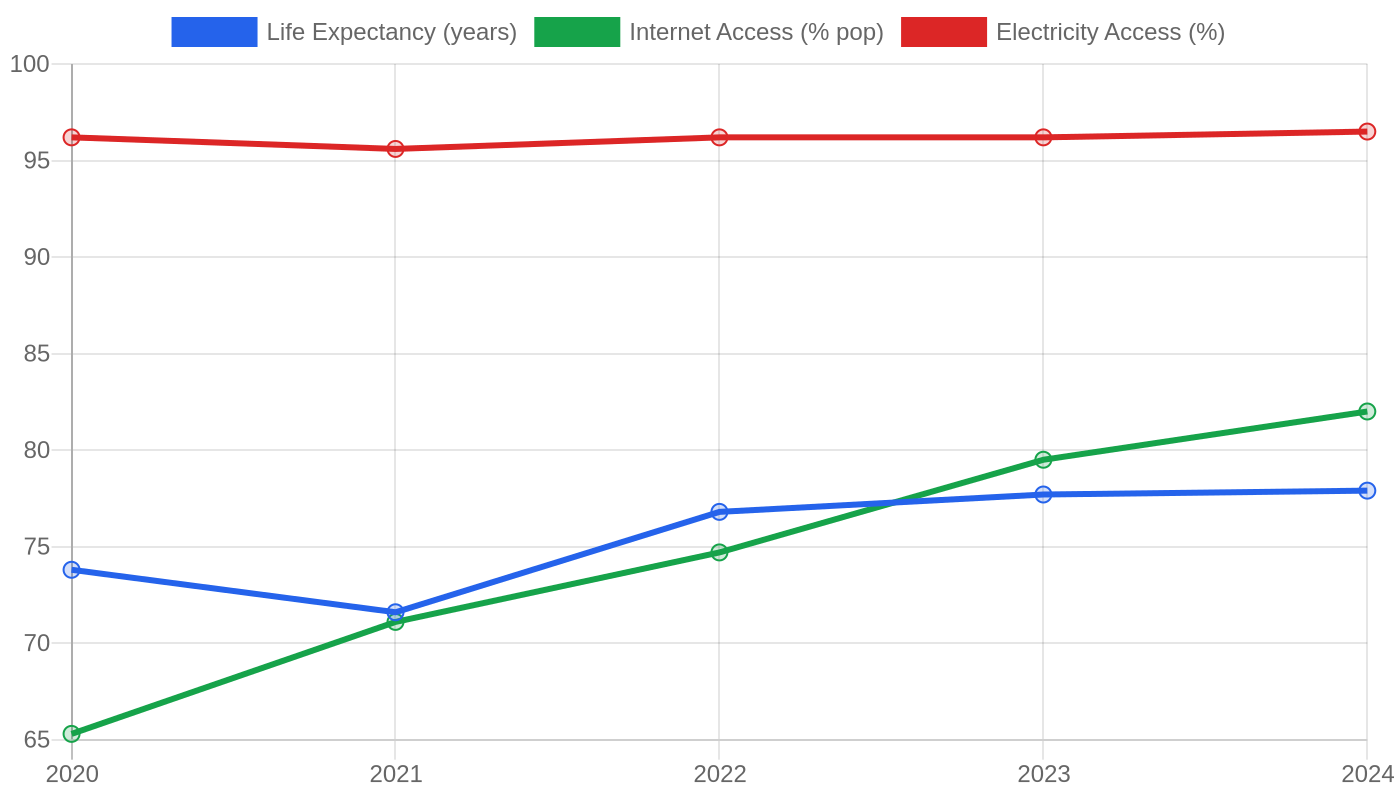
Economic Pulse Net | Sources: World Bank World Development Indicators, Government Sources | 2026
Peru finds itself in an unusual position as 2026 approaches: an economic performer with a political headache. The World Bank’s latest data paints a picture of a country that has managed to tame inflation and maintain growth, yet the underlying currents of political instability continue to shadow its progress.
With a GDP of approximately $334.8 billion and a population of 34.5 million, Peru stands as a significant middle-weight economy in the region, but one that has yet to fully translate its macroeconomic discipline into widespread prosperity.
Key Takeaways
– Growth with stability: Peru’s economy expanded by 3.43% in 2025, according to the World Bank, while inflation sits at a remarkably low 1.53% — an enviable combination in a region often plagued by price volatility.
– The jobs paradox: Unemployment is a modest 5.12%, yet the quality of employment and the scale of the informal sector remain pressing concerns for policymakers.
– A consumer goods powerhouse: Peru’s corporate landscape is dominated by household names in consumer goods and services, from Alicorp to Ajegroup, suggesting a domestic market that is consolidating and maturing.
– Political fragility persists: The country operates as a unitary semi-presidential republic under its 1993 constitution, but recent years have tested the resilience of its liberal democratic framework.
– Income disparity remains: With a GNI per capita of $8,430, Peru remains a middle-income country where the benefits of growth have not yet reached all citizens equally.
Macroeconomic Resilience — The Numbers Behind the Narrative
Peru’s macroeconomic story deserves close attention. The World Bank reports GDP growth of 3.43% for 2025 — a figure that signals a healthy, expanding economy, particularly when set against the backdrop of global headwinds. This is not breakneck expansion, but it is steady, sustainable growth that suggests a diversified economic base capable of weathering external shocks.
The composition of this growth, while not broken down in the available data, is likely driven by the country’s well-established mining sector, its growing agricultural exports, and an increasingly dynamic domestic consumer market.
Inflation at 1.53% is arguably the standout achievement. In a world where many economies are still grappling with the aftereffects of the post-pandemic price surge, Peru’s central bank has managed to keep consumer prices remarkably stable. This low inflation rate preserves purchasing power, protects the savings of ordinary Peruvians, and provides the central bank with room to maneuver should economic conditions deteriorate.
For businesses, this predictability is invaluable — it allows for long-term planning without the fear of cost spirals or currency devaluation.
The employment picture is more nuanced. Unemployment stands at 5.12%, which by international standards is a healthy figure. However, this headline number masks the reality that many Peruvians work in the informal economy, outside the protections of formal labor contracts and social security systems. The challenge for Peru is not merely creating jobs, but creating quality jobs that offer stability and pathways to upward mobility.
The GDP per capita of $18,816 (PPP) indicates a country that has made significant strides in raising living standards, yet the GNI per capita of $8,430 reveals a persistent gap between aggregate economic output and the income actually reaching households.
The Cost of Living — A Tale of Two Perus
For the average Peruvian, the cost of living is a story of contrasts. The low inflation rate means that day-to-day expenses — food, transport, utilities — have remained relatively stable, providing a measure of security for households. However, this stability is unevenly distributed across the country. Lima, the capital and economic hub, commands higher prices for housing, services, and consumer goods, while regional cities and rural areas offer a lower cost of living but often with fewer economic opportunities.
The housing market, while not broken down in specific figures, follows the typical Latin American pattern: a strong preference for homeownership, a rental market that varies dramatically between districts and cities, and a significant gap between formal housing developments and informal settlements on the urban periphery. For young professionals in Lima, the dream of homeownership remains challenging, with property prices in desirable districts outpacing income growth.
The affordability question is one of the most pressing social issues facing the country, as it directly impacts quality of life and economic mobility.
Investment Climate — Consumer Giants and Sectoral Strength
Peru’s corporate landscape offers a clear window into where the economy’s strengths lie. The list of top companies reads like a who’s who of consumer goods and services: Alicorp, one of Latin America’s largest consumer goods companies; Ajegroup, the beverage giant known for its Big Cola brand; and Agroindustrial Casa Grande and Pomalca, both significant players in the agricultural processing sector.
This concentration suggests an economy that has successfully built out its domestic consumer market, creating a virtuous cycle where internal demand drives corporate growth, which in turn creates employment and further demand.
The services sector is also well represented, with Aero Cóndor, Air Perú, and Avianca Perú indicating a robust aviation industry, while América Televisión represents a significant media presence. For investors, this mix of consumer staples, agriculture, and services offers a diversified opportunity set.
The agricultural sector, in particular, deserves attention — Peru has become a major exporter of fruits, vegetables, and specialty products, and companies like Casa Grande and Pomalca are well-positioned to benefit from global demand for quality food products.
The business environment, while not quantified in the available data, benefits from the country’s macroeconomic stability and its commitment to a market-oriented economic model. However, political turbulence has historically been a deterrent to investment, and the country’s ability to maintain policy consistency will be crucial to attracting the foreign capital needed to modernize infrastructure and diversify the economy further.
Politics, Safety, and the Quality of Life Puzzle
Peru’s political system is defined by its 1993 constitution, which established a unitary semi-presidential republic with a multi-party system. This framework was designed to create a strong central government capable of implementing policy effectively, and it has largely succeeded in maintaining democratic governance.
However, the country has experienced significant political instability in recent years, with frequent changes in leadership and periodic constitutional crises that have tested the resilience of its democratic institutions.
The available data does not include crime or safety indices, making it difficult to provide a definitive assessment of public security. What can be said is that Peru, like many countries in the region, faces challenges related to crime and public safety, particularly in certain urban areas. These concerns affect quality of life and can influence business decisions, though they exist alongside a vibrant civil society, a rich cultural heritage, and a generally welcoming social environment.
The quality of life in Peru is a complex equation — economic opportunity, cultural richness, and natural beauty on one side; political uncertainty, infrastructure gaps, and security concerns on the other.
The Road Ahead — A Pivotal Moment
As 2026 approaches, Peru stands at a critical juncture. The economic fundamentals are sound — growth is positive, inflation is under control, and unemployment is manageable. The corporate sector is dynamic, with major players in consumer goods and services demonstrating the strength of the domestic market. Yet the political uncertainty that has characterized recent years remains an unresolved variable, one that could either accelerate or undermine the country’s economic progress.
The World Bank data suggests that Peru has built a solid foundation for continued growth. The low inflation rate provides stability, the GDP expansion indicates momentum, and the presence of major domestic corporations shows that the private sector is capable of driving development.
The challenge now is to translate these macroeconomic achievements into broader social progress — to ensure that growth benefits all Peruvians, that the informal economy is gradually formalized, and that political institutions become as stable as the economic fundamentals they oversee.
The Bottom Line
Peru is a country worth watching for anyone interested in Latin American economics, emerging market investment, or the complex interplay between political stability and economic growth. The World Bank’s data reveals an economy that is performing admirably on the key indicators — growth, inflation, and employment — yet the persistent political uncertainty adds a layer of risk that cannot be ignored.
For investors, the consumer goods and agricultural sectors offer compelling opportunities; for policymakers, the challenge is to build institutional resilience that can match the country’s macroeconomic discipline. Peru has the fundamentals to succeed; what remains to be seen is whether it can overcome the political headwinds that have historically held it back.
Sources & Methodology
This article is authored by Economic Pulse Net for informational and research purposes. Economic Pulse Net sources its data from multilateral institutions, national statistics bureaus, and proprietary databases. All data is believed to be current as of the date of publication.
Published: August 26, 2026 | Category: Research — Peru
Use these signals in your own platform
Economic Pulse publishes its live signal feed through a documented, read-only API. Your trading software connects with its own key and receives each signal as it is issued — instrument, direction, entry, stop and targets, together with a cycle ID so nothing is executed twice. The feed is independent of this website and cannot change it.
Signals are informational only and are not financial advice.