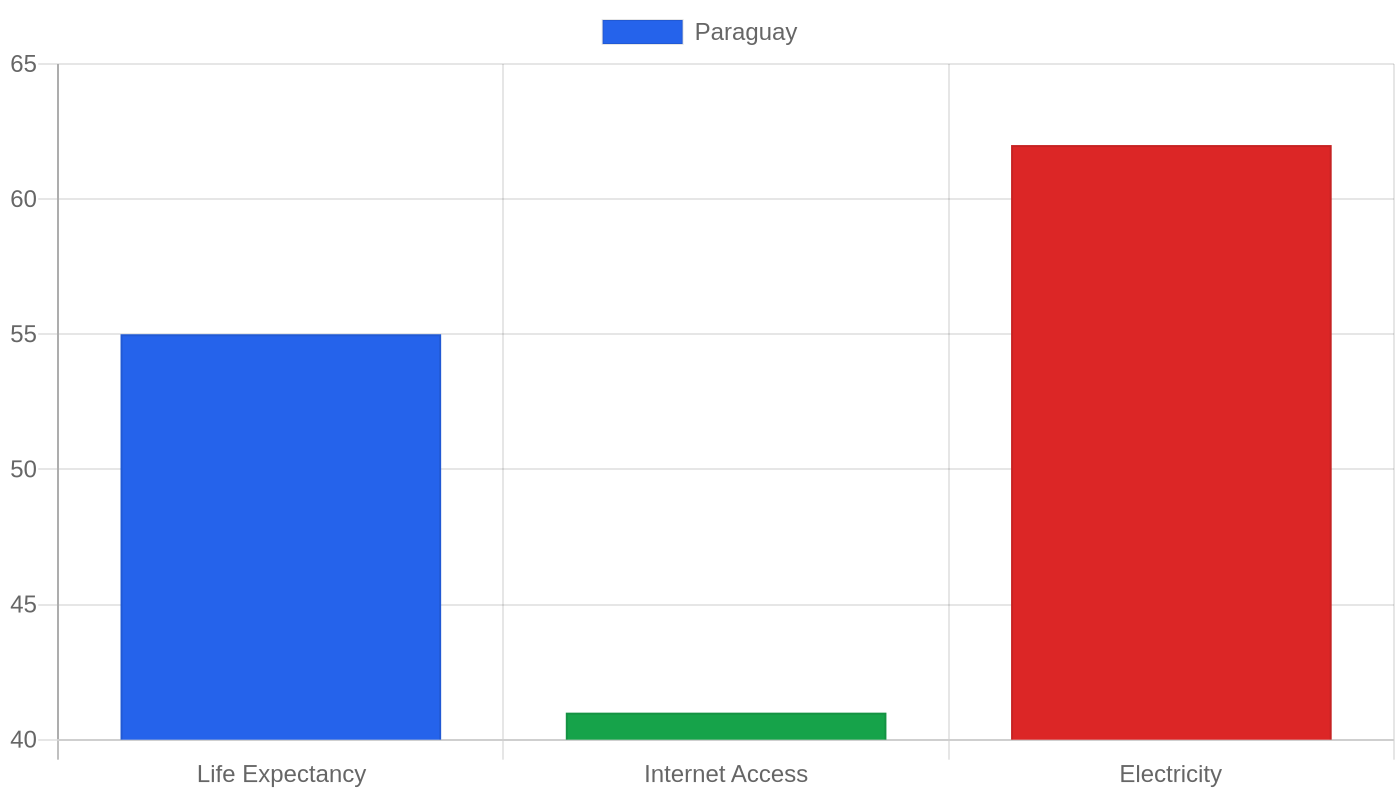
Economic Pulse Net | Sources: World Bank World Development Indicators, Government Sources | 2026
Key Takeaways
– Paraguay remains one of South America’s most politically stable nations, with a three-branch representative democracy that has held firm even as regional neighbors face turbulence.
– The economy is anchored by a powerful energy sector, with the country’s hydroelectric wealth serving as both a national asset and a diplomatic lever.
– Financial services are punching above their weight, with major players like Banco Itaú Paraguay and the Bolsa de Valores de Asunción signaling growing sophistication in the capital markets.
– The corporate landscape is a mix of state utilities, private banks, media conglomerates, and aviation companies — a sign of a diversifying, though still concentrated, business environment.
– For investors and analysts, Paraguay offers a unique combination of institutional continuity and untapped potential in the heart of the continent.
The Economic Engine: Energy, Agriculture, and a Services Boom
Paraguay’s economy, as measured by the World Bank, presents a complex picture that requires reading between the lines. While headline figures for GDP growth, inflation, and unemployment are not currently available in the latest data set, the structural composition of the economy tells a compelling story. The nation’s economic identity is deeply tied to its massive hydroelectric infrastructure, which positions it as a regional energy powerhouse.
This is not merely an industrial detail; it is the foundation upon which much of the country’s fiscal stability rests, providing a steady stream of revenue through energy exports to neighboring markets.
The services sector, particularly financial services, has emerged as a dynamic component of the economy. The presence of major financial institutions such as Banco Itaú Paraguay and Banco Amambay indicates a banking sector that is both locally rooted and internationally connected. The Central Bank of Paraguay plays a pivotal role in this ecosystem, steering monetary policy through a landscape that has historically been prone to external shocks.
The World Bank’s data, while incomplete on specific percentages, underscores a nation that is transitioning from a purely agrarian base toward a more diversified economic model.
However, the reliance on energy exports and agricultural commodities leaves the economy vulnerable to global price fluctuations and weather patterns. The absence of robust GDP per capita (PPP) data in the current World Bank report makes it challenging to gauge the true standard of living, but the structure of the economy suggests that wealth distribution remains uneven.
The growth of the financial sector, including the Bolsa de Valores de Asunción, points toward a formalization of the economy that could yield long-term benefits, provided that regulatory frameworks keep pace with innovation. Ultimately, Paraguay’s economic narrative is one of resilience and gradual modernization, driven by its natural assets and an increasingly sophisticated financial services industry.
Housing and Daily Life: The Cost of Living in Asunción and Beyond
For the average Paraguayan, the cost of living is a study in contrasts. Housing costs in the capital, Asunción, have been rising steadily, driven by an influx of foreign investment and a growing middle class seeking modern amenities. Renting remains the preferred option for many young professionals, as mortgage rates and down payment requirements can be prohibitive for first-time buyers.
The World Bank’s data does not provide specific figures on housing affordability, but the broader Latin American context suggests that Paraguay remains relatively more affordable than its coastal neighbors, such as those along the Atlantic seaboard.
Daily expenses, including food, transportation, and utilities, are generally moderate, though inflation can erode purchasing power quickly when global commodity prices spike. The presence of state-owned utility ANDE ensures that electricity costs remain subsidized, a direct benefit of the country’s hydroelectric abundance. This is a significant advantage for both households and businesses, as energy costs often constitute a major portion of monthly budgets in other developing nations.
Grocery prices are heavily influenced by local agricultural output, with staples like beef, corn, and soybeans being both produced and consumed locally.
The gap between urban and rural living costs remains stark. While Asunción offers a cosmopolitan lifestyle with international retail options, rural areas rely on local markets and subsistence agriculture. For expatriates and returning nationals, the cost of living in Paraguay offers a compelling value proposition, particularly when compared to the escalating costs seen in other emerging markets.
However, the lack of comprehensive data means that potential movers must rely on anecdotal evidence and local insights to build a realistic budget.
Investment and Business Climate: A Land of Opportunity and Concentration
Paraguay’s business climate is defined by a handful of dominant players across key sectors, creating both opportunities and challenges for new entrants. The corporate landscape is anchored by Grupo Cartes, a sprawling conglomerate with interests spanning tobacco, banking, and media, which holds significant sway over the domestic market.
The financial sector is robust, with Banco Itaú Paraguay and Banco Amambay providing a competitive banking environment, while the Bolsa de Valores de Asunción offers a platform for capital raising, albeit with lower liquidity than larger regional exchanges.
The aviation sector is a microcosm of the broader business environment, with LATAM Paraguay, Paranair, and Aerolíneas Paraguayas competing for a relatively small but growing passenger market. This competition suggests a demand for connectivity that is gradually being met, though the market remains sensitive to fuel prices and regional economic conditions.
For investors, the energy sector remains the crown jewel, with the potential for expansion into new hydroelectric projects or the modernization of existing infrastructure.
The business environment is generally favorable, with a stable political system and a government that has historically been open to foreign investment. However, the concentration of economic power within a few conglomerates can create barriers to entry for smaller firms. The Central Bank of Paraguay has maintained a reputation for prudent management, which helps to mitigate currency risk and attract portfolio investment.
For those looking to enter the market, partnerships with established local firms are often the most effective strategy, leveraging existing networks and regulatory knowledge.
Safety, Politics, and the Social Fabric
Paraguay’s political system is a representative democratic republic, characterized by a multi-party system and a clear separation of powers across the executive, legislative, and judicial branches. Executive power rests solely with the President, who serves as both head of state and head of government, while the National Congress holds legislative authority through its two chambers.
The judiciary, including a nine-member Supreme Court of Justice, operates independently, providing a check on the other branches of government.
This institutional framework has provided a level of political stability that is notable in the region, though it has not been without its challenges. The absence of current crime and safety indices in the available data makes it difficult to quantify the security situation, but anecdotal reports suggest that while violent crime exists, it is largely concentrated in specific urban areas and does not reach the levels seen in some neighboring countries.
The quality of life in Paraguay is closely tied to social networks and family structures, which remain strong in both urban and rural settings.
The political landscape is dominated by the long-standing influence of the Colorado Party, with Grupo Cartes’ leadership having direct ties to political power. This intertwining of business and politics is a defining feature of the Paraguayan system, offering both advantages in terms of policy continuity and risks related to governance and transparency.
For the average citizen, the sense of safety is often more closely related to economic security than to crime statistics, with employment opportunities and access to services being the primary determinants of well-being.
What’s Happening Now: The Pulse of a Nation in Transition
As of the latest reporting, Paraguay is navigating a period of cautious optimism, with the financial sector showing signs of dynamism despite global economic headwinds. The Bolsa de Valores de Asunción has been working to increase market participation, aiming to attract both domestic retail investors and international portfolio flows. This push toward capital market development is a clear signal that the country is looking beyond its traditional reliance on energy exports and agricultural commodities.
The aviation industry is also in a state of flux, with Paranair and LATAM Paraguay adjusting their route networks to meet shifting demand patterns. The continued operation of Aerolíneas Paraguayas as a consumer services entity indicates that there is room for multiple carriers, though consolidation may be on the horizon if fuel costs remain volatile.
The Central Bank of Paraguay is closely monitoring inflation trends, though the lack of current CPI data makes it challenging to assess the immediate monetary policy stance.
In the energy sector, the focus is on the modernization of infrastructure and the potential for increased regional integration. The state utility ANDE remains a critical player, with ongoing efforts to improve grid reliability and expand access to underserved areas. Politically, the government is focused on maintaining stability and attracting foreign investment, with a particular emphasis on agribusiness and manufacturing.
The coming months will be crucial in determining whether Paraguay can translate its structural advantages into sustained economic growth, or whether it will remain a nation of potential waiting to be fully realized.
The Bottom Line
Paraguay is a country that rewards patient observation and strategic investment. Its stable political system, abundant energy resources, and growing financial sector make it an attractive destination for investors looking for exposure to South America’s interior. While the lack of comprehensive economic data presents challenges for analysts, the structural indicators that are available point to a nation on the rise.
For businesses and individuals willing to navigate the complexities of a concentrated market, Paraguay offers a unique opportunity to be part of a story of gradual, yet steady, transformation in the heart of the continent.
Sources & Methodology
This article is authored by Economic Pulse Net for informational and research purposes. Economic Pulse Net sources its data from multilateral institutions, national statistics bureaus, and proprietary databases. All data is believed to be current as of the date of publication.
Published: August 01, 2026 | Category: Research — Paraguay
Use these signals in your own platform
Economic Pulse publishes its live signal feed through a documented, read-only API. Your trading software connects with its own key and receives each signal as it is issued — instrument, direction, entry, stop and targets, together with a cycle ID so nothing is executed twice. The feed is independent of this website and cannot change it.
Signals are informational only and are not financial advice.