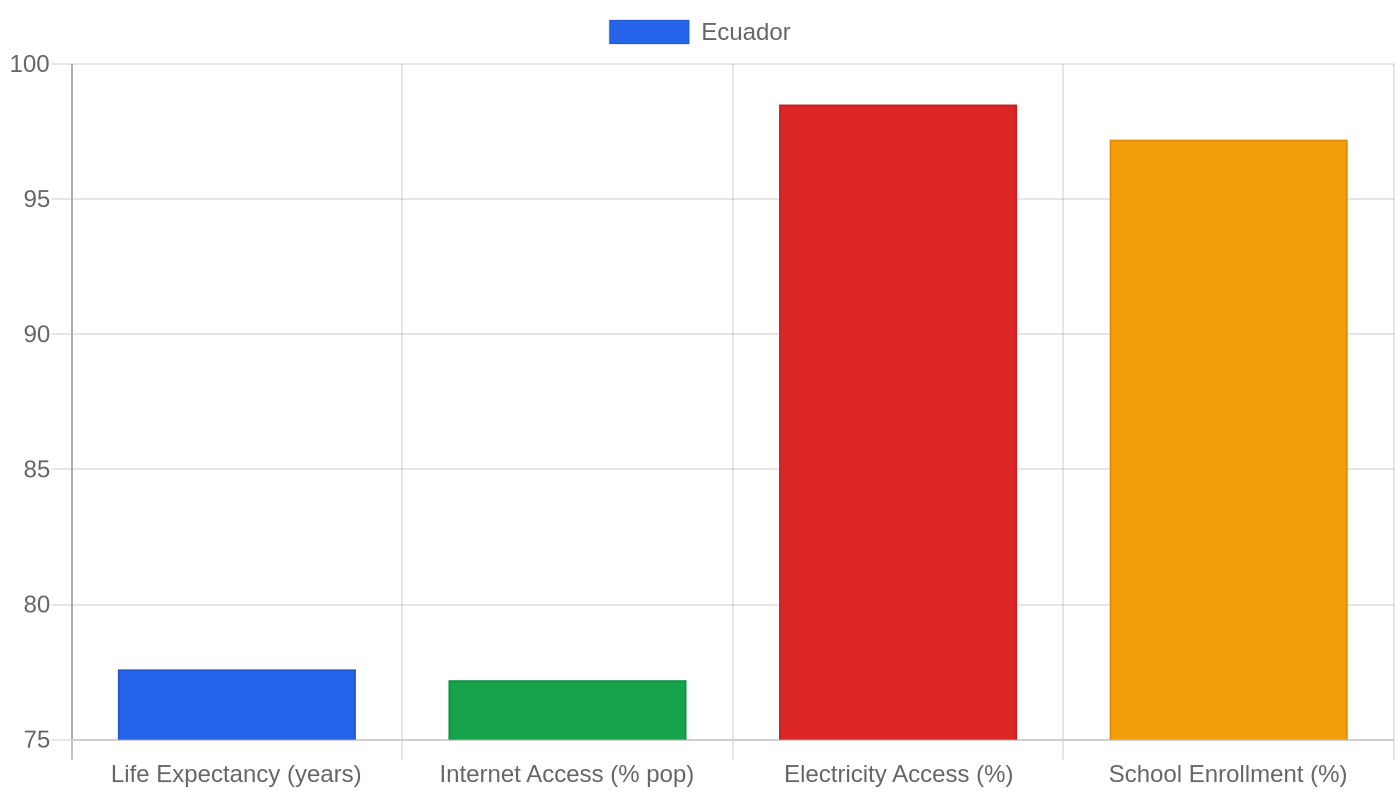
Economic Pulse Net | Sources: World Bank World Development Indicators, Government Sources | 2026
Key Takeaways
– A Diversified Economic Engine: Ecuador’s economy is not a one-trick pony; it relies on a mix of heavyweights, from oil giant Petroecuador to consumer staples like Tonicorp and global craft icons like Ecua-Andino Hats.
– Telecom Titans Dominate: The corporate landscape is anchored by communication giants Claro Ecuador and CNT EP, indicating a robust digital infrastructure push alongside traditional extractive industries.
– A Unique Political Architecture: Unlike most nations, Ecuador operates with five distinct branches of government, including an Electoral Branch and a Transparency and Social Control branch, signaling a complex governance structure.
– Consumer Services are Key: The presence of major retail and service players like Tía, Marathon Sports, and Ecuavisa highlights a vibrant domestic consumption market that is critical to economic resilience.
– A State in Transition: With a heavy reliance on state-owned enterprises like Petroecuador and Correos del Ecuador, the balance between public control and private investment remains the central economic storyline.
The Paradox of Plenty: Growth, Inflation, and the Petro-State Reality
Ecuador sits on a geological and geographical goldmine. It is one of the world’s most biodiverse countries and a significant player in the global oil market, yet its economic narrative is one of constant recalibration. According to the World Bank, the latest hard data on GDP growth, inflation, and unemployment remain unpublished, leaving analysts to rely on structural observations rather than quarterly snapshots.
However, the absence of fresh CPI data does not obscure the underlying truth: Ecuador’s economy is heavily tethered to the volatile swings of crude oil prices. The state-owned behemoth Petroecuador dominates the export ledger, meaning that when global energy markets sneeze, the national budget catches a cold. This dependency creates a “paradox of plenty,” where the nation’s vast resource wealth has historically struggled to translate into stable, low inflation for everyday citizens.
The industrial mix tells a story of a nation trying to modernize while leaning on its historical strengths. While oil is the primary revenue earner, the presence of Tonicorp in the dairy sector and the consumer services triad of Tía, Marathon Sports, and Ecuavisa suggests a mature domestic retail economy that is resilient even when external shocks occur.
The unemployment picture, though lacking a precise World Bank figure, is likely influenced by the informal sector’s massive size—a common feature in Andean economies where formal job creation lags behind population growth. The real economic question for Ecuador is whether the “service-ization” of its economy, evidenced by the telecom and retail giants, can eventually wean the country off its fiscal reliance on Petroecuador’s output.
The Cost of Living: Navigating the Dollarized Andean Market
For the average citizen, the cost of living in Ecuador is a tale of two cities: the highland capital of Quito and the coastal hub of Guayaquil. Ecuador’s adoption of the US dollar as its currency—a fact that shapes all domestic pricing—means that inflation is largely imported, tied to the strength of the dollar and the price of food imports.
While specific housing cost indices are not available in the current World Bank data, the structure of the economy suggests that consumer staples and housing consume a significant portion of household income. The presence of massive retail chains like Tía and Marathon Sports indicates a competitive market for goods, but the service sector, including telecoms like Claro Ecuador, often carries pricing power that can strain household budgets.
Rent versus buy dynamics in Ecuador are heavily skewed by geography. In metropolitan areas, the proliferation of consumer services suggests a middle class with disposable income, yet the gap between the wealthy and the working poor remains stark. The cost of daily essentials—food, transportation, and utilities—is often subject to government subsidies, particularly for fuel, which helps mitigate the shock of global price hikes but creates fiscal strain for the state.
For expatriates and investors, the dollarized economy offers a unique advantage: the absence of currency devaluation risk, which makes long-term financial planning more predictable than in neighboring countries like Colombia or Peru. However, this also means that local wages are subject to the “Dutch Disease” effect, where the strong dollar can make domestic manufacturing less competitive on the global stage.
Investment & Business Climate: Giants, State Control, and the Digital Future
The corporate roster of Ecuador reads like a mix of state-driven nationalism and private sector dynamism. On one hand, you have the state-controlled entities—Petroecuador in oil and CNT EP in telecommunications—which dominate strategic sectors. On the other, you have private players like Claro Ecuador, which compete fiercely in the mobile and data markets. This dual-track approach defines the investment climate.
Foreign investors often look at Ecuador with cautious optimism, drawn by the potential of the oil sector but wary of regulatory unpredictability. The government’s role in the economy is substantial, and the presence of Correos del Ecuador in the industrials sector highlights a state that is reluctant to fully privatize logistics and infrastructure.
The most exciting frontier for business is the digital economy. With two major telecoms—Claro and CNT EP—battling for market share, the push for 5G and fiber-optic expansion is creating ancillary opportunities in e-commerce and fintech. Marathon Sports and Tía are leveraging these digital rails to pivot toward omnichannel retail, blurring the lines between physical stores and online marketplaces.
Furthermore, the global reputation of Ecua-Andino Hats proves that Ecuadorian craftsmanship can command premium pricing on the world stage, offering a template for non-oil exports. The business environment, however, remains a challenge for small and medium enterprises, where bureaucratic hurdles and access to credit are perennial issues.
For investors, the key is to navigate the “Transparency and Social Control” branch of government, which signals a regulatory environment that prioritizes oversight, for better or worse.
Safety, Politics & Quality of Life: The Five-Power System
Ecuador’s political landscape is as unique as its geography. The state is structured across five branches of government: the Executive, Legislative, Judicial, Electoral, and the novel Transparency and Social Control. This fifth branch is designed to oversee public officials and ensure accountability, a direct response to historical corruption scandals. This complex architecture aims to provide checks and balances, but it often results in slow policy implementation and political gridlock.
For citizens, this means that economic reforms rarely pass quickly, creating an environment of uncertainty that can impact consumer confidence and long-term investment.
Regarding quality of life, the lack of current Crime and Safety indices from the World Bank leaves a gap in the data, but the presence of a dedicated Transparency branch suggests that social governance is a top priority. Ecuador is a nation of stark contrasts—from the safety of gated communities in Quito to the bustling, informal markets of Guayaquil.
The country’s rich cultural heritage, anchored by the legacy of the Panama hat (actually originating in Ecuador), provides a strong sense of national identity and pride. However, the political climate has been volatile in recent years, with frequent changes in leadership and policy direction. For the average citizen, the quality of life is heavily influenced by the stability of the job market and the affordability of basic services, both of which remain under pressure as the state balances its books.
What’s Happening Now: The Battle for Economic Sovereignty
Right now, the most pressing narrative in Ecuador is the government’s attempt to balance fiscal responsibility with social welfare. With the World Bank data showing a lag in updated metrics, the focus shifts to the operational realities of the state-owned enterprises. Petroecuador is under immense pressure to increase output to fund the national budget, yet it faces operational challenges and environmental opposition.
Simultaneously, the telecom sector is buzzing with activity; CNT EP is aggressively rolling out infrastructure to compete with Claro Ecuador, aiming to democratize internet access in rural areas. This push is critical, as digital connectivity is seen as the primary lever for economic diversification away from oil.
The political discourse is dominated by debates over the role of the state. The existence of the Transparency and Social Control branch is a double-edged sword; it ensures that public funds are monitored, but it also creates a climate of caution among bureaucrats, slowing down the approval of new business licenses and investments. Meanwhile, the consumer market is showing resilience.
Companies like Tía and Marathon Sports are expanding their footprints, betting on the strength of domestic consumption despite the lackluster GDP figures. The government is also looking to leverage the brand power of Ecua-Andino Hats to boost tourism and artisan exports, seeing it as a soft-power tool to improve the country’s image abroad.
The immediate future hinges on whether the administration can pass a coherent energy policy that satisfies both the fiscal needs of the state and the environmental concerns of the populace.
The Bottom Line
Ecuador is a country for the patient and the strategic. It is not a frontier market for the faint-hearted, but rather a nation with deep structural assets—oil, agriculture, and a unique cultural brand—that are currently under-managed. Analysts and investors should watch Ecuador closely for shifts in the energy sector and the telecoms race, as these will be the bellwethers of broader economic health.
For those willing to navigate the complex five-branch political system, the rewards could be significant, particularly in the digital and consumer goods sectors. Ultimately, Ecuador is a sleeping giant in the Andean region, waiting for the right policy mix to awaken its full potential.
Sources & Methodology
This article is authored by Economic Pulse Net for informational and research purposes. Economic Pulse Net sources its data from multilateral institutions, national statistics bureaus, and proprietary databases. All data is believed to be current as of the date of publication.
Published: August 02, 2026 | Category: Research — Ecuador
Use these signals in your own platform
Economic Pulse publishes its live signal feed through a documented, read-only API. Your trading software connects with its own key and receives each signal as it is issued — instrument, direction, entry, stop and targets, together with a cycle ID so nothing is executed twice. The feed is independent of this website and cannot change it.
Signals are informational only and are not financial advice.