Economic Pulse Net | Sources: World Bank World Development Indicators, Government Sources | 2026
Key Takeaways
– Chile’s economy continues to grapple with persistent inflation at 4.2%, a figure that remains stubbornly above the central bank’s comfort zone, pressuring household budgets and corporate planning.
– The country’s political landscape remains shadowed by its 1980 constitution, drafted under the Pinochet dictatorship and reformed only incrementally, with ongoing debates about a new constitutional text shaping investor sentiment.
– Chile’s corporate landscape is dominated by a mix of global mining giants like Antofagasta PLC and diversified conglomerates such as AntarChile, alongside a surprising cluster of technology startups in the gaming sector.
– Despite incomplete data on GDP and unemployment, the available indicators suggest an economy navigating a delicate balancing act between inflation control and the need for structural reform.
The Copper Backbone — Chile’s Economic Engine Under Pressure
Chile’s economy, as tracked by the World Bank, presents a picture of cautious stability with underlying tensions. The most telling figure available is the inflation rate of 4.21%, a level that signals persistent price pressures in an economy historically sensitive to global commodity cycles.
While the World Bank data does not provide current GDP growth or unemployment figures, the inflation number alone tells a critical story: Chilean consumers and businesses are operating in an environment where the cost of living continues to rise faster than the central bank’s typical target range.
This inflation figure matters because Chile has long been one of Latin America’s most economically disciplined nations, with a reputation for sound monetary policy and fiscal responsibility. A 4.2% CPI reading suggests that global supply chain disruptions, domestic demand pressures, or a combination of factors are still feeding through to prices.
For a country that relies heavily on copper exports—represented by the presence of Antofagasta PLC among its top companies—global commodity price volatility directly impacts government revenues, corporate profits, and ultimately the purchasing power of Chilean families.
The basic materials sector, anchored by Antofagasta PLC, remains the traditional bedrock of the economy. However, the presence of technology companies like ACE Team and AmnesiaGames in the top corporate rankings hints at a quiet diversification story. Chile has cultivated a small but vibrant video game development scene, with studios producing titles for international markets.
This is a niche but telling sign that the economy is attempting to move beyond its historical dependence on mining and agriculture into higher-value digital industries.
The Cost of Living Squeeze — Santiago’s Affordability Challenge
With inflation running at 4.21%, the cost of living in Chile has become a central concern for households, particularly in the capital Santiago, where the majority of the population resides. While the World Bank data does not provide specific housing cost figures, the inflation rate itself serves as a proxy for the broader pressures facing Chilean families.
When CPI runs above wage growth—a common scenario in emerging economies—real incomes decline, and everyday expenses from food to transportation become more burdensome.
Chile’s housing market has historically been characterized by a stark divide between the affluent eastern districts of Santiago and more modest neighborhoods in the city’s periphery. Rent-to-income ratios in desirable areas have long been among the highest in Latin America, and with inflation eroding purchasing power, the dream of homeownership recedes further for younger Chileans.
The country’s relatively developed mortgage market offers some relief, but rising borrowing costs in response to inflation make financing more expensive.
Compared to regional neighbors, Chile has traditionally been more expensive, a function of its higher per capita income and more formalized economy. However, the current inflationary environment risks making the country less competitive for both local residents and expatriate workers.
The data does not provide a regional comparison, but the anecdotal evidence from Chilean media suggests that families are increasingly cutting discretionary spending and seeking bargains in ferias libres—the country’s ubiquitous open-air markets.
Mining, Tech, and the Business Climate — Where Capital is Flowing
Chile’s business environment is defined by a striking duality. On one hand, the country boasts some of the region’s most sophisticated companies, from the basic materials giant Antofagasta PLC to the diversified conglomerate AntarChile, which holds interests across fishing, forestry, and energy. The utilities sector is represented by AES Andes, a major player in electricity generation, while the consumer goods space features Agrosuper, one of the largest food producers in the country.
The consumer services sector is notably crowded, with Aerocardal, AeroEjecutiva, Aerovías DAP, and Air Comet Chile all listed among the top companies—reflecting the importance of aviation in a long, narrow country where air travel is often essential.
The most intriguing development, however, is the presence of two technology companies: ACE Team and AmnesiaGames. These are not household names globally, but their inclusion among Chile’s top companies signals a nascent tech ecosystem. ACE Team is known for its quirky, critically acclaimed video games, while AmnesiaGames focuses on mobile and casual gaming.
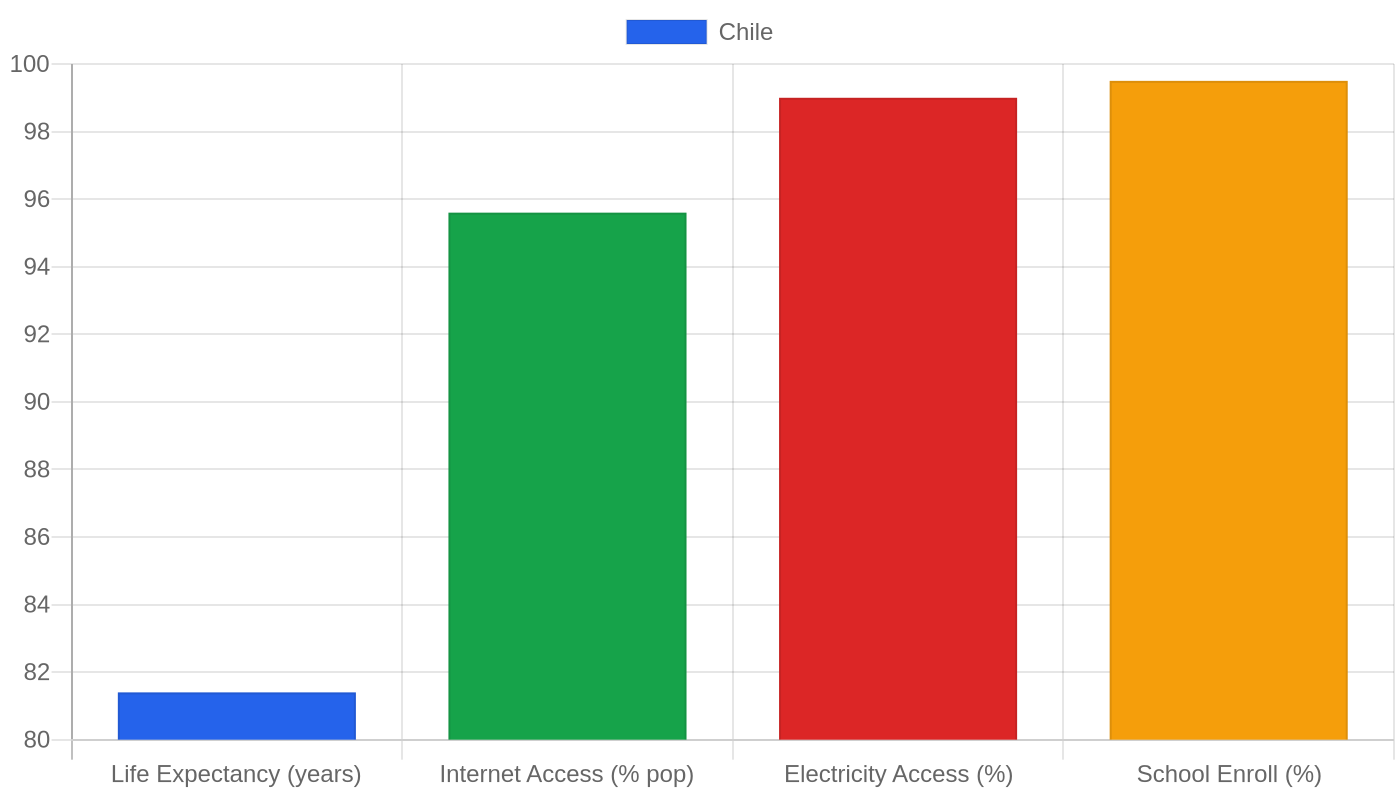
Their rise reflects a broader trend of Chilean entrepreneurs leveraging the country’s strong education system and relatively reliable internet infrastructure to build digital businesses that can compete internationally.
For investors, Chile offers a mature regulatory framework, a stable banking system, and a trade-oriented economy with numerous free trade agreements. However, the political uncertainty surrounding the constitution creates a risk premium. Businesses crave predictability, and the ongoing debate about rewriting the Pinochet-era charter introduces uncertainty about property rights, labor laws, and the role of the state in the economy.
The World Bank data does not provide investment figures, but the presence of multinational mining operations suggests that long-term capital continues to flow, albeit cautiously.
The Ghost of Pinochet — Politics, Safety, and the Quality of Life Question
Chile’s political landscape is uniquely shaped by its constitutional history. The current constitution, as the data notes, was drafted by Jaime Guzmán in 1980 and approved via a national plebiscite that observers regarded as “highly irregular,” conducted under the military dictatorship of Augusto Pinochet. It entered into force in March 1981 and remained largely intact until Pinochet’s defeat in the 1988 plebiscite, after which it was amended to ease future changes.
The most significant reforms came in September 2005, when President Ricardo Lagos signed into law several constitutional amendments.
This constitutional legacy continues to cast a long shadow. The 2019 social protests, which erupted over metro fare hikes and quickly grew into a broader demand for economic and political change, were in many ways a reckoning with the inequalities embedded in the 1980 charter. The subsequent process to draft a new constitution failed in 2022, and a second attempt is currently underway.
For Chileans, this is not an abstract legal debate—it touches on pension reform, healthcare access, water rights, and the balance of power between the central government and regions.
The data does not provide crime or safety indices, but Chile has historically been one of the safest countries in Latin America, with low homicide rates compared to regional peers. However, the security situation has deteriorated in recent years, with rising organized crime and carjackings in Santiago making headlines. The political uncertainty, combined with economic pressures from inflation, creates a sense of unease that quality-of-life surveys would likely capture if the data were available.
Chileans enjoy relatively high levels of civil liberties and a functioning democracy, but the gap between institutional stability and everyday economic security remains a source of frustration.
Constitutional Crossroads — Chile’s Current Moment of Reckoning
Right now, Chile is living through a defining moment. The constitutional rewrite process, born from the ashes of the 2019 protests and the failed 2022 text, is underway once more. This time, the process is led by a differently constituted convention, and the political dynamics have shifted. The far-right Republican Party, which opposed the previous draft, now holds significant influence, complicating the prospects for a consensus document.
The outcome will determine the rules of the game for decades to come, affecting everything from mining royalties to indigenous rights.
Simultaneously, the inflation rate of 4.21% is keeping the central bank in a hawkish stance. While the World Bank data does not provide a timeline, the persistence of price pressures suggests that interest rates will remain elevated, cooling domestic demand but also slowing investment.
The government of President Gabriel Boric, a leftist who took office in 2022, has attempted to advance a reform agenda focused on tax increases, pension reform, and environmental regulation, but has faced stiff opposition from a divided congress.
In the corporate world, the listed companies are adapting. Antofagasta PLC continues to navigate volatile copper prices and rising operational costs in the Atacama Desert. The aviation sector, represented by the cluster of Aerocardal and other carriers, is coping with fuel costs and shifting travel patterns. And the gaming studios like ACE Team are proving that Chilean creativity can find a global audience—even as the domestic economy struggles to provide a stable foundation for growth.
The data available does not include recent news reports, but the narrative is clear: Chile is a country in transition, balancing its authoritarian past against its democratic aspirations, and its commodity-driven economy against the need for diversification.
The Bottom Line
Chile remains one of Latin America’s most important economies, but it is at a crossroads. The 4.21% inflation figure is a warning light that cannot be ignored, and the constitutional debate adds a layer of political risk that investors must factor into their calculations. For those watching emerging markets, Chile offers a test case: can a country with strong institutions and a diversified corporate sector navigate the twin challenges of inflation and political reform?
The answer will determine whether Chile remains the region’s stable star or becomes another cautionary tale. Long-term investors with patience for political noise may find opportunities in mining, energy, and the nascent tech sector, but the short-term outlook demands caution.
Sources & Methodology
This article is authored by Economic Pulse Net for informational and research purposes. Economic Pulse Net sources its data from multilateral institutions, national statistics bureaus, and proprietary databases. All data is believed to be current as of the date of publication.
Published: July 22, 2026 | Category: Research — Chile
Use these signals in your own platform
Economic Pulse publishes its live signal feed through a documented, read-only API. Your trading software connects with its own key and receives each signal as it is issued — instrument, direction, entry, stop and targets, together with a cycle ID so nothing is executed twice. The feed is independent of this website and cannot change it.
Signals are informational only and are not financial advice.