Economic Pulse Net | Sources: World Bank World Development Indicators, Government Sources | 2026
Key Takeaways
– Chile’s economy is expanding at a modest 2.46% pace in 2025, according to the World Bank, but inflation remains stubbornly above target at 4.21%, squeezing household purchasing power.
– Unemployment hovers near 9%, a persistent structural challenge that tempers optimism around GDP growth and per capita income gains.
– The political landscape remains defined by the legacy of the 1980 Pinochet-era constitution, with ongoing debates about reform shaping investor sentiment and institutional stability.
– Chile’s top companies span basic materials, consumer goods, and technology, reflecting an economy in transition from commodity dependence toward digital innovation.
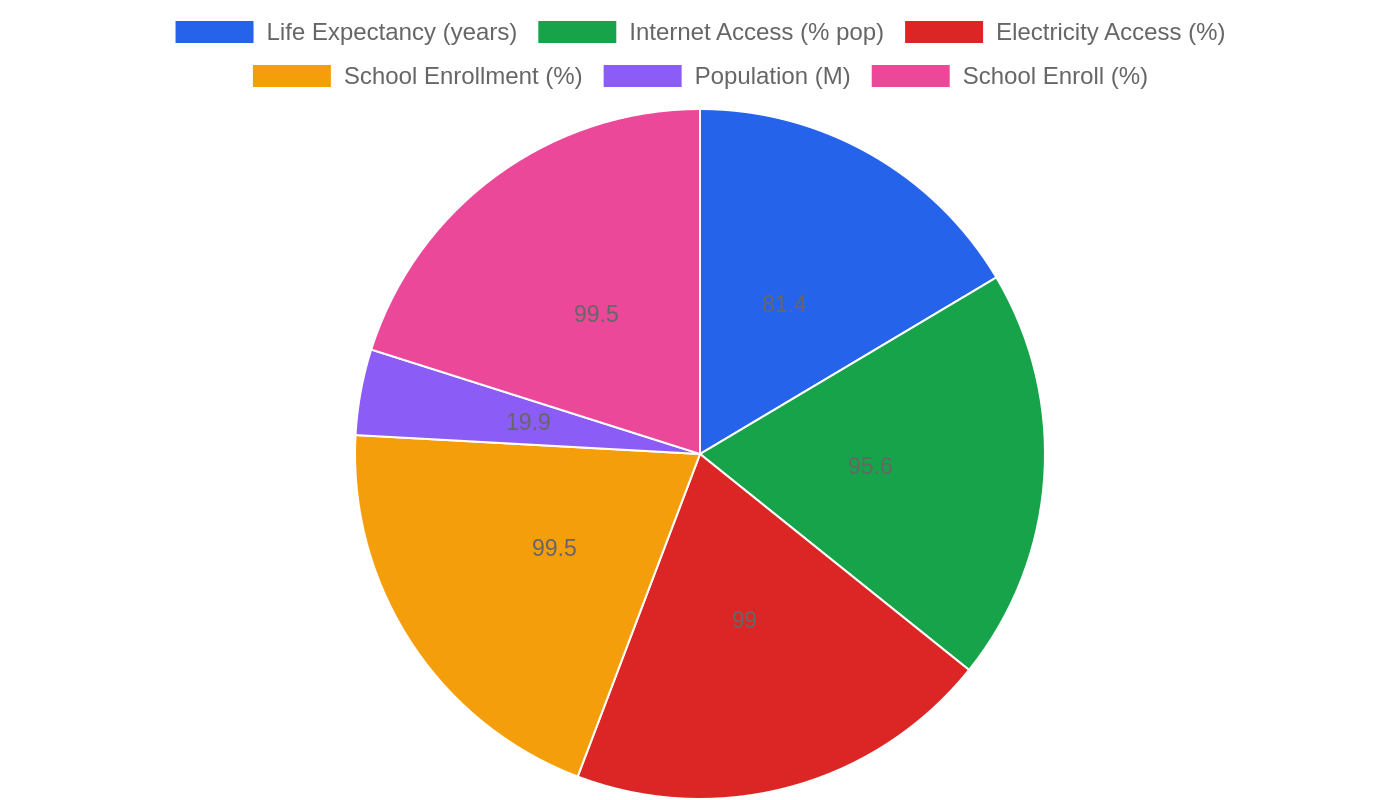
– With a GNI per capita of $16,960 and a population of just under 20 million, Chile remains Latin America’s wealthiest nation per capita, but inequality and cost-of-living pressures are mounting.
The Copper Engine Sputters — Chile’s Economic Reality Check
Chile’s economy in 2025 is a study in cautious momentum. The World Bank reports GDP growth of 2.46%, a respectable figure by regional standards but hardly the roaring expansion that characterized the country’s pre-pandemic years. That growth is powered by a familiar engine: copper. Chile remains the world’s largest copper producer, and mining giants like Antofagasta PLC — listed among the country’s top companies in basic materials — continue to drive export revenues.
But the headline number masks a deeper fragility.
Inflation is running at 4.21% according to the World Bank, well above the central bank’s 3% target. For Chilean households, this means real wages are under pressure. The cost of food, transportation, and housing has risen faster than incomes for many, particularly in Santiago’s sprawling metropolitan area. Meanwhile, unemployment stands at 8.97%, a figure that suggests the labor market is still healing from the shocks of social unrest and the pandemic.
The GDP per capita, measured at purchasing power parity, sits at $37,774 — a figure that places Chile comfortably ahead of its South American peers. But that aggregate number obscures deep regional disparities. The mining-rich north enjoys higher average incomes, while the agricultural south and urban peripheries struggle with informal employment and lower productivity.
Chile’s economic story is one of two nations: one plugged into global commodity markets, the other trying to find its footing in services and technology.
The country’s total GDP of $357 billion makes it a mid-sized economy globally, but its significance in Latin America is outsized. Chile has long been the region’s poster child for free-market orthodoxy, a reputation cemented by the “Chicago Boys” economists of the Pinochet era. Yet that model is showing its age. The growth rate of 2.46% is insufficient to generate the kind of broad-based prosperity that might ease the social tensions that erupted in 2019.
Without structural reforms — in pensions, taxation, and labor markets — Chile risks settling into a low-growth equilibrium.
The Price of Paradise — Housing and Daily Life in Chile
For anyone living in Santiago, the cost-of-living crisis is not an abstract statistic. While the World Bank data does not provide specific housing cost figures, the broader economic indicators paint a clear picture. With inflation at 4.21%, the price of basic goods has risen steadily. Rent in middle-class neighborhoods of the capital has become a major budget item, often consuming 40% or more of household income.
The dream of homeownership has receded for many young Chileans, as property prices in desirable areas have outpaced wage growth for years.
Utilities, too, have become a flashpoint. AES Andes, one of Chile’s top companies in the utilities sector, is a key electricity provider, but energy costs in Chile are among the highest in Latin America. The country’s reliance on imported natural gas and vulnerable hydroelectric infrastructure — increasingly threatened by drought — means that electricity bills are a persistent source of household stress.
For families earning near the median income, the combination of rent, utilities, and food leaves little room for savings or discretionary spending.
Yet there is a flip side. Chile’s per capita income of $16,960, as measured by GNI, remains the highest in South America. For those with formal employment in mining, finance, or technology, the quality of life is high. International schools, modern healthcare, and a vibrant cultural scene are all accessible. The divide, as in many emerging economies, is between those plugged into the global economy and those left behind by it.
The cost of living in Chile is not uniformly punishing — it is punishing for the majority, while comfortable for the elite.
Copper, Code, and Conglomerates — Where the Money Is
Chile’s corporate landscape reveals an economy in transition. The list of top companies is dominated by familiar names from the commodity sector: Antofagasta PLC in basic materials, **AntarChile** in conglomerates, and **Agrosuper** in consumer goods. These firms are deeply integrated into global supply chains, exporting copper, salmon, wine, and fruit to markets in China, the United States, and Europe. Their profitability is tied to commodity prices, which remain volatile in 2025.
But there are signs of diversification. The presence of ACE Team and **AmnesiaGames** on the list of top companies signals a growing technology sector. Chile has invested heavily in digital infrastructure and startup incubation, particularly through programs like Start-Up Chile, which has attracted entrepreneurs from across Latin America. The gaming and software development industries are small but growing, offering a potential pathway away from commodity dependence.
The business climate, however, is mixed. Chile has long been praised for its institutional stability, transparent regulatory framework, and openness to foreign investment. Yet the ongoing political uncertainty — rooted in the contested legacy of the 1980 constitution — has created a climate of caution. Investors are watching the constitutional reform process closely.
A move toward greater state intervention or higher corporate taxes could dampen the enthusiasm that has made Chile a favorite destination for foreign capital in Latin America.
For now, the conglomerates that dominate the economy — like AntarChile, with holdings in energy, forestry, and food — continue to operate profitably. But the question hanging over the boardrooms of Santiago is whether the next decade will look like the last. The answer depends on politics as much as economics.
The Ghost of Pinochet — Politics and Safety in a Divided Society
Chile’s political landscape is haunted by its past. The current constitution, drafted by Jaime Guzmán in 1980 under the military dictatorship of Augusto Pinochet, remains in effect — albeit with amendments. The document was approved in a plebiscite widely regarded as “highly irregular” by observers, and its legitimacy has been contested ever since.
After Pinochet’s defeat in the 1988 plebiscite, the constitution was amended to ease future changes, and in 2005, President Ricardo Lagos signed further reforms into law. But the foundational document remains a symbol of the dictatorship’s enduring influence.
This constitutional question is not academic. It has fueled the social unrest that erupted in 2019, when massive protests demanded a new social contract. The subsequent constitutional convention produced a draft that was rejected by voters in 2022, and a second attempt also failed. The country remains in a state of political limbo, with no clear consensus on how to move forward. This uncertainty weighs on investment and complicates policymaking.
On safety, the data provided does not include specific crime or safety indices. However, it is well-documented that Chile has experienced a rise in violent crime in recent years, particularly in Santiago. Carjackings, organized retail theft, and drug-related violence have increased, eroding the country’s reputation as one of Latin America’s safest. The government has responded with police crackdowns and tougher sentencing laws, but public confidence in security remains low.
Quality of life in Chile is thus a paradox. The country offers high levels of personal freedom, a robust public health system, and beautiful natural landscapes. Yet the combination of political uncertainty, rising crime, and economic inequality creates a sense of fragility. For many Chileans, the question is not whether the country is prosperous, but whether that prosperity is sustainable — and shared.
The Reform Window — What’s Happening in Chile Right Now
As of 2025, Chile is in a moment of political and economic flux. The government is grappling with inflation that remains above target at 4.21%, according to the World Bank, and the central bank is under pressure to maintain a tight monetary policy even as growth slows. The unemployment rate of nearly 9% is a political liability, and the administration is searching for policies that can boost job creation without reigniting inflation.
The constitutional reform process, though stalled, is not dead. Political parties across the spectrum are negotiating a new framework that could command broader support. The outcome of these negotiations will shape Chile’s trajectory for decades. A stable, broadly accepted constitution could unlock a wave of investment and social progress. Another failure could deepen polarization and economic stagnation.
Meanwhile, the corporate sector is adapting. Mining companies like Antofagasta PLC are investing in automation and green technologies, responding to global demand for copper in electric vehicles and renewable energy. The technology sector, led by firms like ACE Team, is growing, though it remains small relative to the traditional pillars of the economy. The challenge for Chile is to nurture these emerging industries while managing the transition away from its dependence on copper.
In the streets of Santiago, the mood is cautious. The protests of 2019 feel both recent and distant — a reminder of the country’s capacity for upheaval, but also of its resilience. Chileans are watching their leaders, their wallets, and the world beyond their borders with a mixture of hope and wariness.
The Bottom Line
Chile in 2025 is a country of contradictions: growing but not booming, stable but unsettled, prosperous but unequal. For investors, it offers a relatively safe entry point into Latin America, with strong institutions and a skilled workforce. For policymakers, it is a case study in the challenges of managing a middle-income democracy under pressure. And for the 20 million Chileans who call it home, it is a place where the future feels both promising and precarious.
Watch Chile — not because it is about to boom, but because it is trying to decide what kind of country it wants to be.
Sources & Methodology
This article is authored by Economic Pulse Net for informational and research purposes. Economic Pulse Net sources its data from multilateral institutions, national statistics bureaus, and proprietary databases. All data is believed to be current as of the date of publication.
Published: July 26, 2026 | Category: Research — Chile
Use these signals in your own platform
Economic Pulse publishes its live signal feed through a documented, read-only API. Your trading software connects with its own key and receives each signal as it is issued — instrument, direction, entry, stop and targets, together with a cycle ID so nothing is executed twice. The feed is independent of this website and cannot change it.
Signals are informational only and are not financial advice.