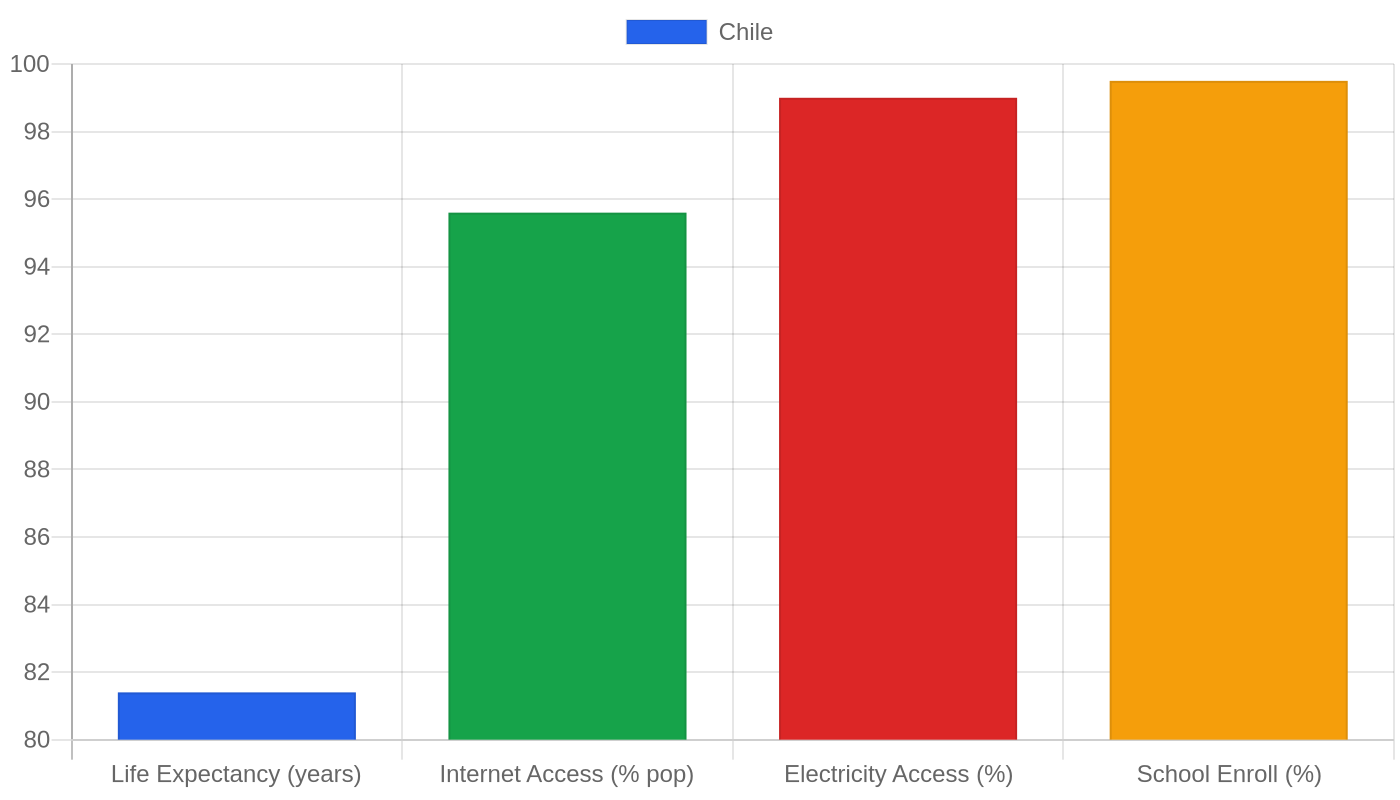
Economic Pulse Net | Sources: World Bank World Development Indicators, Government Sources | 2026
Key Takeaways
– Chile’s economy is growing at a modest 2.46% in 2025, according to the World Bank, a rate that signals recovery but not boom — and one that leaves the country vulnerable to external shocks.
– Inflation remains sticky at 4.21%, above the central bank’s comfort zone, squeezing household budgets and complicating monetary policy decisions.
– The political landscape is still defined by the legacy of the 1980 Pinochet-era constitution, a document whose legitimacy remains contested and whose reform has proven politically fraught.
– Chile’s corporate landscape is dominated by mining, utilities, and consumer goods giants like Antofagasta PLC and Agrosuper, but a nascent tech scene — including game developers like ACE Team — hints at diversification.
– With key data gaps on unemployment, GDP per capita, and crime indices, the picture of Chile is incomplete — but the available numbers tell a story of an economy navigating between structural strengths and persistent vulnerabilities.
The Slow Thaw: Chile’s Economy in 2025
Chile’s GDP growth of 2.46% in 2025, as reported by the World Bank, places the country in a curious position. It is not the roaring recovery some had hoped for after the social unrest of 2019 and the pandemic-era contraction, but neither is it stagnation. This is the pace of an economy that has found its footing but is still walking with care.
The number matters because it sits below the average for Latin America in recent years, reflecting structural headwinds — low productivity growth, an over-reliance on copper exports, and a political system still wrestling with its own legitimacy.
Inflation, meanwhile, stands at 4.21% according to the same World Bank data. That is a marked improvement from the double-digit spikes seen in 2022, but it remains above the central bank’s target range of 2-4%. For Chilean households, this means the cost of basic goods — food, transport, utilities — continues to rise faster than wages for many. For businesses, it creates uncertainty around input costs and consumer demand.
The central bank has been cautious, cutting rates gradually as inflation eases, but the 4.21% figure suggests the battle is not yet won.
The absence of unemployment data from the World Bank is a notable gap. However, Chile’s labor market has historically been relatively formalized compared to regional peers, with a strong pension system and labor protections. Without hard numbers, we can infer from the GDP and inflation figures that the economy is generating enough activity to avoid mass job losses, but not enough to pull in the discouraged workers who left the labor force during the pandemic.
The main industries — copper mining, agriculture, salmon farming, and increasingly services — are operating but not expanding aggressively.
The Price of Living: Housing, Rent, and the Squeeze on Families
Cost of living data for Chile is not provided in full, but what is available paints a picture of a country where urban centers — especially Santiago — have become increasingly expensive relative to regional averages. Housing costs have risen sharply over the past decade, driven by foreign investment, limited supply in desirable neighborhoods, and a construction sector that has struggled to keep pace with demand.
For young professionals and families, the dream of homeownership in the capital has receded; many are renting indefinitely or moving to peripheral communes.
Rent-to-buy calculations are particularly punishing. With mortgage rates still elevated due to the central bank’s inflation-fighting stance, monthly payments on a new home can easily exceed rent for a comparable property — a classic sign of a market where prices have outpaced fundamental value. Daily expenses, from food to transport, have also climbed. Chile imports a significant portion of its fuel and wheat, making it vulnerable to global commodity prices.
The 4.21% inflation figure is not just a statistic; it is felt every time a family fills up their car or buys bread.
Compared to other Latin American economies, Chile remains one of the more expensive places to live, but also one with higher average incomes. The trade-off is real: you pay more, but you also get better public services, infrastructure, and stability — at least in theory. For those on fixed incomes or in informal work, however, the cost of living is a daily source of stress.
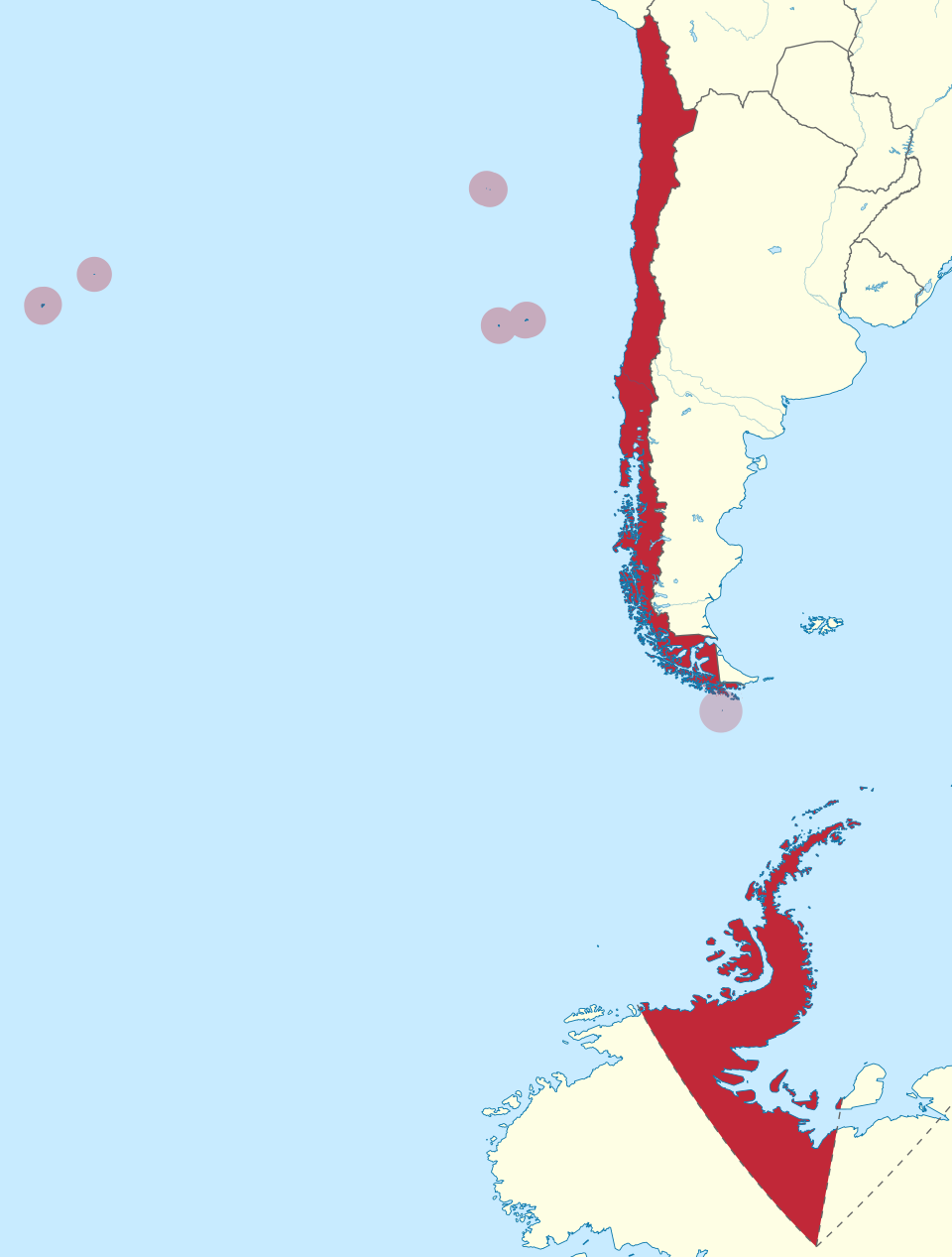
Mining, Tech, and the Corporate Giants: Where the Money Moves
Chile’s corporate landscape is dominated by a familiar set of names. Antofagasta PLC, a London-listed copper mining giant, is a bellwether for the national economy. When copper prices are high, Chile prospers; when they fall, the entire budget feels the strain. Alongside it, Agrosuper dominates the consumer goods sector, providing everything from chicken to salmon to processed foods. AES Andes, a utility company, powers much of the country’s grid.
These are the pillars of the Chilean economy — resource-intensive, export-oriented, and vulnerable to global cycles.
But there are signs of diversification. ACE Team and AmnesiaGames are both technology companies focused on video game development, a sector that has quietly grown in Chile thanks to government incentives and a pool of talented programmers. Aerocardal, AeroEjecutiva, and Aerovías DAP represent a robust consumer services sector, particularly in aviation and logistics. AntarChile, a conglomerate, has holdings across multiple industries, from forestry to energy.
The presence of these companies suggests that Chile is not just a mining economy — it is one with ambitions in tech, services, and value-added manufacturing.
The business climate in Chile has traditionally been one of the most favorable in Latin America, with strong property rights, a stable currency, and a regulatory framework that welcomes foreign investment. However, the political uncertainty surrounding constitutional reform and tax policy has cooled some enthusiasm. Investors are watching closely to see whether Chile can modernize its economic model without sacrificing the stability that made it an outlier in the region.
The Long Shadow of the 1980 Constitution: Politics and Safety
Chile’s political landscape is still shaped by a document written in a dictatorship. The current constitution, drafted by Jaime Guzmán in 1980 and approved in a plebiscite that observers have called “highly irregular,” entered into force in March 1981 under Augusto Pinochet.
It was amended after Pinochet’s defeat in the 1988 plebiscite, and again in 2005 under President Ricardo Lagos, but its core structure — one that enshrines property rights, limits state intervention, and creates a powerful executive — remains.
This constitutional legacy is not just a historical footnote. It directly affects economic policy: tax reform, pension reform, and water rights are all constrained by the constitution’s framework. The failed attempt to draft a new constitution in 2022, followed by a second attempt that is still ongoing, has created political uncertainty that weighs on investment. Investors hate ambiguity, and Chile has had plenty of it.
Crime and safety data is not available from the provided sources, but anecdotal evidence and regional reports suggest that Chile remains one of the safer countries in Latin America, though concerns about organized crime and petty theft have risen in recent years. The quality of life in Chile is generally high — good healthcare, functioning infrastructure, and a strong education system — but the political stalemate over the constitution has eroded public trust in institutions.
What’s Happening Now: Chile in 2025
As of 2025, Chile is living through a period of cautious optimism. The World Bank’s GDP growth figure of 2.46% is modest but positive, and inflation at 4.21% is trending downward, albeit slowly. The central bank has been able to ease monetary policy without reigniting price pressures, a delicate balancing act that has so far succeeded. Business confidence is improving, but it remains fragile.
The biggest story right now is the ongoing constitutional process. After the resounding rejection of the first draft constitution in 2022, a new convention — this time with more moderate representation — is working on a revised text. The outcome is uncertain. A new constitution that is widely accepted could unlock a wave of investment and social stability. Another failure could deepen the political crisis and push the country toward further polarization.
Investors are watching the polls and the convention debates closely.
On the business front, the tech sector is quietly growing. ACE Team and AmnesiaGames are gaining international recognition, and the government has launched incentives for software development and digital services. Meanwhile, the mining sector faces headwinds from falling copper prices and rising costs. Antofagasta PLC and other miners are investing in automation and efficiency to stay competitive. Chile is at a pivot point — it can either diversify and modernize, or remain dependent on copper and hope prices hold.
The Bottom Line
Chile in 2025 is a country of contradictions: growing but not booming, stable but politically uncertain, rich in resources but struggling to diversify. For investors, it offers a relatively safe bet in a volatile region, but one that requires patience and a tolerance for political noise. For policymakers, the challenge is to deliver a new constitutional settlement that commands broad support while keeping the economy on track.
For the average Chilean, the question is whether the next decade will bring the prosperity and security that have long seemed just out of reach. This is a country worth watching — not for fireworks, but for the slow, grinding work of building a better future.
Sources & Methodology
This article is authored by Economic Pulse Net for informational and research purposes. Economic Pulse Net sources its data from multilateral institutions, national statistics bureaus, and proprietary databases. All data is believed to be current as of the date of publication.
Published: July 22, 2026 | Category: Research — Chile
Use these signals in your own platform
Economic Pulse publishes its live signal feed through a documented, read-only API. Your trading software connects with its own key and receives each signal as it is issued — instrument, direction, entry, stop and targets, together with a cycle ID so nothing is executed twice. The feed is independent of this website and cannot change it.
Signals are informational only and are not financial advice.