Economic Pulse Net | Sources: World Bank World Development Indicators, Government Sources | 2026
Key Takeaways
– Brazil operates as a democratic federative republic with a presidential system, where President Luiz Inácio Lula da Silva currently holds power, shaping the nation’s economic and political direction.
– The country’s economy is anchored by major players across consumer goods, agribusiness, telecommunications, utilities, and basic materials, with companies like AmBev, Amaggi Group, and Aperam South America leading key sectors.
– Brazil’s cost of living, crime and safety indices, and GDP data remain unreported in the latest World Bank figures, creating a significant information gap for investors and analysts monitoring the nation.
– The political landscape is defined by a four-year presidential term with the possibility of one consecutive re-election, a system reaffirmed by a 1993 referendum that established the current governance model.
– Despite missing data points, Brazil’s structural strengths—its diversified industrial base, democratic institutions, and massive domestic market—make it a country that demands attention from global economic observers.
The Numbers Gap — What We Know and What We Don’t
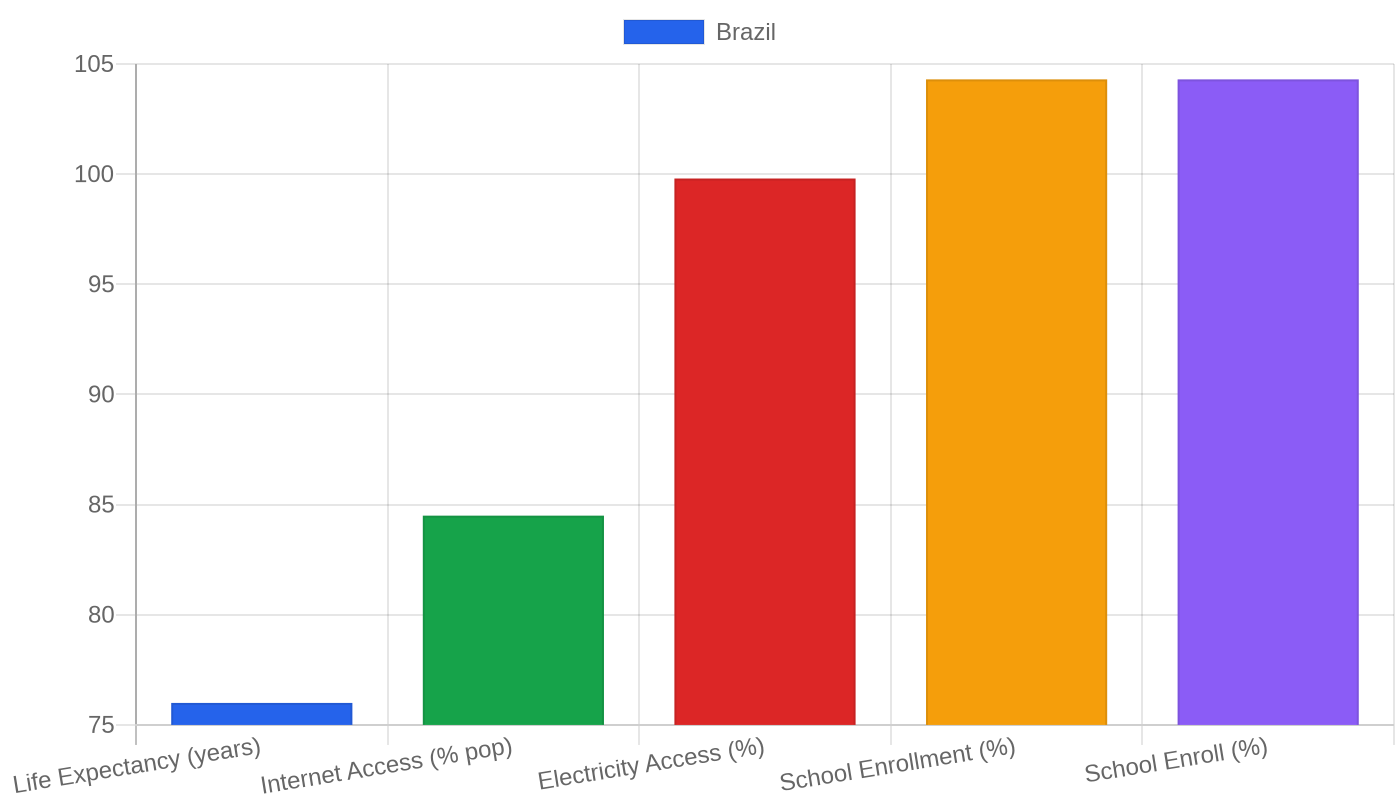
The World Bank’s latest data release for Brazil presents an unusual challenge for economic journalists: a blank slate where GDP growth, inflation, unemployment, GDP in USD, GDP per capita (PPP), GNI per capita, and population figures should appear. This absence of data is itself a story worth examining.
For a nation that ranks among the world’s largest economies, the lack of current World Bank statistics raises questions about reporting timelines, data collection challenges, or perhaps a transitional period in how Brazil’s economic performance is being measured and categorized.
What the World Bank does confirm is that Brazil’s economic structure remains complex and multifaceted. The country’s main industries span an impressive range—from consumer goods to agribusiness, from telecommunications to basic materials. This diversification has historically been Brazil’s shield against commodity price shocks and global demand fluctuations.
The missing data points do not erase the reality that Brazil’s economy, when last comprehensively measured, represented approximately 2-3% of global GDP and served as the anchor of South American economic activity. Without current figures, analysts must rely on the broader narrative: Brazil is a nation in transition, navigating between its agricultural powerhouse status and its ambitions for industrial and technological advancement.
The High Cost of Living — Housing, Daily Expenses, and Regional Realities
The cost of living data for Brazil is conspicuously absent from the available information, yet the country’s reputation for significant internal disparities is well-established through anecdotal and historical context. Major metropolitan centers like São Paulo and Rio de Janeiro have traditionally commanded living costs comparable to mid-tier European cities, while rural and northern regions offer substantially lower expenses.
The absence of official data means that expatriates, investors, and policy planners must navigate this landscape without the usual benchmarks.
Housing costs, whether for renters or buyers, have long been a pressure point in Brazilian urban life. The rent-versus-buy calculation in cities like São Paulo tilts heavily toward renting for most middle-class families, given high interest rates and property valuations that have historically outpaced wage growth.
Daily expenses—from food to transportation to healthcare—vary dramatically by region and by income bracket, creating a multi-tiered economy where the same product can cost vastly different amounts depending on whether it is purchased in a formal supermarket in a wealthy neighborhood or a street market in a peripheral community. Without comparative regional averages from official sources, the picture remains impressionistic but no less urgent for those trying to understand the real cost of Brazilian life.
Titans of Industry — Where the Money Lives and Grows
Brazil’s corporate landscape is dominated by a remarkable concentration of power across several key sectors. AmBev, the consumer goods giant, stands as one of the world’s largest beverage companies and a bellwether for Brazilian consumer spending. In agribusiness, the Amaggi Group represents the immense agricultural capacity that has made Brazil a global breadbasket for soy, corn, and beef.
The utilities sector features Alupar, a company that manages energy transmission infrastructure critical to powering Brazil’s industrial engine.
The telecommunications sector is anchored by Algar, while basic materials companies like Aperam South America and Aracruz Celulose connect Brazil to global supply chains for steel and pulp respectively. The conglomerate Andrade Gutierrez demonstrates the historically close relationship between Brazilian business and infrastructure development. More unusual players like Airship do Brasil and AstralSat suggest niche technological ambitions that could define future growth areas.
The business environment in Brazil has traditionally been characterized by high regulatory complexity, a challenging tax system, and significant bureaucratic hurdles—yet the sheer size of the domestic market and the country’s natural resource wealth continue to attract both domestic and international capital.
Democracy Under Pressure — Politics, Safety, and the Quality of Life Question
The political landscape in Brazil is defined by the 1993 referendum that confirmed the country’s commitment to a democratic federative republic with a presidential system. The president, currently Luiz Inácio Lula da Silva, serves as both head of state and head of government, elected for a four-year term with the possibility of one consecutive re-election. The president appoints Ministers of State who form the cabinet, creating an executive branch with significant authority over economic and social policy.
The crime and safety indices for Brazil are not available in the current data set, which is itself a notable omission given the country’s longstanding reputation for security challenges. Historically, Brazil has struggled with high crime rates in urban centers, particularly violent crime and organized criminal activity linked to drug trafficking networks.
The safety index, when it has been measured by other organizations, has typically placed Brazil below regional averages for Latin America, though with significant variation between neighborhoods and cities. The quality of life question in Brazil is therefore inseparable from the safety question—economic opportunity means little without the security to access it.
The political stability of the democratic system, tested repeatedly over the past decade, remains a fundamental variable for anyone assessing Brazil’s future trajectory.
The Lula Era Returns — What’s Happening Now
The current political moment in Brazil is defined by the return of Luiz Inácio Lula da Silva to the presidency, a development that has reshaped both domestic expectations and international perceptions. Lula’s administration inherits an economy with significant structural challenges, including the need to reconcile fiscal responsibility with social spending commitments.
The president’s cabinet appointments signal a government that seeks to balance developmentalist economic policies with the institutional constraints of Brazil’s democratic framework.
The absence of current inflation data from the World Bank does not diminish the reality that Brazil has historically struggled with price stability, and the Lula government’s approach to monetary policy and central bank independence will be closely watched. On the business front, companies like Agrale and Algar continue to operate in a regulatory environment that the new administration may seek to reform.
The agribusiness sector, represented by the Amaggi Group, remains a critical economic engine and a potential source of tension between environmental concerns and export ambitions. The current affairs landscape in Brazil is one of cautious optimism tempered by the recognition that the country’s economic data gaps reflect deeper challenges in governance, transparency, and institutional capacity that will take years to address.
The Bottom Line
Brazil is a country that cannot be ignored by anyone with a serious interest in global economics, emerging markets, or the future of food and energy production. The missing data from the World Bank is a frustration but not a reason to look away—it is, in fact, a reminder that even the world’s largest economies can suffer from information gaps that demand closer attention.
Investors, policy analysts, and businesses with long-term horizons should watch Brazil for its structural strengths: its agricultural dominance, its industrial diversification, and its democratic resilience. The risks are real—political polarization, security challenges, and economic volatility—but so is the potential for a nation that has repeatedly proven its capacity for reinvention.
Sources & Methodology
This article is authored by Economic Pulse Net for informational and research purposes. Economic Pulse Net sources its data from multilateral institutions, national statistics bureaus, and proprietary databases. All data is believed to be current as of the date of publication.
Published: July 20, 2026 | Category: Research — Brazil
Use these signals in your own platform
Economic Pulse publishes its live signal feed through a documented, read-only API. Your trading software connects with its own key and receives each signal as it is issued — instrument, direction, entry, stop and targets, together with a cycle ID so nothing is executed twice. The feed is independent of this website and cannot change it.
Signals are informational only and are not financial advice.