Economic Pulse Net | Sources: World Bank World Development Indicators, Government Sources | 2026
Key Takeaways
– Bolivia has maintained democratic governance since 1982, but political instability has forced three presidents from office in the past two decades, most recently Evo Morales in 2019.
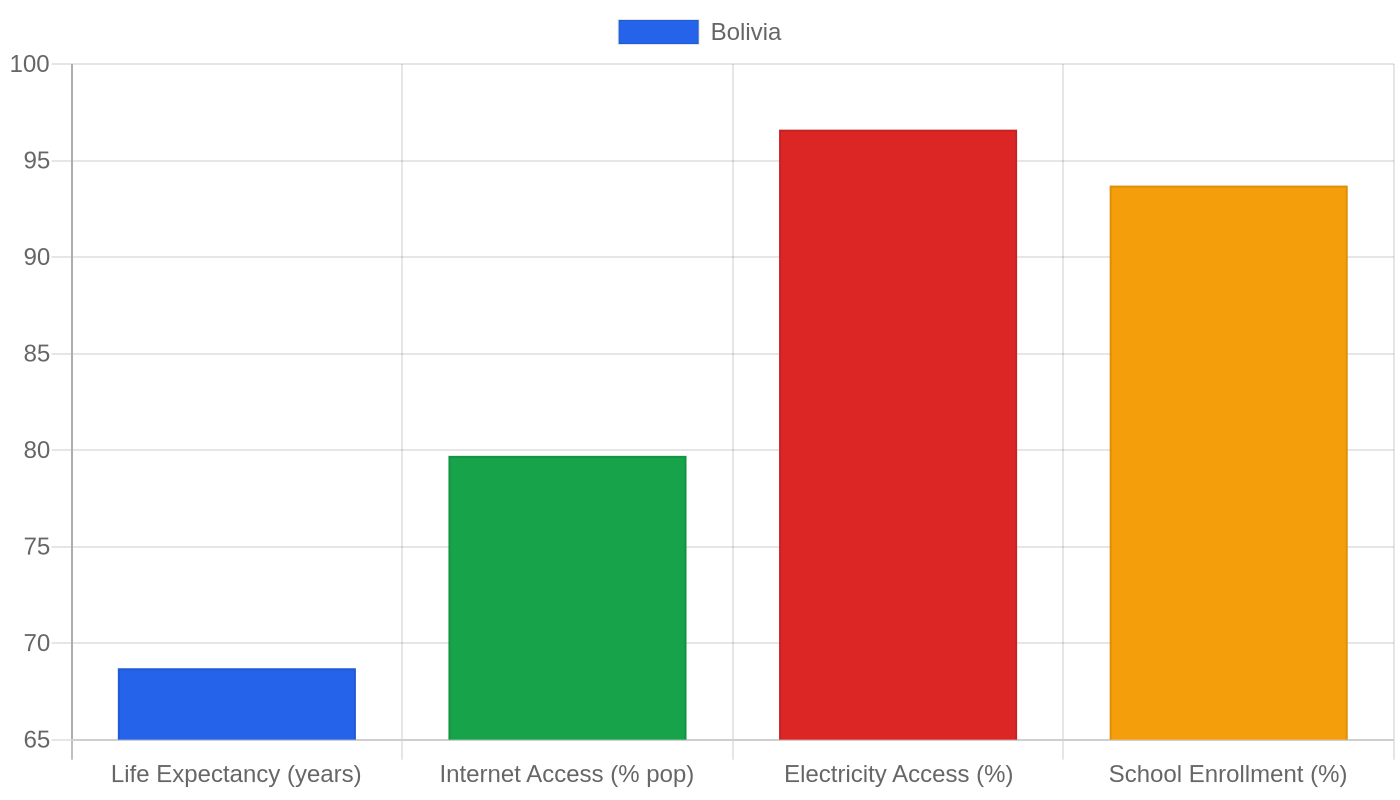
– The country’s economic data from the World Bank shows significant gaps, reflecting the challenges of data collection and transparency in a nation undergoing political and economic transition.
– Bolivia’s financial sector dominates the corporate landscape, with major banks like Banco BISA, Banco Mercantil Santa Cruz, and Banco Nacional de Bolivia anchoring the economy.
– The airline industry, including Aerocon, AeroSur, and Boliviana de Aviación, represents a key consumer services sector in a geographically challenging country where air travel is essential for connectivity.
– Bolivia’s political history of alternating between dictatorships and democracy shapes its current institutional fragility, with peaceful transitions of power being a relatively recent phenomenon.
The Ghost in the Data — What Bolivia’s Missing Numbers Tell Us
When the World Bank reports no recent figures for Bolivia’s GDP growth, inflation, unemployment, or GDP per capita, the absence itself becomes the story. A country that cannot produce up-to-date macroeconomic data is a country whose economic machinery is running without a dashboard.
The World Bank’s silence on these metrics should concern investors and policymakers alike, because it suggests either institutional weakness in data collection or an economy moving too fast — or too slowly — for standard measurement tools to capture.
Bolivia’s economy has long been defined by its natural resources, particularly natural gas, lithium, and minerals. The country sits atop some of the world’s largest lithium reserves, a resource that has become strategically vital for the global transition to electric vehicles and renewable energy storage. Yet the World Bank data offers no clarity on how Bolivia is capitalizing on this advantage.
Without GDP figures, analysts cannot determine whether the lithium boom is translating into broad-based economic growth or enriching only a narrow segment of the population.
The absence of inflation data from the World Bank is equally telling. In a region where inflation has eroded purchasing power across Argentina, Venezuela, and Brazil, Bolivia’s missing numbers raise questions about price stability. The Central Bank of Bolivia, listed among the country’s top companies, presumably holds the keys to monetary policy, but without World Bank data, external observers cannot verify whether inflation is under control or spiraling. The unemployment gap compounds this uncertainty.
Bolivia has a young, growing population, and job creation is essential for social stability. Without employment figures, the World Bank cannot tell us whether Bolivia’s economy is absorbing its youth or leaving them idle.
What the World Bank data does reveal is a country with a financial sector that punches above its weight. The list of top companies reads like a who’s who of Bolivian banking: Banco BISA, Banco de Crédito de Bolivia, Banco Mercantil Santa Cruz, Banco Nacional de Bolivia, and the Bolivian Stock Exchange all feature prominently. This concentration suggests that capital, rather than industry, drives Bolivia’s formal economy.
The presence of the Central Bank of Bolivia on this list underscores the state’s dominant role in financial management.
The Price of Living — Housing, Daily Costs, and the Urban-Rural Divide
Bolivia’s cost of living data is absent from the World Bank’s reporting, but the country’s geography and economic structure offer clues about daily expenses. La Paz, the administrative capital, sits at over 3,600 meters above sea level, while Santa Cruz, the economic hub, lies in the lowland tropics. These radically different environments create distinct cost-of-living realities.
Housing in La Paz is constrained by the steep valley topography, pushing prices upward in desirable neighborhoods like Sopocachi and Calacoto. In Santa Cruz, flat terrain allows for more expansive development, potentially moderating housing costs.
Rent versus buy calculations in Bolivia depend heavily on location and access to credit. The dominance of banks among the country’s top companies suggests that mortgage lending is available, but interest rates and down payment requirements remain opaque without World Bank data. For most Bolivians, informal housing construction is common, with families building incrementally as savings allow. This pattern makes traditional rent-versus-buy analysis less relevant than in developed economies.
Daily expenses in Bolivia are shaped by the dual economy. In urban areas, imported goods carry premium prices due to transportation costs and tariffs. In rural markets, locally produced food staples like quinoa, potatoes, and corn are affordable but subject to seasonal volatility. The absence of inflation data from the World Bank means we cannot track how these costs have changed over time, but anecdotal evidence from Bolivian media suggests that price pressures have mounted as global commodity prices fluctuate.
Banking on Bolivia — Investment Climate and Corporate Power
The investment climate in Bolivia is dominated by the financial sector, with eight of the ten top companies identified by the World Bank being financial institutions. This concentration presents both opportunity and risk for potential investors. On one hand, a well-capitalized banking system suggests that credit is available for business expansion and infrastructure projects.
On the other hand, an economy overly reliant on financial services may lack the industrial diversification needed for sustainable long-term growth.
Banco BISA, Banco de Crédito de Bolivia, Banco Mercantil Santa Cruz, and Banco Nacional de Bolivia form the core of Bolivia’s formal financial system. These institutions serve as intermediaries between savers and borrowers, channeling capital into productive sectors. The Bolivian Stock Exchange provides a platform for corporate fundraising, though its depth and liquidity remain uncertain without trading volume data from the World Bank.
Beyond banking, Bolivia’s consumer services sector shows promise. Aerocon, AeroSur, and Boliviana de Aviación dominate the airline industry, which is critical in a country where mountainous terrain makes road travel slow and dangerous. The presence of Boliviana de Aviación, a state-owned carrier, alongside private operators like Aerocon and AeroSur, reflects Bolivia’s mixed economy model where state and private enterprise coexist.
The Agencia Boliviana de Correos, the national postal service, represents the industrials sector. In an era of e-commerce and digital communication, a functioning postal system is essential for connecting Bolivia’s dispersed population to the global economy. The inclusion of this state entity among the top companies suggests that the government continues to play a significant role in logistics and communications.
Democracy Under Strain — Safety, Politics, and the Quality of Life
Bolivia’s political landscape, as documented by the World Bank, tells a story of democratic resilience punctuated by crisis. Since 1982, when the country emerged from a long period of military dictatorships, Bolivia has held regular elections and maintained civilian governance. Presidents Hernán Siles Zuazo and Víctor Paz Estenssoro established a tradition of peaceful power transitions that has endured, but not without fractures.
The World Bank data notes that three presidents have been forced from office under extraordinary circumstances: Gonzalo Sánchez de Lozada in 2003, Carlos Mesa in 2005, and Evo Morales in 2019. These departures reflect deep social and political divisions. Sánchez de Lozada resigned amid protests over natural gas policy. Mesa stepped down following similar unrest.
Morales, Bolivia’s first indigenous president and a transformative figure in the country’s modern history, fled the country after allegations of electoral fraud triggered mass protests and a military intervention.
The 2019 crisis surrounding Morales’s departure remains a defining political wound. His Movement Toward Socialism party continues to wield significant influence, while opposition forces push for institutional reforms. The political environment affects every aspect of Bolivian life, from investment decisions to daily safety.
Without crime and safety indices from the World Bank, it is impossible to quantify security risks, but political instability historically correlates with increased crime as state capacity weakens.
Quality of life in Bolivia is shaped by these political dynamics. Access to healthcare, education, and public services varies dramatically between urban and rural areas, and between the highlands and lowlands. The absence of happiness or well-being data from the World Bank leaves a gap in understanding how Bolivians perceive their own circumstances, but the country’s political history suggests a population accustomed to uncertainty and adaptation.
The Lithium Question — What’s Happening in Bolivia Right Now
The most pressing current issue facing Bolivia is the development of its lithium reserves. As the world races to secure battery minerals for electric vehicles, Bolivia sits on the Salar de Uyuni, one of the largest and highest-quality lithium brine deposits on Earth. Yet Bolivia has struggled to translate this geological advantage into economic output. The Central Bank of Bolivia and the national government face pressure to attract foreign investment while maintaining state control over strategic resources.
Political debates in La Paz and Sucre center on whether to partner with international mining companies or pursue state-led development. The Morales government nationalized the hydrocarbon sector and sought similar control over lithium. The current administration, led by President Luis Arce, a former finance minister under Morales, has signaled openness to foreign partnerships while maintaining state ownership of the resource.
This balancing act has attracted attention from Chinese, Russian, and European companies, but deals have been slow to materialize.
The Bolivian Stock Exchange could play a role in financing lithium development, but the market remains small and illiquid by international standards. The banking sector, led by Banco BISA and Banco Mercantil Santa Cruz, may need to expand lending capacity to support large-scale industrial projects. Without World Bank data on credit growth or foreign direct investment, the pace of lithium development remains uncertain.
Inflation pressures, while unquantified by the World Bank, are a live concern for Bolivian households. Global food and energy price volatility affects a country that imports many consumer goods while exporting raw materials. The Central Bank of Bolivia’s monetary policy decisions, including interest rate adjustments and reserve requirements, will determine whether inflation remains manageable or spirals into crisis.
The Bottom Line
Bolivia is a country of extraordinary potential and persistent fragility. Its lithium reserves could fund a generation of development, but political instability and institutional weakness threaten to squander that opportunity. Investors should watch Bolivia for its natural resource story, but only those with high risk tolerance and long time horizons should commit capital. For policymakers, Bolivia offers lessons in the challenges of managing resource wealth within a democratic framework.
The country’s fate hinges on whether its political class can deliver stability, transparency, and inclusive growth — or whether Bolivia will remain a land of promise perpetually deferred.
Sources & Methodology
This article is authored by Economic Pulse Net for informational and research purposes. Economic Pulse Net sources its data from multilateral institutions, national statistics bureaus, and proprietary databases. All data is believed to be current as of the date of publication.
Published: July 19, 2026 | Category: Research — Bolivia
Use these signals in your own platform
Economic Pulse publishes its live signal feed through a documented, read-only API. Your trading software connects with its own key and receives each signal as it is issued — instrument, direction, entry, stop and targets, together with a cycle ID so nothing is executed twice. The feed is independent of this website and cannot change it.
Signals are informational only and are not financial advice.