Economic Pulse Net | Sources: World Bank World Development Indicators, Government Sources | 2026
Key Takeaways
– A Democratic Exception: Bolivia has maintained democratically elected governments since 1982, a remarkable feat in a region often marked by instability, though the road has included three presidents stepping down under extraordinary pressure.
– A Financial Core: The nation’s economic backbone is anchored by a powerful financial sector, including Banco BISA, Banco Mercantil Santa Cruz, and the Central Bank of Bolivia, alongside a state-driven aviation industry.
– A Story of Political Rupture: The legacy of Evo Morales’s 2019 resignation continues to shape the national conversation, highlighting deep political fractures that influence economic policy.
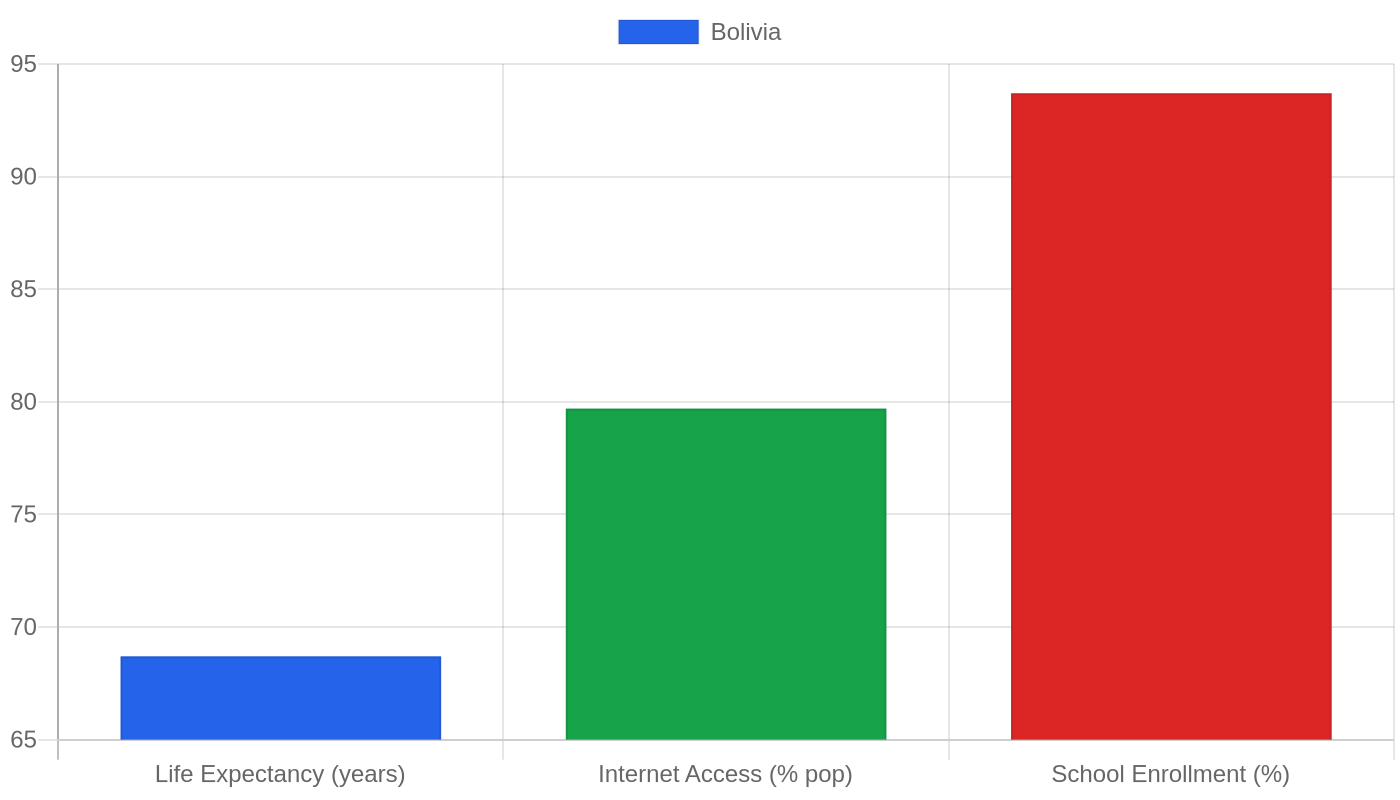
– A Data Vacuum: With key economic indicators like GDP growth and inflation currently unavailable from the World Bank, the focus shifts to structural realities and the resilience of its core industries.
– A Nation in Transition: Bolivia is not a story of boom or bust, but of a patient, resource-rich nation navigating a complex political landscape to find its footing in a volatile global economy.
The Long View: The Numbers We Have, and the Story They Tell
For a country that sits on some of the world’s most significant natural gas and lithium reserves, Bolivia’s latest economic dashboard from the World Bank is conspicuously blank. There is no headline GDP growth figure, no inflation CPI, and no unemployment rate to parse. In many financial capitals, this absence of data would be treated with suspicion.
But for Bolivia, the silence of the spreadsheets speaks to a broader reality: this is an economy in a holding pattern, one where the formal metrics have yet to catch up with the lived experience of its citizens.
We must, therefore, look at the structures that do exist. The World Bank’s list of top companies is dominated by financial institutions — Banco BISA, Banco de Crédito de Bolivia, Banco Mercantil Santa Cruz, and Banco Nacional de Bolivia. This is a telling detail. A robust banking sector, even in a data vacuum, suggests a formal economy that is functioning, with capital circulating through established channels.
The presence of the Bolivian Stock Exchange on this list is equally significant; it signals an attempt to formalize investment and provide a platform for corporate growth, even if its depth and liquidity remain limited compared to regional giants.
The real economic narrative, however, is likely found in the extractive industries and agriculture, sectors that are often less visible in corporate registries but dominate the export ledger. Bolivia’s economy has historically been a commodity play, vulnerable to global price swings for natural gas, minerals, and soy. Without current data, we can infer that the country is likely experiencing the classic symptoms of a commodity-dependent nation: volatility.
The Central Bank of Bolivia, as a top company, underscores the state’s heavy hand in managing this volatility, often using reserves to subsidize fuel and food to keep domestic prices stable. The absence of inflation data from the World Bank does not mean prices are stable; it means we lack the precise metric to measure the pressure. The economy is a patient giant, reliant on its financial infrastructure to weather the storms that come with its resource wealth.
The Cost of Living: A Tale of Two Economies
In Bolivia, the cost of living is a story of duality. On one hand, the formal economy, anchored by the financial giants listed by the World Bank, operates with a certain standard of pricing for goods and services. On the other, the informal sector—the sprawling markets of El Alto and La Paz—sets the true price of daily survival. Without specific housing cost indices from the World Bank, we can look at the structural reality: Bolivia is a country where the gap between the formal and informal economy is vast.
The presence of a state-backed airline, Boliviana de Aviación, alongside legacy carriers like AeroSur and Aerocon, suggests that domestic connectivity is treated as a public utility, which can influence regional price convergence. However, the cost of living for the average Bolivian is heavily subsidized by the state, particularly through fuel and food price controls. This is a double-edged sword: it keeps the cost of living low for consumers, but it creates a massive fiscal burden for the government.
For a potential expatriate or investor, the lack of hard data on housing costs means that the market is less transparent and potentially more volatile. Renting in the major cities is generally more common than buying, due to high interest rates and a lack of long-term mortgage financing. The daily expenses are manageable for those earning in dollars, but for the local population earning in bolivianos, the pressure is real. The economic model is built on stability, but that stability comes at the cost of dynamism.
The Investment & Business Climate: Banking on Stability
For investors, the World Bank’s company list is the clearest signal of where the safe havens are: the banks. Banco Mercantil Santa Cruz and Banco BISA are not just financial institutions; they are the pillars of the Bolivian economy, acting as intermediaries for everything from micro-loans to corporate financing. The presence of the Central Bank of Bolivia as a top entity reinforces the notion that this is a state-guided economy.
Investment opportunities exist, but they are heavily regulated and often require navigating a complex web of bureaucratic requirements.
The sectors to watch are the ones that dominate the corporate registry: financials and consumer services. The aviation industry, represented by Boliviana de Aviación, is a key player, but it operates in a challenging environment due to the country’s rugged geography. The business climate is not for the faint-hearted. It requires patience, local partnerships, and a deep understanding of the political landscape.
The Bolivian Stock Exchange offers a potential exit route for investors, but it is a shallow market. The real opportunity lies in the long-term play: the country’s lithium reserves are a future asset, but one that requires massive capital investment and political stability to unlock. For now, the private sector is dominated by the financial institutions that have learned to thrive within the state-centric model.
Safety, Politics & Quality of Life: The Weight of the Past
The political landscape in Bolivia is the most defining feature of its quality of life. As the World Bank data notes, Bolivia has been a democracy since 1982, a point of pride. Yet, the list of presidents who have stepped down early—Gonzalo Sánchez de Lozada in 2003, Carlos Mesa in 2005, and Evo Morales in 2019—reveals a nation that is frequently on the brink of institutional crisis.
The resignation of Evo Morales, a towering figure who led the country for nearly 14 years, was not a quiet transition; it was a rupture that exposed deep ethnic, economic, and regional divisions. This political volatility directly impacts the perception of safety and the overall quality of life.
While the World Bank does not provide a crime index for Bolivia, the political instability suggests a society where social tensions can boil over into protests and blockades, which are common tools of political pressure. The safety of the average citizen is less about street crime and more about the stability of the state.
The quality of life is a mixed bag: the country boasts a rich cultural heritage and a strong sense of community, particularly among its indigenous majority, but this is often overshadowed by economic uncertainty and political gridlock. The democratic tradition is real, but it is a fragile one. The fact that power has been ceded peacefully since 1982 is a testament to the strength of its institutions, but the frequency of early departures suggests that those institutions are often tested to their limits.
For the people, life goes on, but it is a life lived with the knowledge that the political ground can shift beneath their feet at any moment.
What’s Happening Now: The Echoes of 2019
The most pressing current affair in Bolivia is not a new policy or a market shift; it is the lingering shadow of the 2019 political crisis. The departure of Evo Morales was not the end of the story, but the beginning of a new, uncertain chapter. The political factions that clashed then have not reconciled; they have merely regrouped.
The current government, which emerged from the post-2019 elections, is tasked with the monumental challenge of unifying a fractured nation while managing an economy that lacks fresh data and faces headwinds from global commodity price fluctuations.
The Central Bank of Bolivia is likely under immense pressure to maintain the currency peg and control inflation, but without the World Bank’s latest CPI figures, we are left to infer that this is a battle being fought with dwindling reserves. The financial institutions on the World Bank’s list are the frontline soldiers in this fight, tasked with maintaining liquidity and confidence in a system that is politically fragile.
The presence of the Bolivian Stock Exchange suggests a push for more formal investment, but the political risk premium remains high. The country is not in freefall, but it is in a state of suspended animation, waiting for a political consensus that has yet to materialize. The focus is inward, on resolving the domestic impasse, rather than outward, on attracting foreign capital. Bolivia is a nation holding its breath, and the sound you hear is not a boom, but the quiet rustling of patience.
The Bottom Line
Bolivia is a market for the patient and the brave. It is not a destination for those seeking quick returns or high liquidity; it is a country for those who understand that its true value lies in its long-term potential. The financial sector offers a stable, if unexciting, entry point, while the political landscape demands constant attention and risk assessment.
Watch Bolivia if you are interested in the future of energy, the resilience of democratic institutions in the face of populist pressure, and the slow, painstaking work of building an economy that benefits all its citizens. It is a country that has survived dictatorships and economic shocks, and it will likely survive this period of uncertainty, but the path forward will be neither smooth nor fast.
Sources & Methodology
This article is authored by Economic Pulse Net for informational and research purposes. Economic Pulse Net sources its data from multilateral institutions, national statistics bureaus, and proprietary databases. All data is believed to be current as of the date of publication.
Published: August 02, 2026 | Category: Research — Bolivia
Use these signals in your own platform
Economic Pulse publishes its live signal feed through a documented, read-only API. Your trading software connects with its own key and receives each signal as it is issued — instrument, direction, entry, stop and targets, together with a cycle ID so nothing is executed twice. The feed is independent of this website and cannot change it.
Signals are informational only and are not financial advice.