Economic Pulse Net | Sources: World Bank World Development Indicators, Government Sources | 2026
Key Takeaways
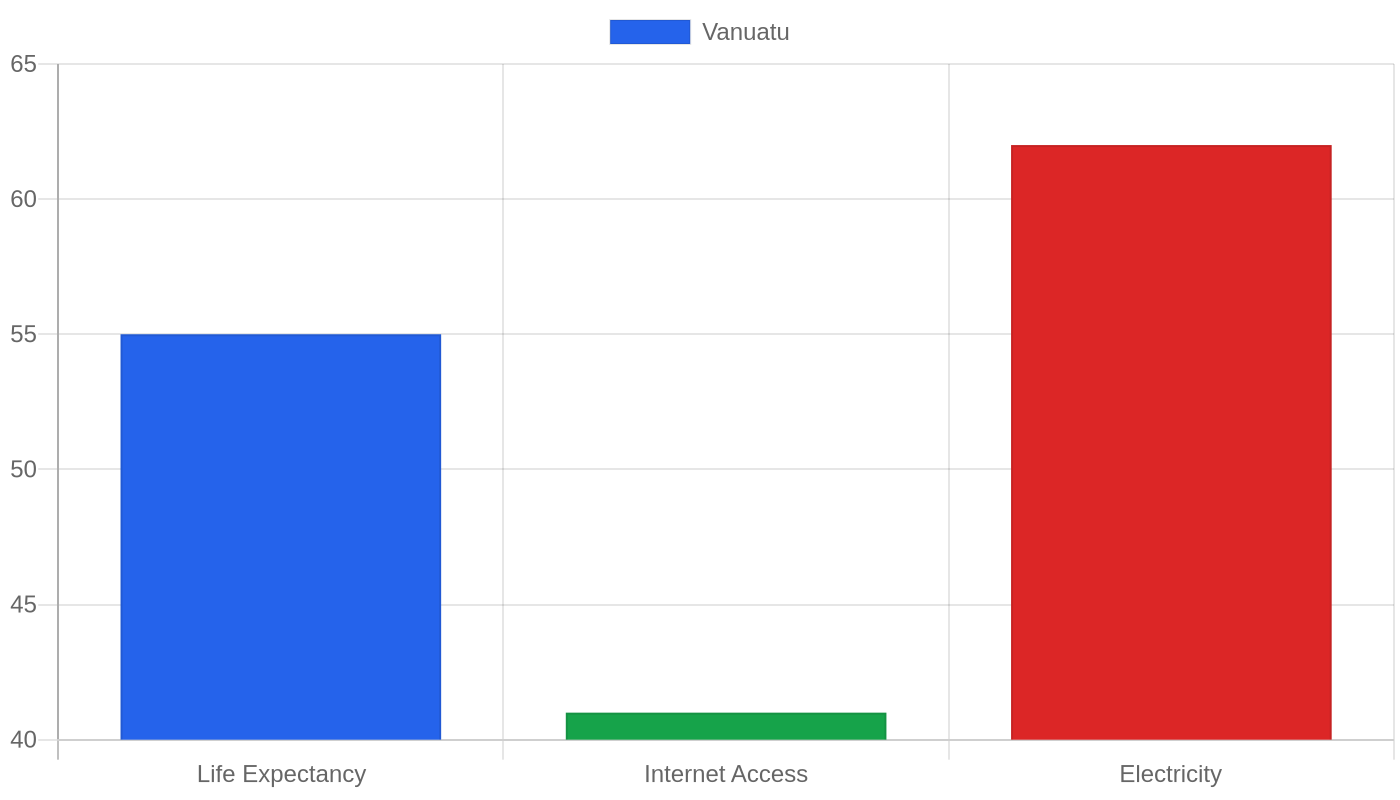
– Vanuatu operates as a stable parliamentary democracy with a ceremonial president, but its economic data remains largely opaque, with the World Bank reporting no figures for GDP growth, inflation, unemployment, or income per capita.
– The country’s political system features a president elected for a five-year term by a two-thirds vote of an electoral college, which includes members of Parliament and regional council presidents—a structure designed to balance central and local power.
– Without key economic indicators from the World Bank, analysts must rely on qualitative assessments of Vanuatu’s development trajectory, which is heavily dependent on agriculture, tourism, and foreign aid.
– The nation’s small population and remote Pacific island geography create unique challenges for economic diversification and data collection, making it one of the least-measured economies in the region.
– Political stability, while constitutionally anchored, faces pressures common to small island developing states, including climate vulnerability and external economic shocks.
The Missing Numbers — What Vanuatu’s Economic Silence Tells Us
The World Bank’s dataset for Vanuatu is striking for what it does not contain. There are no figures for GDP growth, no inflation rate, no unemployment statistics, no GDP in US dollars, no GDP per capita based on purchasing power parity, and no GNI per capita. This absence is not merely a bureaucratic gap—it is a story in itself.
For a nation of scattered islands in the South Pacific, the lack of comprehensive economic data reflects profound structural realities: a small, informal economy where cash transactions dominate, a limited statistical infrastructure, and a development model that resists easy quantification.
Vanuatu’s economy has traditionally relied on three pillars: subsistence agriculture, tourism, and offshore financial services. The agricultural sector employs the majority of the population, with copra, kava, beef, and cocoa as primary exports. Tourism, before the pandemic, accounted for a significant share of foreign exchange earnings, drawing visitors to the archipelago’s volcanic landscapes, coral reefs, and cultural heritage.
The offshore financial sector, while controversial internationally, has provided a stream of revenue through registration fees and licensing.
Without hard numbers from the World Bank, one must look to qualitative signals. The country has faced repeated natural disasters—cyclones, volcanic eruptions, and earthquakes—that have periodically devastated infrastructure and crops. These shocks, combined with global tourism disruptions and the ongoing effects of climate change, suggest an economy under persistent stress.
The absence of inflation data is particularly telling; in small, import-dependent island economies, price volatility is often acute, and the lack of monitoring suggests either limited capacity or a high degree of informality in price-setting.
Employment figures are similarly absent, but in a nation where much of the population engages in subsistence farming and small-scale fishing, formal unemployment statistics may capture only a fraction of economic reality. The World Bank’s silence on these metrics should be read not as a void, but as an invitation to understand Vanuatu on its own terms—an economy where resilience and tradition matter as much as growth rates and inflation targets.
The Price of Paradise — Living Costs in a Remote Archipelago
Housing costs in Vanuatu vary dramatically between the capital, Port Vila on Efate Island, and the outer islands. In Port Vila, rental prices for a modest two-bedroom house can consume a significant portion of local incomes, driven by limited supply, expatriate demand, and the high cost of imported construction materials. On outer islands, housing is often traditional—thatched or corrugated iron structures on customary land—and costs are far lower, but access to services and infrastructure is minimal.
The cost of daily essentials tells a story of dependency. Vanuatu imports the vast majority of its processed foods, fuel, vehicles, and manufactured goods. Rice, flour, canned goods, and cooking oil arrive by ship, and their prices reflect global commodity markets plus shipping and handling markups. Fresh local produce—root crops, fruits, and vegetables—is cheaper in markets but subject to seasonal availability and transport disruptions.
Utilities, particularly electricity generated by diesel generators in many areas, are expensive by regional standards.
Comparing Vanuatu’s cost of living to regional averages is difficult without precise data, but anecdotal evidence from development organizations and expatriate communities suggests that Port Vila is more expensive than comparable Pacific capitals like Honiara or Suva for imported goods, while cheaper for local produce and land-based housing on customary tenure.
The dual economy—cash-based in urban centers, subsistence-based in rural areas—means that “cost of living” means different things to different Vanuatuans. For the majority living on customary land, housing is essentially free, but cash income for school fees, medical costs, and store-bought goods remains a constant pressure.
Business in the Blue Pacific — Investment Climate and Corporate Landscape
Vanuatu’s top companies are not household names internationally, but they dominate the local economy. The sector includes telecommunications firms, shipping and logistics companies, tourism operators, and financial service providers. The business environment is shaped by the country’s legal framework, which combines British common law traditions with French civil law influences, a legacy of the colonial condominium period.
Company registration is relatively straightforward, and there are no capital gains taxes, making Vanuatu attractive for certain types of investment.
The sectors to watch are renewable energy, tourism infrastructure, and agricultural processing. Vanuatu has abundant solar, wind, and geothermal potential, and international development partners have funded pilot projects to reduce diesel dependency. Tourism, while volatile, offers opportunities in eco-lodges, dive operations, and cultural tourism. Agricultural processing—particularly of kava, cocoa, and coconut products—could add value to raw exports and create rural employment.
However, the business climate faces headwinds. The country’s small market size, remote location, and vulnerability to natural disasters deter large-scale foreign investment. Infrastructure—roads, ports, electricity grids—is limited and frequently damaged by cyclones. Land tenure is overwhelmingly customary, meaning that foreign investors cannot own land outright but must lease it from customary owners, a process that can be complex and politically sensitive.
The financial sector is small, and access to credit is limited for local entrepreneurs. These constraints mean that Vanuatu’s business environment is best suited for niche, high-adaptability ventures rather than mass-market operations.
Stability Amid Uncertainty — Politics, Safety, and Life in Vanuatu
The Republic of Vanuatu is a parliamentary democracy with a written constitution, according to the World Bank data. The president, elected for a five-year term by a two-thirds vote of an electoral college, serves as a ceremonial head of state symbolizing national unity. The electoral college comprises members of Parliament and the presidents of Regional Councils, a structure designed to ensure broad representation. The president may be removed by the electoral college, though this mechanism has rarely been tested.
Crime and safety indices are not available from the provided data, but Vanuatu is generally considered a safe country by regional standards. Petty crime exists in urban areas, particularly Port Vila, but violent crime is rare. The larger threats to personal safety come from natural disasters—cyclones, volcanic activity, earthquakes, and tsunamis—rather than from criminal activity. Community-based social structures and the persistence of customary law in many areas contribute to social cohesion.
The political landscape is characterized by frequent changes of government through parliamentary maneuvers rather than elections. Vanuatu has seen multiple no-confidence votes and coalition shifts, reflecting the fragmented nature of its party system. This instability can delay policy implementation and deter long-term investment, but it has not led to civil unrest or authoritarian backsliding.
The constitution’s checks and balances, combined with a free press and active civil society, have maintained democratic governance even amid political turbulence.
Quality of life in Vanuatu is a study in contrasts. For those with access to cash income and urban services, life can be comfortable, with a warm climate, beautiful natural surroundings, and a relaxed pace. For the rural majority, life is physically demanding, with limited access to healthcare, education, and economic opportunity.
The World Bank’s lack of data on income and employment underscores the difficulty of measuring well-being in a context where traditional livelihoods and cash economies coexist uneasily.
The Climate Frontier — What’s Happening Now in Vanuatu
Vanuatu is currently at the forefront of global conversations about climate change and loss and damage. The country has been a vocal advocate at international climate negotiations, pushing for developed nations to compensate vulnerable states for the irreversible impacts of global warming. Cyclones have become more intense, sea levels are rising, and coral reefs are bleaching—all of which directly threaten Vanuatu’s economy and way of life.
On the political front, the government has been navigating the aftermath of recent no-confidence motions and coalition realignments. The stability of the current administration remains uncertain, as is typical in Vanuatu’s fluid parliamentary system. Policy continuity on climate adaptation, infrastructure development, and economic diversification depends on the longevity of the governing coalition.
Business developments include renewed interest in renewable energy projects, supported by grants from international climate funds and bilateral donors. Solar microgrids are being installed in rural areas, reducing diesel costs and improving energy access. The tourism sector is slowly recovering from pandemic-era closures, with boutique resorts and liveaboard dive vessels returning to pre-pandemic occupancy levels.
Kava exports to Pacific diaspora communities and international markets continue to grow, though quality control and regulatory harmonization remain challenges.
The most pressing current issue is climate adaptation financing. Vanuatu’s government has been working with development partners to build cyclone-resistant infrastructure, improve early warning systems, and develop climate-resilient agriculture. These efforts require sustained funding and technical support, which are not guaranteed in an era of competing global priorities.
The country’s success or failure in securing and deploying adaptation finance will shape its economic trajectory for decades to come.
The Bottom Line
Vanuatu is a country that defies easy categorization—a stable democracy with an opaque economy, a paradise of natural beauty confronting the harsh realities of climate change, and a small nation with outsized influence on the global stage. For investors, it offers niche opportunities in tourism, renewable energy, and specialty agriculture, but requires patience with infrastructure limitations and political volatility.
For development economists and policymakers, Vanuatu is a critical case study in how small island states can navigate the twin challenges of economic development and climate survival. Watch this country not for its quarterly GDP figures, but for the lessons it offers about resilience, adaptation, and the future of life on a warming planet.
Sources & Methodology
This article is authored by Economic Pulse Net for informational and research purposes. Economic Pulse Net sources its data from multilateral institutions, national statistics bureaus, and proprietary databases. All data is believed to be current as of the date of publication.
Published: July 18, 2026 | Category: Research — Vanuatu
Use these signals in your own platform
Economic Pulse publishes its live signal feed through a documented, read-only API. Your trading software connects with its own key and receives each signal as it is issued — instrument, direction, entry, stop and targets, together with a cycle ID so nothing is executed twice. The feed is independent of this website and cannot change it.
Signals are informational only and are not financial advice.