Economic Pulse Net | Sources: World Bank World Development Indicators, Government Sources | 2026
Key Takeaways
* Vanuatu operates as a parliamentary democracy with a ceremonial presidency, emphasizing national unity through a written constitution.
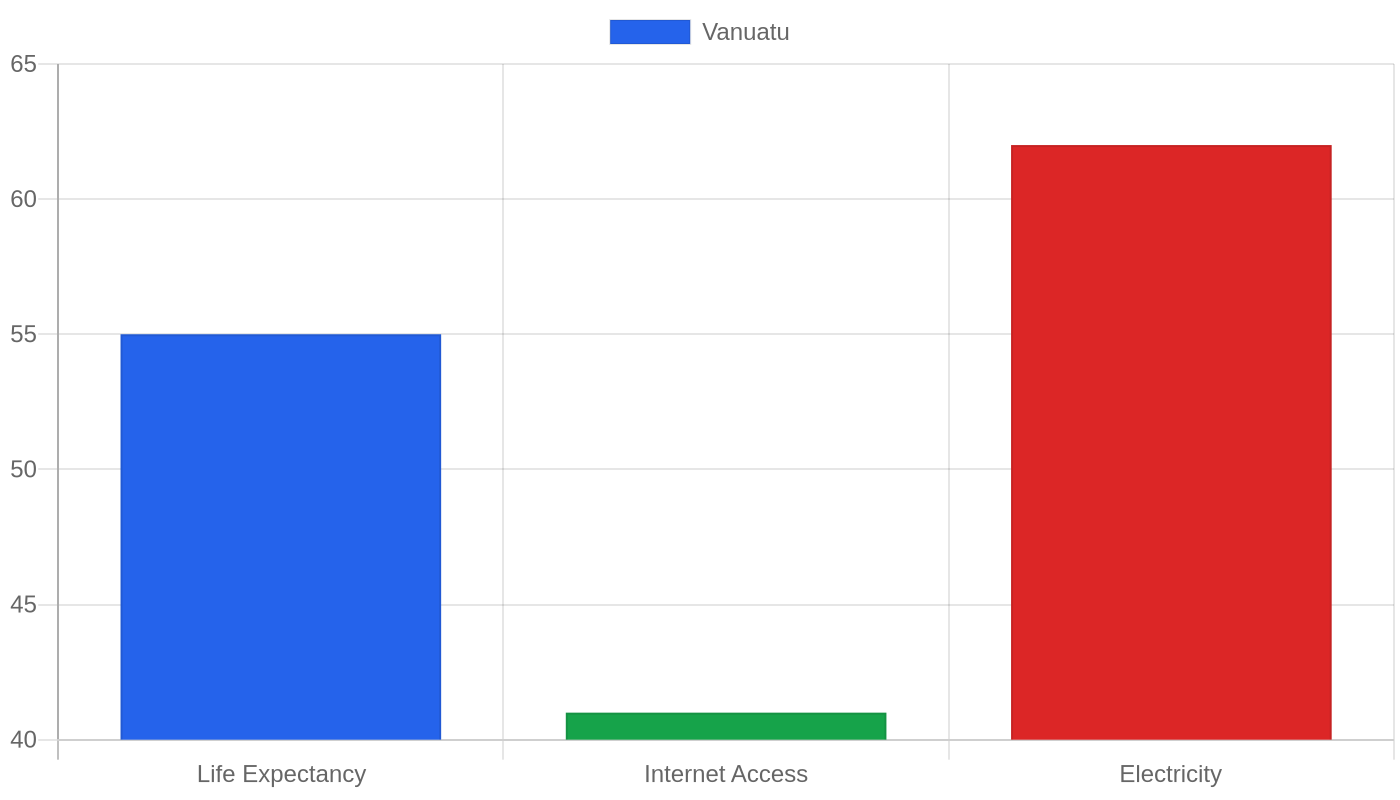
Comprehensive macroeconomic indicators, including GDP growth, inflation, and unemployment rates, are currently listed as unavailable by the World Bank.
Specific data regarding main industries, cost of living metrics, top corporate entities, and crime indices is not provided in current datasets.
The political structure relies on an electoral college comprising Parliament members and Regional Council presidents to select the head of state.
Investors and analysts must rely on qualitative political stability assessments rather than quantitative economic forecasts due to significant data voids.
Economic Landscape: The Challenge of Invisible Metrics
The economic narrative of Vanuatu is currently defined as much by what is missing from the ledger as by what is present. According to the World Bank, key macroeconomic indicators such as GDP growth, inflation CPI, and unemployment rates are recorded as N/A for the latest reporting period. This absence of hard data presents a unique challenge for economists attempting to gauge the pulse of the nation’s financial health.
Without specific figures for GDP in USD or per capita PPP, it is difficult to benchmark Vanuatu against its regional peers in the South Pacific. Typically, island nations like Vanuatu rely heavily on tourism, agriculture, and offshore financial services, but without explicit industry listings in the provided data, these sectors remain inferred rather than confirmed. The lack of population statistics further complicates any attempt to calculate labor force participation or consumer demand trends.
Consequently, economic analysis shifts from quantitative modeling to qualitative observation of policy directions and external aid flows. For international observers, this data gap suggests that while the economy may be functioning, its visibility to global standard-setting bodies is limited. It underscores the need for improved statistical infrastructure in developing island economies to ensure accurate global integration.
Cost of Living and Housing Dynamics
Assessing the daily financial reality for residents and expatriates in Vanuatu is complicated by the absence of detailed cost-of-living indices. The provided dataset does not include specific housing costs, rental yields, or comparative expense ratios against regional averages. In many Pacific island nations, import dependency often drives up the price of basic goods, making local production critical for affordability, yet no specific industry data confirms the extent of local manufacturing here.
Without concrete numbers on inflation or purchasing power parity, prospective residents cannot easily compare the cost of utilities, food, or transportation to other destinations. However, the general understanding of small island developing states (SIDS) implies that logistics and supply chain vulnerabilities likely influence everyday expenses. The lack of safety and crime indices also makes it difficult to factor in security-related costs, such as insurance premiums or gated community fees.
Therefore, the financial planning for anyone considering relocation to Vanuatu must rely on anecdotal evidence and direct inquiries rather than standardized economic models. This opacity highlights a broader issue in emerging markets where informal economies and cash-based transactions often escape official statistical capture.
Investment and Business Climate
The business environment in Vanuatu appears to be shaped more by its political framework than by a visible roster of major corporate players. The provided data lists “N/A” for top companies, leaving investors without clear benchmarks for market leaders or dominant private sector entities. This absence suggests either a highly fragmented SME-driven economy or a lack of centralized public disclosure for major commercial entities.
For foreign direct investment (FDI), the primary attraction often lies in the jurisdictional stability rather than immediate high-yield returns. The government’s role in facilitating trade and maintaining regulatory frameworks becomes the central pillar for business confidence. Without data on specific industries, potential investors must look toward traditional strengths such as sustainable tourism, fisheries, and potentially green energy projects, which are common priorities for Pacific nations.
The lack of crime and safety indices further adds an element of uncertainty for long-term capital deployment. Businesses operating in this space must navigate a landscape where regulatory clarity is paramount, even if market size data remains elusive. The focus for new entrants should be on building relationships with local councils and understanding the decentralized nature of economic governance.
Safety, Politics, and Quality of Life
Vanuatu’s political stability is anchored in a well-defined constitutional framework that prioritizes national cohesion. The Republic is a parliamentary democracy with a written constitution that establishes the President as a symbolic head of the Republic, representing the unity of the nation. The President is elected for a five-year term by an electoral college consisting of members of Parliament and the presidents of Regional Councils, ensuring a broad base of political support.
These powers are primarily ceremonial, indicating that executive authority likely rests with the Prime Minister and Cabinet, though specific details on legislative dynamics are not fully expanded in the snippet. The ability to remove the President via the electoral college provides a mechanism for accountability within the highest office. While crime and safety indices are listed as N/A, the structured political system suggests a degree of institutional order.
The separation of ceremonial duties from active governance allows for a stable transition of power, which is crucial for social harmony in a multi-ethnic society. For residents, this political architecture offers a predictable legal environment, even if day-to-day safety metrics are not quantified in current reports. The emphasis on unity in the constitution reflects the diverse cultural landscape of the archipelago, aiming to mitigate ethnic tensions through shared national symbols.
Current Affairs and Policy Shifts
The most tangible aspect of Vanuatu’s current affairs revolves around its democratic processes and constitutional adherence. Recent political developments highlight the ongoing importance of the electoral college system in selecting the head of state. The provision that the President may be removed by the electoral college indicates a dynamic political environment where accountability mechanisms are actively maintained.
With no recent news items or live indicators provided in the dataset, current discussions likely center on domestic governance rather than external shocks. The focus remains on strengthening the institutions that support the parliamentary democracy. Any shifts in policy would likely emerge from the interaction between the ceremonial presidency and the active parliament. Observers should watch for changes in regional council compositions, as these directly influence the presidential election outcome.
The absence of economic data means that current affairs are dominated by political maneuvering and constitutional interpretation. This period represents a time of institutional consolidation rather than rapid economic transformation. Stakeholders should monitor parliamentary debates for clues on future regulatory changes affecting trade and local development.
The Bottom Line
Vanuatu presents a case study in political stability amidst economic data scarcity. Investors and policymakers should focus on the robustness of its democratic institutions rather than short-term financial metrics. The country offers a unique blend of ceremonial tradition and parliamentary function that ensures continuity. For those seeking entry into the Pacific market, patience and local engagement are more valuable than reliance on aggregate statistics.
Sources & Methodology
This article is authored by Economic Pulse Net for informational and research purposes. Economic Pulse Net sources its data from multilateral institutions, national statistics bureaus, and proprietary databases. All data is believed to be current as of the date of publication.
Published: October 19, 2026 | Category: Research — Vanuatu
Use these signals in your own platform
Economic Pulse publishes its live signal feed through a documented, read-only API. Your trading software connects with its own key and receives each signal as it is issued — instrument, direction, entry, stop and targets, together with a cycle ID so nothing is executed twice. The feed is independent of this website and cannot change it.
Signals are informational only and are not financial advice.