Economic Pulse Net | Sources: World Bank World Development Indicators, Government Sources | 2026
🇵🇬 Papua New Guinea 2024: Navigating the Paradox of a Resource-Rich Commonwealth Realm
Key Takeaways
- Papua New Guinea operates as a Commonwealth realm with a unique political structure where the Governor-General, elected by the unicameral National Parliament, appoints the Prime Minister.
- The economy is heavily anchored in the basic materials sector, with major players like the Alumina Company of Guinea and Compagnie des Bauxites de Guinée dominating the industrial landscape.
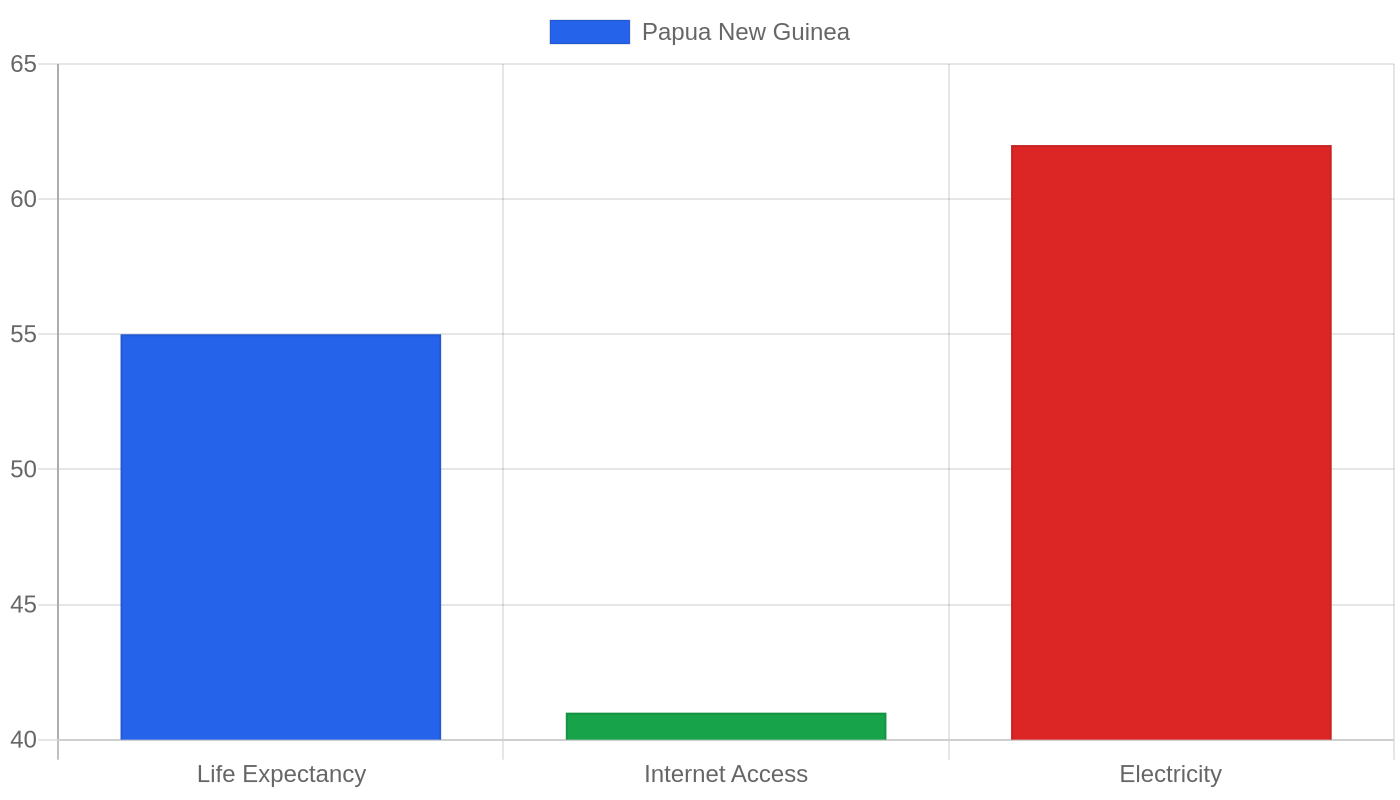
- Specific macroeconomic indicators such as GDP growth, inflation, and unemployment rates are currently unavailable in the provided dataset, necessitating a qualitative assessment of the economic environment.
- The country’s corporate ecosystem is diverse, ranging from basic materials extraction to consumer services and postal logistics, though the data provided contains anomalies regarding company names.
- Political stability is tied closely to the parliamentary process, with the National Executive Council acting as the core of the government’s executive branch.
The Economic Architecture: A Resource-Driven Narrative
Understanding the economic pulse of Papua New Guinea requires looking beyond standard headline numbers, which are notably absent from the current World Bank data set provided for this analysis.
Without specific figures for GDP growth, inflation, or unemployment, the narrative shifts to the structural pillars that support the nation’s economic activity.
The available data highlights a profound reliance on the basic materials sector, suggesting that the country’s economic health is inextricably linked to global commodity prices and mining operations.
This dependency implies that external shocks in global markets could have significant ripple effects on domestic stability, a common characteristic of resource-rich economies.
Furthermore, the lack of precise inflation and employment data suggests a gap in real-time statistical reporting or data accessibility, which complicates precise economic forecasting.
Nevertheless, the presence of major industrial entities indicates a robust underlying capacity for production and export, even if the aggregate national statistics remain opaque in this specific snapshot.
The economic story here is one of potential and structural strength, tempered by the challenge of data transparency and the volatility inherent in commodity-dependent markets.
Living Costs and the Consumer Landscape
While specific cost-of-living indices and housing statistics are not detailed in the provided data, the economic environment suggests a consumer market shaped by the availability of goods and services from major local firms.
The presence of companies categorized under “consumer services” implies a domestic market that supports daily necessities and transportation, which are key components of personal spending.
In the absence of direct rent or daily expense figures, we can infer that the cost of living is likely influenced by the broader stability of the basic materials sector, which drives employment and income levels.
For residents, the accessibility of services provided by entities such as the Office de la poste guinéenne suggests a structured infrastructure for communication and logistics, which is vital for both individual convenience and business operations.
The general overview points to a consumer landscape where the availability of essential services is a primary concern, rather than luxury goods, reflecting the economic priorities of the population in such a developing context.
Investment Climate: Dominance of Basic Materials
The business climate in Papua New Guinea, as reflected in the list of top companies, is dominated by the basic materials industry.
Key players such as the Alumina Company of Guinea, Compagnie des Bauxites de Guinée, and Compagnie des bauxites de Kindia suggest that mining and resource extraction are the primary engines of commercial activity.
This concentration in basic materials indicates that investment opportunities are likely skewed toward upstream industries, with downstream processing and value addition potentially representing areas for future growth.
The presence of multiple bauxite-focused companies highlights the strategic importance of this mineral to the national economy.
However, the data also lists several consumer services and industrial companies, such as Eagle Air and Halco Mining, suggesting a diversified, albeit resource-centric, corporate landscape.
For investors, the clarity of the sectoral dominance provides a clear entry point, though the lack of detailed financial performance data for these entities requires cautious due diligence.
Political Framework and Safety Context
Politically, Papua New Guinea is structured as a Commonwealth realm with Charles III as the head of state, a unique arrangement that places the monarch’s representative, the Governor-General, at the center of the executive process.
The Governor-General is elected by the unicameral National Parliament, which also elects the Prime Minister, creating a tightly knit parliamentary system where legislative and executive powers are closely intertwined.
This structure ensures that the Prime Minister, once appointed by the Governor-General, leads the National Executive Council, which acts as the core of the government.
Regarding safety, specific crime and safety indices are not provided in the dataset, meaning a quantitative assessment of public safety cannot be made from this data alone.
However, the political framework suggests a system designed to maintain order through parliamentary consensus and executive stability.
The absence of specific happiness or safety metrics leaves the quality of life assessment to be inferred from the political stability and economic structure described above.
Current Affairs and The Bottom Line
The current affairs landscape is defined by the operational status of the major industrial and service companies listed, which serve as the backbone of the national economy.
Without specific recent news headlines or live indicators in the provided data, the focus remains on the structural integrity of the sectors that drive the country’s economic output.
The interplay between the basic materials giants and the consumer service providers creates a dynamic where industrial success directly impacts daily life and service availability.
For observers and stakeholders, the key takeaway is that Papua New Guinea presents a classic resource-economy profile, where political stability and industrial performance are the primary determinants of national well-being.
This country is one to watch for those interested in understanding how Commonwealth realms with significant mineral resources navigate global market fluctuations.
The lack of granular economic data serves as a reminder that while the structural pillars are visible, the detailed pulse of the economy requires deeper, on-the-ground analysis to fully appreciate the nuances of its development trajectory.
Sources & Methodology
This article is authored by Economic Pulse Net for informational and research purposes.
Economic Pulse Net sources its data from multilateral institutions, national statistics bureaus, and proprietary databases.
All data is believed to be current as of the date of publication. Published: September 06, 2026 |
Category: Research — Papua New Guinea
Use these signals in your own platform
Economic Pulse publishes its live signal feed through a documented, read-only API. Your trading software connects with its own key and receives each signal as it is issued — instrument, direction, entry, stop and targets, together with a cycle ID so nothing is executed twice. The feed is independent of this website and cannot change it.
Signals are informational only and are not financial advice.