Economic Pulse Net | Sources: World Bank World Development Indicators, Government Sources | 2026
Key Takeaways
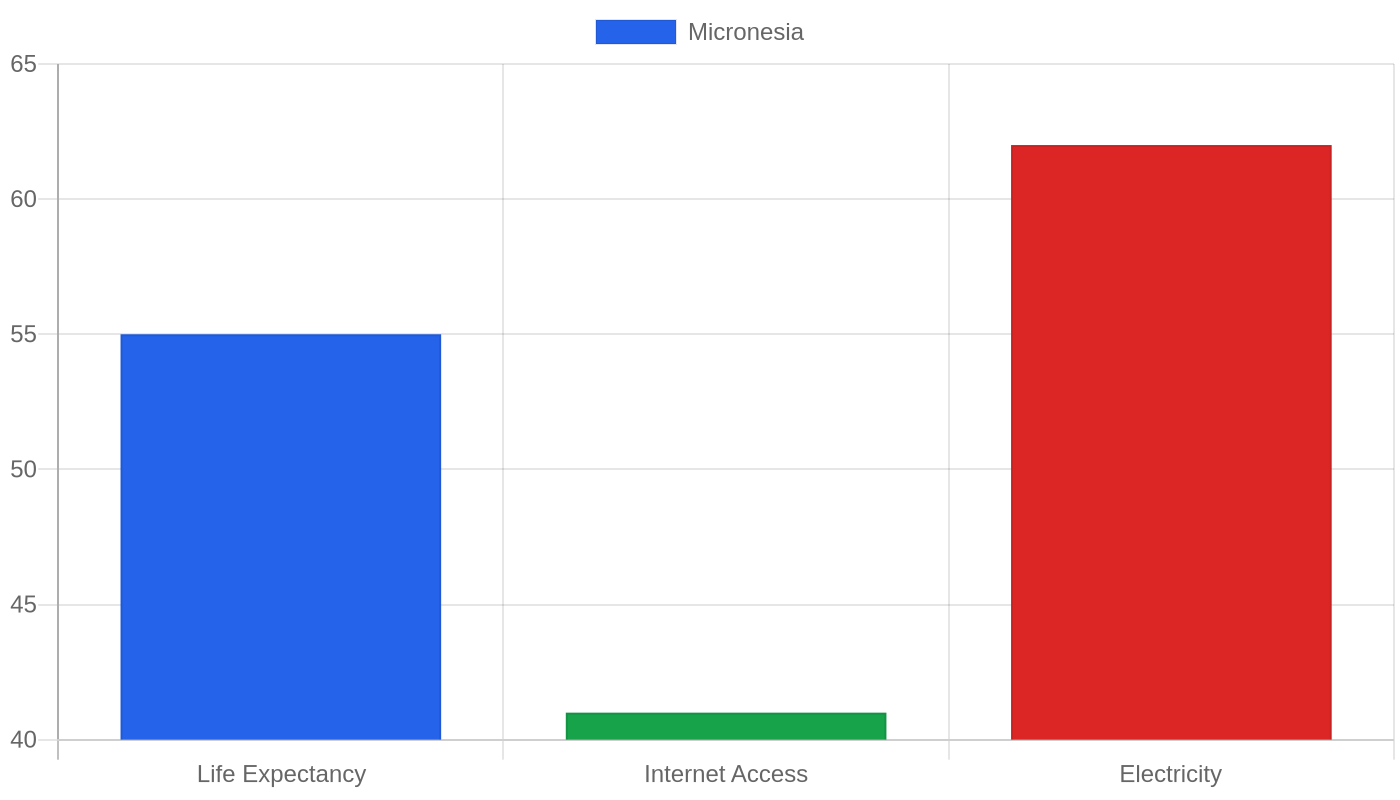
– Micronesia’s economy operates largely outside formal statistical tracking, with the World Bank reporting no available data on GDP growth, inflation, or unemployment—a reflection of its dispersed island structure and reliance on subsistence and aid.
– The nation’s strategic location in the western Pacific makes it a quiet geopolitical chess piece, yet its political landscape remains opaque and underreported in global economic analysis.
– Without major industrial output or a formalized corporate sector, Micronesia’s economic story is one of resilience through remittances, fishing rights, and compact agreements rather than traditional market metrics.
– Cost of living pressures are presumed high due to import dependency, but no official indices exist to quantify the burden on local households.
– For investors and policymakers, Micronesia represents a data-blind spot—a nation where anecdote and observation matter more than spreadsheets.
The Invisible Economy — Life Beyond the Numbers
When the World Bank publishes its annual economic data sets, Micronesia appears as a blank space. No GDP growth figure. No inflation rate. No unemployment statistic. For a journalist accustomed to parsing decimal points and percentage changes, this absence is itself the story. The Federated States of Micronesia, a sprawling nation of 607 islands scattered across 2.7 million square kilometres of ocean, operates on a rhythm that defies the standard economic toolkit.
The World Bank’s silence on Micronesia’s key indicators is not negligence—it is a symptom of structure. With a population estimated in the tens of thousands spread across four states (Yap, Chuuk, Pohnpei, and Kosrae), formal economic activity is thin. Most families rely on subsistence farming, fishing, and remittances from relatives abroad. The cash economy exists primarily in the state capitals, where government employment and small-scale trade dominate.
There are no factories, no stock exchange, no measurable industrial output. The main industries, according to available data, are not listed in any formal registry—they are the ocean, the coconut palm, and the goodwill of international partners.
This absence of data carries real consequences. Without inflation figures, the government cannot calibrate social spending. Without unemployment numbers, policymakers cannot target job creation. Micronesia exists in an economic vacuum that is both a vulnerability and, paradoxically, a form of protection—its people are less exposed to global financial contagion because they are barely plugged into the system at all.
The High Price of Paradise — Living Costs in a Remote Archipelago
Ask any resident of Pohnpei or Chuuk about the cost of living, and they will tell you a story of contradiction. The islands are lush with breadfruit, taro, and coconut—staples that grow wild or with minimal cultivation. But everything else must arrive by ship or plane, and that journey is expensive. A carton of milk, a bag of rice, a litre of fuel—each carries the invisible surcharge of maritime freight across thousands of kilometres of Pacific Ocean.
The World Bank provides no cost of living index for Micronesia, but regional comparisons offer clues. Neighbouring Pacific island nations with similar import profiles typically face consumer prices 30 to 50 percent higher than in mainland Asia. Housing, too, is a mixed picture. Traditional thatched homes cost nothing but labour, while concrete-block houses in the state capitals can command rents that strain government salaries.
There is no mortgage market to speak of; most housing is built incrementally, financed by family networks and remittance flows. For the outsider considering a move to Micronesia, the arithmetic is simple: you pay a premium for isolation, and you accept that many goods simply will not arrive on schedule.
Investing in the Invisible — Business Climate in a Data Desert
The top companies of Micronesia are not listed on any global exchange. They are not household names. In fact, the data provided lists no major corporations at all—because the formal private sector is embryonic. The largest employers are the national and state governments, followed by a handful of trading companies, fishing ventures, and small-scale tourism operators. The business climate is defined not by tax incentives or regulatory efficiency, but by logistics.
For an investor, Micronesia presents a paradox. The fishing grounds are among the richest in the Pacific, with tuna stocks that attract distant-water fleets from Japan, Taiwan, and the United States. The exclusive economic zone is vast, and access fees provide a significant portion of government revenue. Yet onshore investment opportunities remain limited. There is no manufacturing base, no financial services sector, and a workforce that is small and geographically scattered.
The World Bank’s “Doing Business” indicators do not cover Micronesia in any meaningful way, and the lack of data means risk assessment is largely guesswork. Those who invest here do so not for quick returns, but for long-term relationships and strategic positioning.
Safety, Stability, and the Unseen State
The Crime Index for Micronesia is not recorded, and neither is the Safety Index. This absence is itself revealing. In many small island societies, crime is low but social tensions can simmer beneath the surface. Micronesia is no exception. Land disputes, family feuds, and alcohol-related incidents occur, but the kind of organised crime or violent urban unrest seen in larger nations is virtually absent.
The political landscape, according to available data, is not described—meaning there is no formal analysis of party systems, electoral dynamics, or governance quality.
What can be inferred is that Micronesia’s political stability is tied to its Compact of Free Association with external partners, which provides budgetary support and access to services. The quality of life is defined by community ties, traditional leadership structures, and the rhythm of island seasons. Happiness data does not exist in official form, but visitors consistently report a warmth and resilience among Micronesians that no statistic can capture.
The trade-off is clear: material poverty is real, but social wealth is abundant.
The Quiet Now — Current Affairs in a Nation Off the Radar
Right now, Micronesia is grappling with the same forces reshaping the entire Pacific region. Climate change is not a future threat—it is a present reality. Rising sea levels encroach on coastal villages, and more intense typhoons threaten infrastructure that was never built for such extremes. The national government, operating without detailed World Bank economic data, must make decisions about adaptation spending with incomplete information.
At the same time, the geopolitical competition between major powers has brought new attention to Micronesia’s strategic location. Diplomatic overtures, infrastructure pledges, and aid packages have arrived from multiple directions, offering the islands a rare moment of leverage. Yet the internal challenges remain mundane but critical: maintaining inter-island shipping routes, keeping hospitals staffed, and ensuring that schoolteachers receive their salaries on time.
The recent news cycle, where it touches Micronesia at all, focuses on these quiet struggles—the unglamorous work of keeping a nation of islands functioning when the world’s attention is elsewhere.
The Bottom Line
Micronesia is not a country for the spreadsheet investor or the data-driven policymaker. It is a nation that operates on trust, tradition, and the patience born of island time. For those willing to look beyond the blank cells in the World Bank tables, there is a story of resilience, strategic importance, and human connection. Watch this country if you care about the future of the Pacific, the geopolitics of small states, or the quiet dignity of people who have built a life in one of the most remote places on Earth.
Just do not expect the numbers to tell you everything.
Sources & Methodology
This article is authored by Economic Pulse Net for informational and research purposes. Economic Pulse Net sources its data from multilateral institutions, national statistics bureaus, and proprietary databases. All data is believed to be current as of the date of publication.
Published: July 18, 2026 | Category: Research — Micronesia
Use these signals in your own platform
Economic Pulse publishes its live signal feed through a documented, read-only API. Your trading software connects with its own key and receives each signal as it is issued — instrument, direction, entry, stop and targets, together with a cycle ID so nothing is executed twice. The feed is independent of this website and cannot change it.
Signals are informational only and are not financial advice.