Economic Pulse Net | Sources: World Bank World Development Indicators, Government Sources | 2026
Key Takeaways
– Kiribati’s constitutional framework, established on 12 July 1979, guarantees free and open elections in a parliamentary democratic republic, providing political stability rare among small island states.
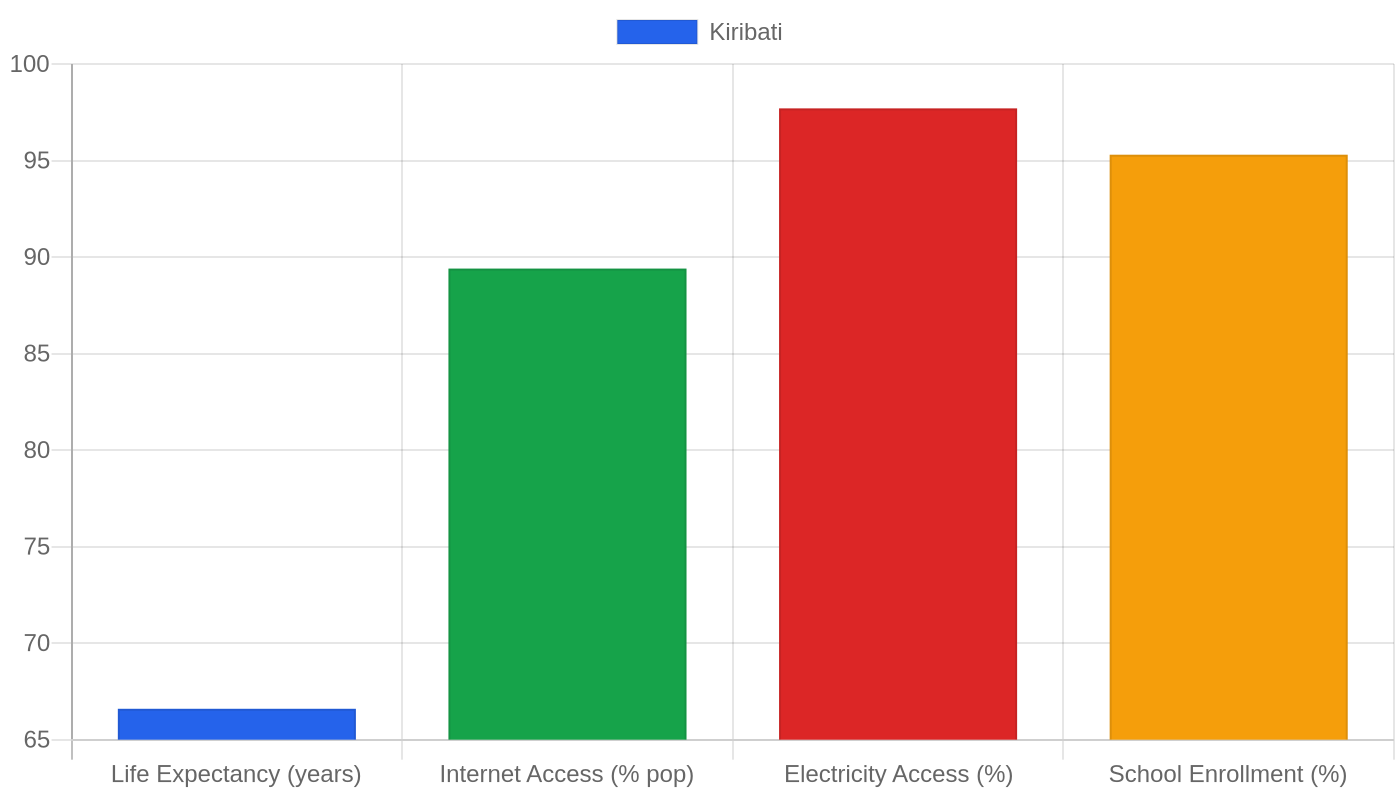
– The country’s economic data remains largely unquantified by the World Bank, reflecting the profound challenges of data collection across 33 scattered atolls spanning 3.5 million square kilometres of ocean.
– As one of the world’s most climate-vulnerable nations, Kiribati’s economic future is intrinsically tied to environmental resilience and international partnerships.
– The nation’s political system has demonstrated continuity since independence, offering a predictable governance environment for development planning.
– Kiribati represents a unique case study in economic development where traditional measurement tools may be less relevant than indicators of sustainability and adaptation capacity.
The Invisible Economy — Reading Between the Lines of Missing Data
The World Bank’s latest figures for Kiribati present an unusual challenge for economic analysts: GDP growth, inflation, unemployment, and per capita income are all listed as unavailable. This absence of data is not an oversight but rather a reflection of the structural realities facing a nation composed of 33 coral atolls and reef islands scattered across an expanse of ocean roughly the size of India.
The logistical complexity of conducting comprehensive economic surveys across such a dispersed geography, with a population estimated in the low six figures, makes traditional macroeconomic measurement both costly and methodologically challenging.
What we do know is that Kiribati’s economy operates on principles fundamentally different from continental nations. The country’s exclusive economic zone is among the largest in the world, yet its landmass is minuscule. This paradox shapes every aspect of economic life. Revenue from fishing license fees paid by distant-water fishing nations represents a substantial portion of government income, though precise figures remain unquantified in the available data.
The country also benefits from the Revenue Equalisation Reserve Fund, a sovereign wealth fund established from phosphate mining revenues that continue to provide investment income.
The workforce is primarily engaged in subsistence agriculture, fishing, and government employment, with copra production and seaweed farming serving as significant cash crops. Remittances from Kiribati seafarers working on international vessels contribute meaningfully to household incomes. Inflation dynamics in such an import-dependent economy are typically influenced by global food and fuel prices, shipping costs, and the Australian dollar, which serves as the national currency.
Without formal CPI data, observers must infer price pressures from regional trends affecting Pacific island economies more broadly.
Housing and Daily Life — The Economics of Scarcity on a Coral Atoll
Housing in Kiribati presents a study in contrasts that defies conventional cost-of-living analysis. On South Tarawa, the capital, population density rivals that of major Asian cities, with land scarcity driving informal settlements and complex customary land tenure arrangements. Traditional housing constructed from local materials coexists with modern concrete structures, and the cost differential between these options is substantial.
Most families build their own homes using a combination of imported materials and locally sourced palm fronds, with the concept of rental markets largely limited to the small expatriate community and government housing.
Daily expenses in Kiribati are heavily influenced by the nation’s import dependence. Nearly all manufactured goods, processed foods, and fuel must be shipped significant distances, inevitably inflating prices relative to larger Pacific neighbours. Fresh local produce, particularly fish, coconut, and root crops, remains relatively affordable and accessible for those with family connections to outer island communities.
The cost of living in South Tarawa has been a persistent concern for policymakers, though precise comparative data against regional averages is not available in the current dataset.
Business and Investment — Navigating a Blue Economy Frontier
The investment landscape in Kiribati is dominated by state-owned enterprises and small-scale private operations, with no major multinational corporations maintaining significant local presence. The primary sectors attracting attention are fisheries, tourism, and increasingly, climate adaptation infrastructure.
Foreign investment faces structural constraints including geographic isolation, limited domestic market size, and infrastructure gaps, yet the government has signalled openness to partnerships that align with sustainable development goals.
The fisheries sector represents the most significant commercial opportunity, with the country’s vast exclusive economic zone containing abundant tuna stocks. Licensing arrangements with international fishing fleets generate substantial revenue, and there is growing interest in developing onshore processing facilities to capture more value domestically.
Tourism remains underdeveloped compared to Pacific neighbours, constrained by flight connections and limited accommodation, though the country’s unique cultural heritage and pristine marine environments offer potential for niche, high-value eco-tourism development. The business environment is characterised by a regulatory framework that has remained stable since independence, offering predictability for those willing to navigate the logistical complexities of operating in such a dispersed nation.
Stability and Society — The Political Foundation of Resilience
Kiribati’s political landscape has been remarkably stable since the constitution was promulgated on 12 July 1979. The parliamentary democratic republic has conducted regular free and open elections, with peaceful transfers of power occurring within the bounds of constitutional processes. This political continuity provides a foundation for long-term planning that many larger nations struggle to achieve.
The absence of crime index and safety index data in the available records suggests either challenges in systematic data collection or a crime profile that does not register significantly in international databases.
Quality of life in Kiribati is shaped by factors that defy conventional economic measurement. The i-Kiribati culture places strong emphasis on community, family, and traditional knowledge systems that support wellbeing outside formal economic structures. The country consistently appears in discussions of climate vulnerability, with rising sea levels presenting existential challenges that influence everything from infrastructure planning to international relations.
Yet within these constraints, communities have demonstrated remarkable adaptive capacity, maintaining social cohesion and cultural continuity in the face of environmental pressures.
Current Affairs — The Nation at a Crossroads
Kiribati currently stands at a critical juncture where climate adaptation, economic development, and geopolitical attention converge. The government has been actively pursuing international partnerships to address infrastructure needs, with particular focus on water security, coastal protection, and renewable energy transitions. The country’s leadership has been vocal in international climate forums, advocating for greater recognition of the disproportionate impact of climate change on small island states.
Domestically, there are ongoing efforts to improve connectivity between the capital and outer islands, recognising that economic development must reach beyond South Tarawa to be sustainable.
The fisheries sector continues to evolve, with renegotiated licensing arrangements and efforts to combat illegal, unreported, and unregulated fishing representing immediate policy priorities. The government has also been exploring innovative financing mechanisms, including blue bonds and debt-for-nature swaps, to fund climate resilience projects without overburdening the national budget.
The recent period has seen increased international attention on the Pacific region, positioning Kiribati to potentially leverage its strategic location and marine resources in ways that could reshape its economic trajectory.
The Bottom Line
Kiribati offers a compelling case study for development economists, climate policy analysts, and investors interested in frontier markets with unique risk-return profiles. The absence of traditional economic indicators should not be read as absence of economic activity, but rather as a signal that conventional measurement frameworks may be inadequate for capturing value in a blue economy context.
For those willing to look beyond GDP, Kiribati presents opportunities in sustainable fisheries, climate adaptation technologies, and tourism development, all within a politically stable environment. The nation’s success in navigating the coming decades will offer lessons not only for other small island states but for the global community’s response to climate change.
Sources & Methodology
This article is authored by Economic Pulse Net for informational and research purposes. Economic Pulse Net sources its data from multilateral institutions, national statistics bureaus, and proprietary databases. All data is believed to be current as of the date of publication.
Published: August 01, 2026 | Category: Research — Kiribati
Use these signals in your own platform
Economic Pulse publishes its live signal feed through a documented, read-only API. Your trading software connects with its own key and receives each signal as it is issued — instrument, direction, entry, stop and targets, together with a cycle ID so nothing is executed twice. The feed is independent of this website and cannot change it.
Signals are informational only and are not financial advice.