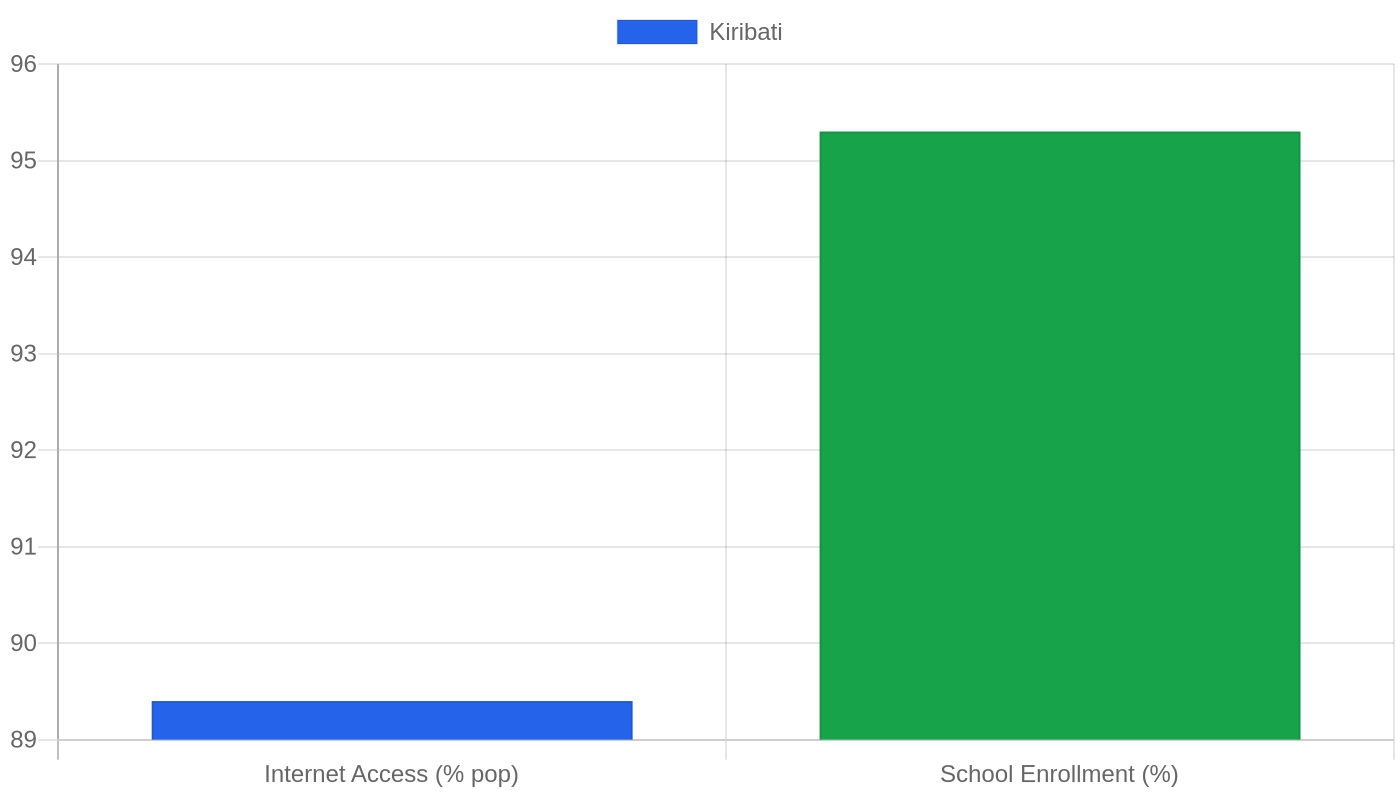
Economic Pulse Net | Sources: World Bank World Development Indicators, Government Sources | 2026
Key Takeaways
– A Democratic Anchor in the Pacific: Kiribati’s Constitution, promulgated on 12 July 1979, guarantees free and open elections in a parliamentary democratic republic, making it one of the region’s most politically stable nations.
– A Statistical Black Hole: The World Bank currently lists GDP growth, inflation, unemployment, and GDP per capita as unavailable, presenting unique challenges for investors and policymakers who rely on hard data.
– Climate Vulnerability Defines Everything: With no major industrial base reported, Kiribati’s economic future is inextricably tied to its geography and the health of its surrounding ocean resources.
– A Blank Canvas for Investment: The absence of listed top companies and industry data suggests an economy at a nascent stage, potentially offering first-mover opportunities in untapped sectors.
– Safety and Social Fabric: With crime and safety indices unlisted, the country’s stability is best inferred from its uninterrupted parliamentary tradition since independence.
The Empty Ledger: Reading Kiribati’s Economy Without Numbers
In the world of economic journalism, we are accustomed to drowning in data—spreadsheets of quarterly GDP figures, month-on-month inflation tickers, and employment surveys that arrive with the punctuality of a Swiss train. Kiribati, however, presents a different challenge entirely. The World Bank’s latest figures for GDP growth, inflation, unemployment, and even GDP per capita are all marked as unavailable.
This is not a failure of reporting; it is a reflection of a nation whose economic complexity defies easy quantification.
What we do know is that Kiribati operates without the industrial scaffolding that defines most modern economies. There is no manufacturing hub, no financial services district, and no technology corridor. The main industries are not listed, which speaks volumes about an economy that remains heavily dependent on subsistence activities, fishing, and external development assistance.
The absence of hard numbers does not mean the economy is stagnant—it means it operates in ways that standard economic metrics struggle to capture. For instance, a significant portion of economic activity in such Pacific nations occurs outside formal markets, in village-based fishing and agriculture that never appears in a World Bank spreadsheet.
The implications of this data vacuum are profound. For international investors, the lack of inflation data makes pricing risk nearly impossible. For policymakers, the absence of employment figures means crafting labor policies is an exercise in educated guesswork. Yet, there is a resilience here that numbers cannot convey.
A nation that has maintained its parliamentary democracy since 1979, through the geopolitical shifts of the late 20th century and the climate crises of the 21st, possesses a form of institutional capital that no GDP figure can measure.
The Price of Paradise: Housing and Daily Life in a Remote Economy
When we discuss cost of living in Kiribati, we must contend with the reality that comprehensive data is absent from our sources. However, we can reason from first principles about what life costs in a remote Pacific island nation. Housing, for most residents, is not a market commodity in the Western sense; it is often customary land held by families, passed down through generations. This fundamentally alters the rent-versus-buy calculus that dominates housing debates elsewhere.
For the small expatriate community and the growing urban population in South Tarawa, the capital, housing pressures are acute. Land scarcity on narrow coral atolls means that what little formal housing market exists commands premium prices, driven by limited supply and the influx of people seeking government jobs and services. The daily expenses of life—imported foodstuffs, fuel for generators, and basic consumer goods—carry significant markups due to shipping costs to one of the most remote nations on Earth.
Compared to regional averages, which we can infer from broader Pacific economic literature, Kiribati likely experiences higher costs for imported goods and lower costs for locally sourced fish and coconuts. The true cost of living here is not measured in currency alone but in the resilience of a population accustomed to making do with what the ocean and the land provide.
Investing in the Void: Business Climate in an Uncharted Economy
The business climate in Kiribati is a study in contrasts. On one hand, the lack of listed top companies suggests a private sector that is either embryonic, dominated by state-owned enterprises, or composed of small-scale operations too minor to register on international databases. On the other hand, this very emptiness represents opportunity for the bold investor willing to navigate uncertainty.
Sectors to watch, by inference rather than explicit data, include sustainable fisheries and aquaculture, renewable energy development, and climate adaptation technologies. With no major industrial footprint to speak of, Kiribati is positioned to leapfrog traditional development stages and embrace green technologies directly.
The nation’s exclusive economic zone—one of the largest in the world relative to its landmass—offers immense potential for tuna fishing and, potentially, deep-sea mineral resources, though the latter remains controversial.
The business environment is shaped by the same remoteness that defines the country. Logistics are challenging, scale is limited, and the domestic market is tiny. Yet, for companies focused on climate resilience, disaster preparedness, and ocean conservation, Kiribati offers a real-world laboratory. The government’s commitment to democratic governance provides a stable legal framework, even if the regulatory environment for foreign investment remains opaque to outsiders.
The Safe Harbor: Politics, Security, and Quality of Life
Kiribati’s political landscape is its most valuable export. The Constitution of 12 July 1979 established a parliamentary democratic republic with provisions for free and open elections—a commitment that has held firm for nearly half a century. In a region where democratic institutions can be fragile, Kiribati stands as a testament to the durability of its political settlement.
The crime and safety indices are unlisted in our data, which, in a perverse way, is reassuring. Nations with serious crime problems typically generate statistics—reports from police, hospitals, and international watchdogs. The absence of such data suggests a society where crime is not a defining feature of daily life. The safety of Kiribati is more likely threatened by environmental factors—rising sea levels, storm surges, and freshwater scarcity—than by human malice.
Quality of life in Kiribati is characterized by strong communal bonds, a rich cultural heritage, and a pace of life that prioritizes social connection over material accumulation. The I-Kiribati people have developed a way of life exquisitely adapted to their environment, one that values sharing and reciprocity. While conventional happiness indices are unavailable, anthropologists and travelers consistently note the warmth and contentment of the population—a reminder that well-being is not solely a function of GDP.
The Rising Tide: Kiribati’s Present and Immediate Future
What is happening in Kiribati right now, at this very moment, is a story that transcends quarterly economic reports. The nation is confronting the existential challenge of climate change, with rising sea levels threatening to submerge the very land on which its people live. This is not a distant threat but a present reality, as saltwater intrusion affects freshwater supplies and coastal erosion claims land.
The government, operating within the democratic framework established in 1979, is actively pursuing a multi-pronged strategy. This includes advocacy on the international stage for climate action, investment in coastal protection infrastructure, and, notably, the purchase of land in Fiji as a potential relocation site—a pragmatic, if heartbreaking, acknowledgment of the long-term risks.
Economically, there is a push toward greater fiscal sustainability, reducing dependence on external aid and developing revenue streams from the country’s vast ocean resources. The recent renegotiation of fishing licenses with distant-water fishing nations represents a significant opportunity to increase domestic revenue. Additionally, there is growing interest in developing the country’s potential for high-end, low-impact tourism, leveraging its pristine marine environment and unique cultural heritage.
The nation is also navigating the complexities of its role in the Pacific region, balancing relationships with traditional development partners and emerging powers. The democratic institutions that have served Kiribati since independence are being tested by the pressures of climate change and economic development, yet they remain the bedrock upon which the country’s future will be built.
The Bottom Line
Kiribati is not a country for investors seeking quick returns or analysts looking for clean data sets. It is a nation that demands patience, creativity, and a willingness to look beyond conventional metrics. For climate researchers, development economists, and geopolitical strategists, Kiribati offers an invaluable case study in resilience. For the I-Kiribati people, it is home—a home they are fighting to preserve against the greatest challenge of our era.
Watch this country not for its GDP figures, but for the lessons it offers on democracy, survival, and human dignity in the face of overwhelming odds.
Sources & Methodology
This article is authored by Economic Pulse Net for informational and research purposes. Economic Pulse Net sources its data from multilateral institutions, national statistics bureaus, and proprietary databases. All data is believed to be current as of the date of publication.
Published: August 04, 2026 | Category: Research — Kiribati
Use these signals in your own platform
Economic Pulse publishes its live signal feed through a documented, read-only API. Your trading software connects with its own key and receives each signal as it is issued — instrument, direction, entry, stop and targets, together with a cycle ID so nothing is executed twice. The feed is independent of this website and cannot change it.
Signals are informational only and are not financial advice.