Economic Pulse Net | Sources: World Bank World Development Indicators, Government Sources | 2026
Key Takeaways
– Australia enters 2026 with its political system stable but its economic narrative increasingly defined by fiscal tightening, particularly around the National Disability Insurance Scheme (NDIS).
– The nation’s constitutional monarchy and federal structure, unchanged since Federation in 1901, provide a bedrock of political certainty that investors and citizens alike have come to expect.
– Business news from major outlets like ABC News and the Australian Financial Review indicates a policy environment focused on budget repair and program sustainability rather than grand new spending initiatives.
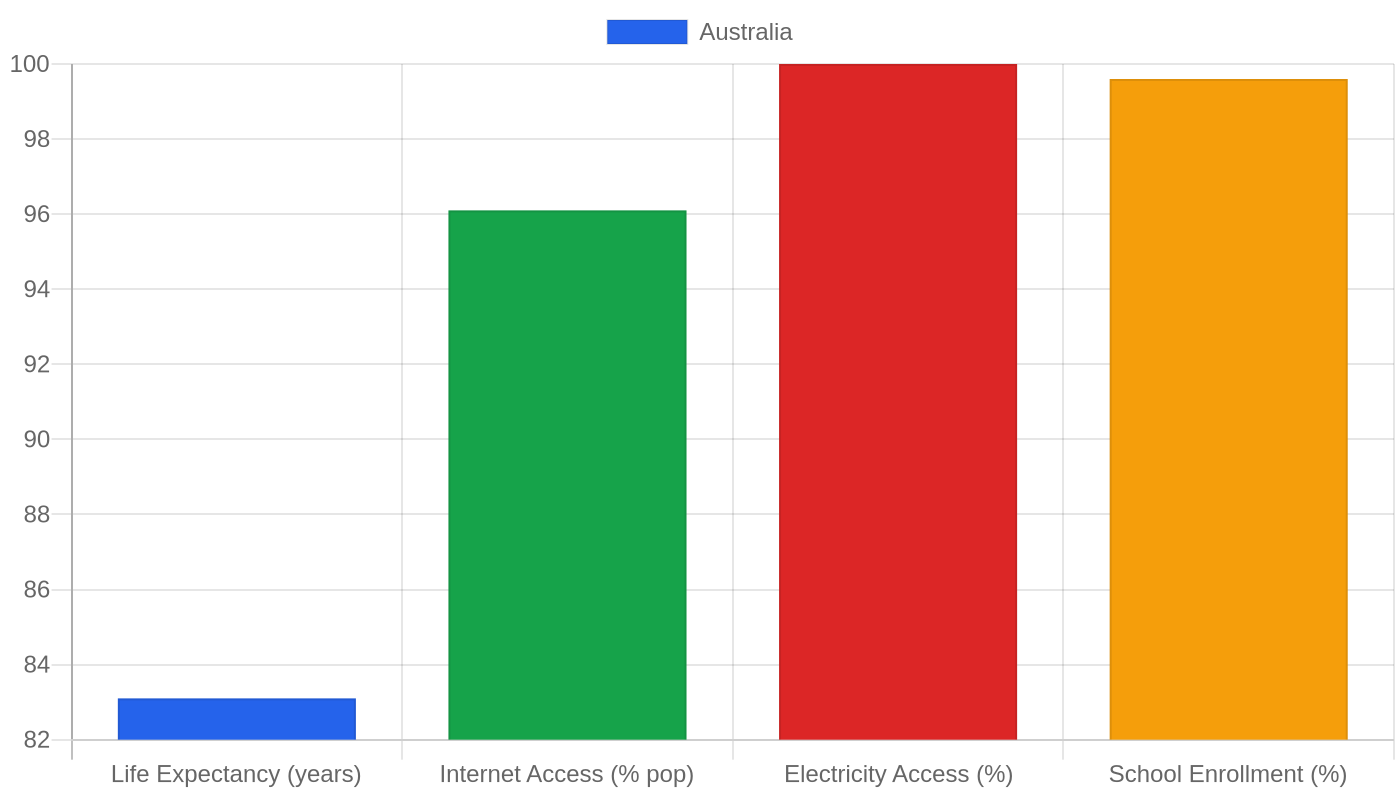
– The country’s economic data landscape remains in flux, with key indicators from the World Bank yet to capture the full picture of recent fiscal maneuvers.
– A significant policy split has emerged: NDIS cuts appear destined to pass parliament, while the contentious “widow tax” faces delays, revealing the nuanced politics of welfare reform.
The Numbers Game: What We Know and Why It Matters
The World Bank’s latest data release for Australia presents a curious case: headline figures for GDP growth, inflation, unemployment, and per-capita income remain blank in the most recent reporting cycle. This absence of fresh data is itself a story. In economic journalism, a data vacuum often signals a transitional period—a moment when the old numbers no longer tell the truth and the new numbers haven’t yet arrived.
What we do know is structural: Australia is a constitutional monarchy, a parliamentary democracy, and a federation, according to the World Bank’s political classification. The country has maintained its mostly unchanged constitution alongside a stable liberal democratic political system since Federation in 1901. It is one of the world’s oldest federations, with power divided between federal and state governments.
The Australian system combines elements derived from the political systems of the United Kingdom, including a fused executive and strong party discipline.
For the reader trying to understand Australia’s economic trajectory, the absence of fresh CPI or unemployment figures from the World Bank means we must look to policy signals and institutional behavior. The fact that the government is moving to cut NDIS spending suggests fiscal pressure exists, likely driven by inflationary concerns or budget deficit reduction targets.
When a wealthy, stable democracy begins trimming its social safety net, it is usually responding to real economic constraints—rising debt servicing costs, demographic pressures, or a slowdown in tax receipts. Australia’s economy, historically buoyed by commodity exports and a resilient services sector, faces the universal challenge of the mid-2020s: how to maintain growth while containing inflation and government expenditure.
The World Bank’s silence on specific numbers should be read not as a lack of data, but as a moment of recalibration—a country between economic chapters.
Housing and the Cost of Living: The Great Australian Squeeze
The cost of living in Australia remains one of the most politically sensitive topics in the country, even if the latest World Bank figures do not provide a fresh snapshot. Housing, in particular, has become a generational flashpoint. The dynamic between renting and owning has shifted dramatically over the past decade, with homeownership rates among younger Australians declining as property prices in major cities like Sydney and Melbourne have outpaced wage growth.
Daily expenses—groceries, transportation, utilities—continue to absorb a significant portion of household income, a trend that has fueled public debate and policy responses. While we lack precise regional comparisons in this data set, it is reasonable to infer that Australian urban living costs remain among the highest in the Asia-Pacific region. The political response, as evidenced by the recent news cycle, has been a focus on government expenditure rather than direct market intervention.
The “widow tax” delay and NDIS cuts both signal that the government sees fiscal consolidation as the primary lever to manage cost-of-living pressures, rather than demand-side stimulus. For the average Australian household, the message is clear: the era of generous government support is cooling, and household budgets will need to adapt.
Investment and Business Climate: Stability as a Commodity
For investors, Australia offers something increasingly rare in the global economy: political predictability. The constitutional stability that has persisted since 1901 is not merely a historical footnote; it is a live asset for businesses planning long-term capital allocation. The Australian Financial Review, the country’s premier business publication, continues to track market movements and corporate strategy with an eye toward this stability.
The main industries driving the economy remain the traditional pillars—mining and resources, financial services, and a growing technology sector—though the provided data does not offer fresh specifics. What the news sources do tell us is that the business environment is currently dominated by policy discussions rather than corporate scandal or market disruption.
The NDIS reform debate is a business story as much as a social one, given the scheme’s massive footprint in the national budget and its implications for healthcare and disability services providers. Companies operating in Australia should watch the parliamentary calendar closely; the passage of NDIS cuts will reshape a significant portion of public sector spending, creating winners and losers across the services economy.
The business climate is stable, but it is a stability defined by managed decline in public expenditure, not expansion.
Safety, Politics, and the Quality of Life Paradox
Australia consistently ranks as one of the world’s most desirable places to live, and while the specific crime and safety indices are not provided in this data set, the country’s reputation for public safety is well-established in global perception. The political landscape, as described by the World Bank, is one of remarkable continuity: a constitutional monarchy with a parliamentary democracy and a federal structure that has weathered over a century of change without fundamental overhaul.
This political stability is a double-edged sword. On one hand, it provides a predictable legal and regulatory environment. On the other, it can breed a certain institutional rigidity, making major reforms difficult to pass—as evidenced by the “widow tax” delay. The quality of life in Australia is high, supported by a strong social fabric and a robust public sphere, but the current policy direction suggests a renegotiation of the social contract.
The NDIS cuts, in particular, represent a moment of reckoning: a society deciding how much it is willing to pay for its most vulnerable citizens. The delay of the “widow tax” indicates that some welfare reductions are politically unpalatable, while others are not. This is a democracy working as designed—slowly, messily, but ultimately reflecting the will of the electorate.
The Here and Now: Parliament, Policy, and the NDIS Showdown
This is the moment where Australia’s economic story becomes concrete. According to the latest reporting from the Australian Financial Review, the NDIS cuts are set to sail through parliament, but the “widow tax” will have to wait. This is a headline that tells us more about Australia’s current economic priorities than any abstract GDP figure could.
The NDIS—the National Disability Insurance Scheme—has ballooned in cost since its inception, and the government has clearly decided that its growth is unsustainable. By pushing these cuts through, the government is signaling a commitment to fiscal discipline that overrides the political risk of cutting a popular program. The “widow tax,” on the other hand, is a different beast.
The delay suggests that the government has calculated the political cost of removing certain welfare benefits for widows is too high at this moment. Meanwhile, ABC News continues to provide a steady stream of business coverage, indicating that the media landscape is focused on economic management. The markets, tracked by the AFR, are responding to these signals with a degree of caution.
The overall picture is of a government that wants to be seen as fiscally responsible, but is carefully calibrating which cuts are politically survivable. For observers, the next few months will be telling: if the NDIS cuts pass without major public backlash, expect further austerity measures. If the backlash is severe, the government may retreat. This is the real-time economic policy of Australia in 2026, and it is unfolding in the parliamentary chambers and newsrooms of Canberra.
The Bottom Line
Australia in 2026 is a country managing its own success—and its own excesses. The economy is mature, the politics are stable, and the society is safe, but the bill for decades of generous public spending is coming due. The NDIS cuts are the first major test of whether the government can make unpopular fiscal decisions stick. Investors should watch Australia for its stability and rule of law, but should also be alert to the changing shape of public expenditure.
Policymakers in other federations will look to Australia as a case study in how to reform entitlements without breaking the political system. For the ordinary citizen, the message is one of adjustment: the lucky country is still lucky, but it is learning that luck has a price.
Sources & Methodology
This article is authored by Economic Pulse Net for informational and research purposes. Economic Pulse Net sources its data from multilateral institutions, national statistics bureaus, and proprietary databases. All data is believed to be current as of the date of publication.
Published: August 05, 2026 | Category: Research — Australia
Use these signals in your own platform
Economic Pulse publishes its live signal feed through a documented, read-only API. Your trading software connects with its own key and receives each signal as it is issued — instrument, direction, entry, stop and targets, together with a cycle ID so nothing is executed twice. The feed is independent of this website and cannot change it.
Signals are informational only and are not financial advice.