Economic Pulse Net | Sources: World Bank World Development Indicators, Government Sources | 2026
Key Takeaways
– Panama’s economy remains heavily dependent on its service sector, with the Panama Canal and financial services acting as twin engines of growth, though recent data gaps make precise assessment challenging.
– The country’s political system operates as a stable presidential representative democracy, but the absence of updated economic indicators creates uncertainty for investors and analysts alike.
– Panama’s top companies are dominated by aviation and financial services, reflecting its role as a regional hub for both transport and capital.
– Despite being a high-income Latin American economy by regional standards, the lack of current cost-of-living and crime data leaves significant gaps in understanding daily life for residents.
The Canal Economy — Navigating Without a Compass
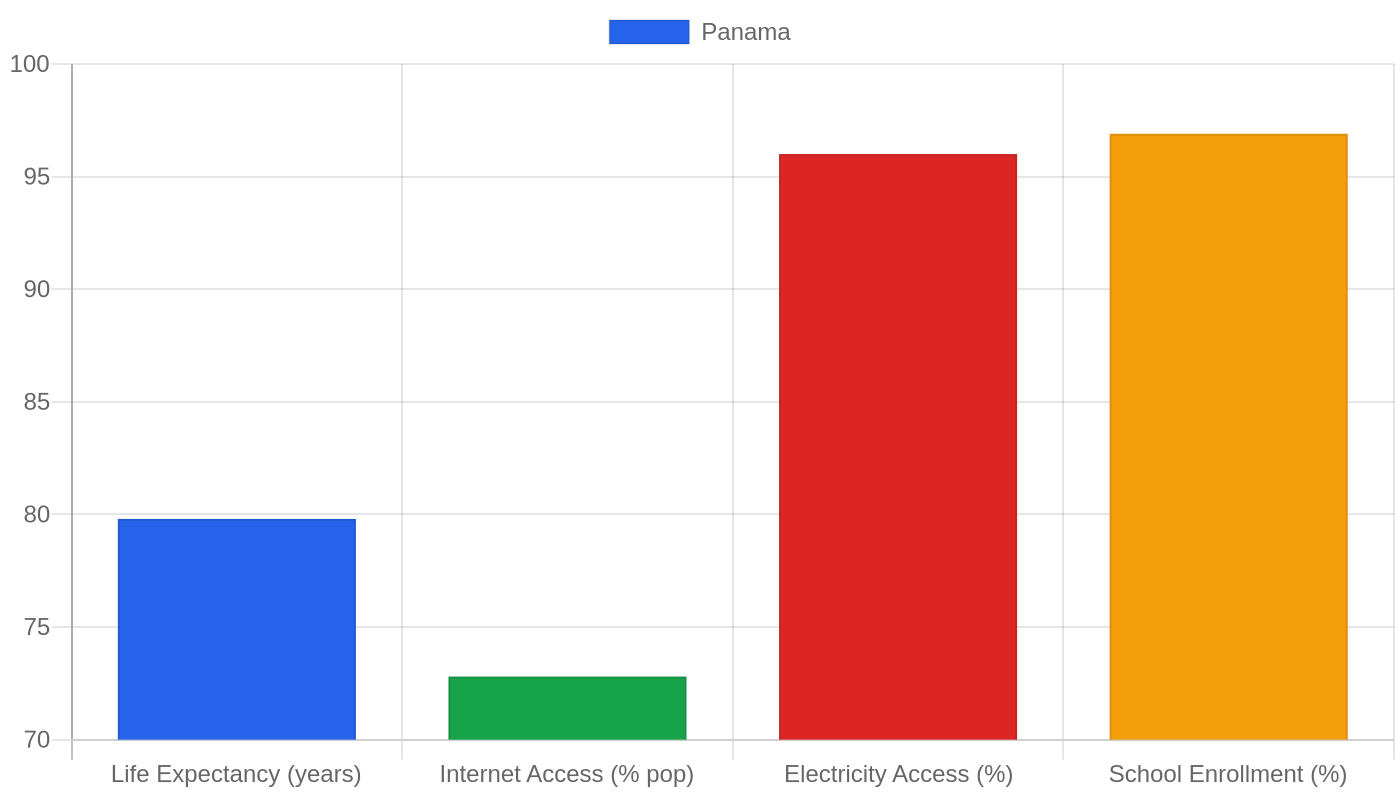
The Panamanian economy has long defied the gravitational pull of its Central American neighbors. Built around the 82-kilometer waterway that connects the Atlantic and Pacific Oceans, Panama has transformed itself into a services-based economy where logistics, banking, and aviation reign supreme. According to the World Bank, the country’s economic structure reflects this unique positioning, though the most recent GDP growth figures are not currently available.
This absence of updated data is itself a story — it suggests either a statistical lag or a deliberate opacity that should concern international observers.
What we do know is that Panama’s economic model has historically been resilient, powered by canal tolls, the Colón Free Trade Zone, and a dollarized financial system that insulates it from currency crises. The country’s GDP per capita on a purchasing power parity basis has traditionally placed it among the wealthiest in Latin America, though the World Bank does not provide current figures.
Inflation, too, remains unquantified in the available data, which is particularly worrying given global price pressures that have affected import-dependent economies across the region. Without these numbers, analysts must rely on anecdotal evidence and regional trends — a precarious foundation for investment decisions.
The Price of Paradise — Housing and Daily Life in a Dollarized Economy
Panama City’s skyline tells a story of wealth and aspiration, with gleaming towers rising along the coastline and the Cinta Costera offering a modern waterfront lifestyle. However, without specific cost-of-living data from the World Bank or other provided sources, painting a precise picture of housing affordability proves difficult.
What can be inferred is that Panama’s dollarized economy means prices are tied to US currency, which historically has made imported goods more accessible but local services more expensive relative to regional neighbors.
The rental market in Panama City has traditionally been bifurcated: luxury high-rises in areas like Punta Paitilla and Costa del Este command premium prices, while more modest accommodations in suburbs like San Miguelito offer relative affordability. The decision to rent versus buy depends heavily on employment stability and access to mortgage financing, which in Panama is dominated by the very financial institutions listed among the country’s top companies.
Daily expenses for groceries, utilities, and transportation have historically tracked closer to US levels than to those of other Central American nations, a direct consequence of the dollarized economy that eliminates exchange rate risk but also limits price competitiveness.
Banking on the Bridge — Investment Climate and Corporate Power
Panama’s business environment has long been defined by its openness to foreign investment and its role as a regional financial center. The top companies list provided reveals a striking concentration in two sectors: aviation and financial services. Copa Airlines and its holding company Copa Holdings dominate the skies, while Banco Latinoamericano de Comercio Exterior and Balboa Bank and Trust anchor the financial sector.
This dual focus reflects Panama’s strategic position as both a transportation hub and a banking destination for Latin American capital.
The aviation cluster is particularly telling. Aeroperlas, Air Panamá Internacional, Air Panama, and Alas Chiricanas join Copa in creating a dense network of consumer-facing carriers, while DHL Aero Expreso and Air Services Cargo handle the logistics backbone. This concentration suggests that air transport is not merely an industry in Panama — it is the industry, connecting the country to markets across the Americas.
For investors, the financial sector offers stability through dollarization and a regulatory framework that has historically favored foreign capital, though the absence of updated GDP and inflation data should give pause to those seeking current economic clarity.
Democracy in the Tropics — Politics, Safety, and Quality of Life
Panama operates as a presidential representative democratic republic, with the President serving as both head of state and head of government within a multi-party system. According to the political landscape data provided, executive power is exercised by the government, while legislative authority rests with the National Assembly. The judiciary maintains independence from both branches, creating a separation of powers that has historically provided political stability in a region often marked by turbulence.
The crime and safety indices are not available in the provided data, which is a significant gap for anyone considering relocation or extended business travel. Panama City has traditionally experienced property crime rates typical of large Latin American capitals, while violent crime has been more concentrated in specific neighborhoods and provinces. The political landscape, while stable on paper, has faced challenges including corruption scandals and debates over canal management.
Quality of life in Panama has historically been rated highly by expatriates, who cite the tropical climate, modern infrastructure in urban areas, and the convenience of dollarization as major draws — though the lack of current safety data means these assessments come with significant caveats.
The Data Vacuum — What We Don’t Know About Panama Right Now
The most striking feature of the current Panamanian economic landscape is what we do not know. The World Bank data provided contains no figures for GDP growth, inflation, unemployment, GDP in absolute terms, GDP per capita, GNI per capita, or population. This absence of fundamental economic indicators is unusual for a country of Panama’s importance and sophistication.
It may reflect reporting delays, methodological changes, or a deliberate decision to withhold data — but regardless of the cause, it leaves investors, journalists, and policymakers operating in a fog.
What we can piece together comes from the corporate landscape and political structure. The dominance of Copa Holdings and its airline subsidiaries suggests that air travel remains robust, while the presence of Banco Latinoamericano de Comercio Exterior indicates continued activity in trade finance. The political framework remains stable, with the presidential system continuing to function as it has for decades.
Yet without knowing whether inflation is accelerating, whether unemployment is rising, or whether the population is growing or shrinking, any analysis of Panama’s current affairs is necessarily incomplete. This data vacuum itself should be a story that international media and investors press the Panamanian government to address.
The Bottom Line
Panama remains one of Latin America’s most strategically important economies, a linchpin of global trade and a regional financial hub that punches well above its weight. However, the absence of current economic data from the World Bank creates a dangerous information gap for anyone considering investment, business expansion, or relocation.
Investors should watch Panama for its aviation and financial services sectors, but they should demand greater transparency from both government and statistical agencies before committing capital. Journalists and analysts should treat the missing data as a story in itself — a silent signal that even the most polished economic narratives deserve scrutiny.
Sources & Methodology
This article is authored by Economic Pulse Net for informational and research purposes. Economic Pulse Net sources its data from multilateral institutions, national statistics bureaus, and proprietary databases. All data is believed to be current as of the date of publication.
Published: July 23, 2026 | Category: Research — Panama
Use these signals in your own platform
Economic Pulse publishes its live signal feed through a documented, read-only API. Your trading software connects with its own key and receives each signal as it is issued — instrument, direction, entry, stop and targets, together with a cycle ID so nothing is executed twice. The feed is independent of this website and cannot change it.
Signals are informational only and are not financial advice.