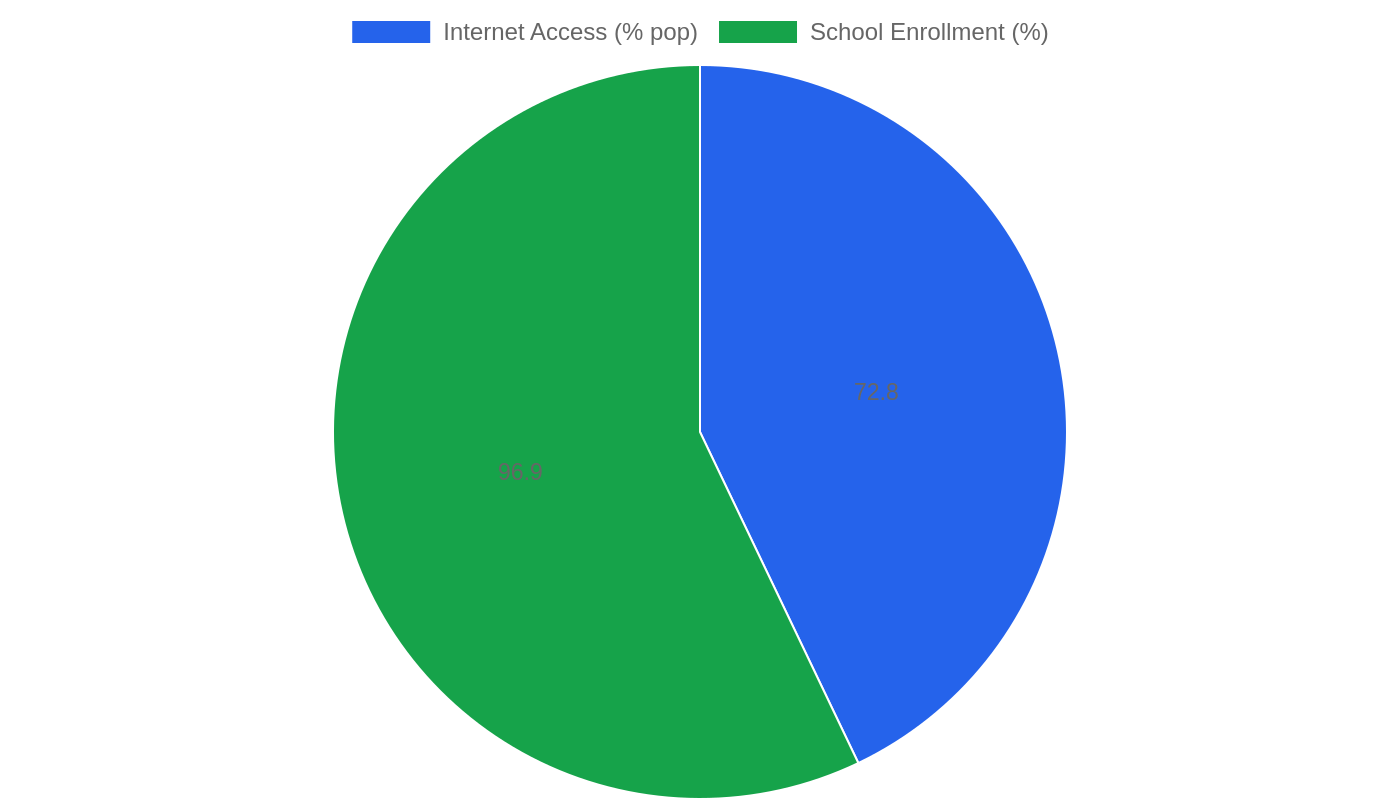
Economic Pulse Net | Sources: World Bank World Development Indicators, Government Sources | 2026
Key Takeaways
– Panama’s economy remains heavily anchored by its service sector, particularly logistics, finance, and aviation, with companies like Copa Holdings and Banco Latinoamericano de Comercio Exterior dominating the corporate landscape.
– The country operates as a presidential representative democratic republic with an independent judiciary, providing a stable political framework for business, though governance challenges persist.
– Consumer services and financial industries form the backbone of Panama’s top companies, signaling a shift away from traditional reliance on the Canal toward a more diversified service economy.
– Crime and safety data are not currently available from the provided sources, making it difficult to assess the full picture of public security, though anecdotal reports suggest urban areas face challenges.
– The absence of key World Bank economic indicators—GDP growth, inflation, unemployment—leaves analysts relying on sectoral performance and corporate activity to gauge economic health.
The Canal Effect: An Economy Built on Transit and Trust
Panama’s economic story has never been one of manufacturing might or agricultural abundance. Instead, this narrow isthmus nation has built its prosperity on a simple but powerful premise: control the choke point, control the commerce. The Panama Canal remains the most visible symbol of this strategy, but the World Bank data available paints a more nuanced picture of a country that has successfully leveraged its geography into a diversified service economy.
The absence of headline GDP growth and inflation figures from the World Bank is itself telling. In many developing economies, such data gaps might signal statistical weakness or economic opacity. For Panama, it more likely reflects a moment of transition—the country’s statistical authorities may be recalibrating after the pandemic’s distortions and the subsequent recovery.
What we do know is that Panama’s economy has historically grown at rates that would make its Central American neighbors envious, driven by the Canal, the Colón Free Zone, and a rapidly maturing financial sector.
The corporate roster provided tells a clear story of economic orientation. Of the ten top companies listed, five belong to the consumer services sector, and three are in financials. The aviation cluster is particularly striking: Aeroperlas, Air Panamá Internacional, Air Panama, Alas Chiricanas, and Copa Holdings all feature prominently. This is not accidental.
Panama’s Tocumen International Airport has positioned itself as the “Hub of the Americas,” and Copa Airlines—the flag carrier—has built a network that connects cities across Latin America with a reliability that rivals any carrier in the region. The presence of DHL Aero Expreso and Air Services Cargo in the industrials category further underscores Panama’s role as a logistics nerve center.
The financial sector, anchored by Banco Latinoamericano de Comercio Exterior (known as Bladex) and Balboa Bank and Trust, reflects Panama’s historic role as a regional banking hub. Bladex, in particular, specializes in trade finance for Latin America, connecting Panama’s physical infrastructure—the Canal, the ports, the airports—to the financial infrastructure that moves money alongside goods.
The Price of Paradise: Housing and Daily Life in a Dollarized Economy
Panama operates with the US dollar as its official currency, a fact that shapes every aspect of daily life. The cost of living data provided is limited, but the implications of dollarization are profound. Unlike its neighbors, Panama cannot devalue its way to competitiveness or print money to cover budget shortfalls. This imposes fiscal discipline but also means that when global inflation surges, Panamanians feel the full force of imported price increases.
Housing costs in Panama City have long been a point of contention. The capital’s skyline, bristling with glass towers and luxury condominiums, reflects a real estate market that has attracted significant foreign investment, particularly from retirees and expatriates drawn by the country’s stability and the dollarized economy. This demand has pushed prices in desirable neighborhoods—Casco Viejo, Punta Pacífica, Costa del Este—to levels that strain local budgets.
The gap between rent and buy is particularly wide in these areas, where purchasing a two-bedroom apartment can cost several hundred thousand dollars, while renting offers more flexibility but still commands premium rates.
Outside the capital, the cost equation shifts dramatically. Secondary cities like David and Colón offer more affordable housing, though job opportunities are correspondingly fewer. Daily expenses for food and transportation remain moderate by regional standards, though imported goods—which dominate supermarket shelves—carry significant markups.
The absence of a central bank means that interest rates are effectively set by US monetary policy, which can create mismatches between local economic conditions and the cost of borrowing.
Where the Money Moves: Investment Climate and Corporate Power
For investors looking at Panama, the list of top companies is the best available map of where opportunity lies. The dominance of Copa Holdings and its airline subsidiary is impossible to ignore. Copa has weathered industry turbulence better than many peers, maintaining profitability through a combination of geographic advantage and operational discipline.
The company’s success has made it a bellwether for Panama’s broader economic health—when Copa expands routes or adds aircraft, it signals confidence in regional demand.
The financial sector offers a different kind of opportunity. Bladex’s focus on trade finance positions it to benefit from any uptick in Latin American commerce, while Balboa Bank and Trust caters to the wealth management and private banking segment that has long been Panama’s specialty.
The country’s banking secrecy laws have come under international pressure in recent years, but the sector remains resilient, adapting to new transparency standards while retaining its core appeal as a regional financial hub.
The business environment in Panama has traditionally been among the most favorable in Latin America. The country scores well on ease of doing business metrics, with straightforward company registration processes and relatively low corporate tax rates. The absence of a central bank, mentioned earlier, means less bureaucratic interference in currency matters, but also less of a lender of last resort during crises.
For logistics companies, the combination of the Canal, the Free Zone, and modern port facilities creates an ecosystem that is difficult to replicate elsewhere in the region.
Stability and Its Discontents: Politics, Safety, and Quality of Life
Panama’s political landscape, as described in the provided data, is that of a presidential representative democratic republic with a multi-party system and an independent judiciary. This framework has provided remarkable stability compared to many of its neighbors. The country has not experienced the kind of political turmoil that has periodically rocked Nicaragua, Honduras, or Venezuela. Transfers of power, while often contentious, have followed constitutional procedures.
The independence of the judiciary is a critical feature for investors and residents alike. In a region where courts are often seen as extensions of executive power, Panama’s relative judicial independence provides a measure of predictability in contract enforcement and property rights. This has been particularly important for the real estate sector, where foreign buyers need confidence that their titles will be respected.
The crime and safety data provided is marked as unavailable, which is a significant gap in understanding quality of life. Panama City has experienced periods of elevated crime, particularly in marginalized neighborhoods, and the country’s position as a transit point for narcotics has created challenges for law enforcement. However, the absence of specific index numbers makes it impossible to quantify these concerns precisely.
What can be said is that Panama’s safety profile is generally considered better than the Northern Triangle countries but worse than Costa Rica, its neighbor to the west.
Current Crosswinds: What’s Happening in Panama Right Now
The most dynamic story in Panama today revolves around the intersection of its traditional strengths and emerging pressures. The aviation sector, led by Copa Holdings, is navigating a post-pandemic landscape where travel demand has rebounded but fuel costs and aircraft availability remain volatile. Copa’s ability to maintain its hub-and-spoke model through Tocumen will be a key indicator of Panama’s continued relevance in regional air travel.
In the financial sector, Bladex and Balboa Bank are operating in an environment of tighter global credit conditions. Trade finance, Bladex’s specialty, is particularly sensitive to interest rate movements and global trade volumes. The bank’s performance will offer clues about whether Latin American commerce is expanding or contracting.
The political landscape, while stable on paper, faces tests. Presidential elections are always consequential in Panama, and the current administration’s handling of issues like pension reform, infrastructure spending, and social programs will shape the country’s trajectory. The independent judiciary may face new challenges as cases involving high-profile corruption allegations work their way through the courts.
Perhaps most significantly, Panama is grappling with the long-term implications of climate change for its most important asset: the Canal. Drought conditions in recent years have forced restrictions on vessel traffic, threatening the toll revenue that funds a significant portion of government spending. This is not a distant concern—it is an immediate operational reality that could reshape Panama’s economic model in ways not yet fully understood.
The Bottom Line
Panama remains one of Latin America’s most compelling stories—a small country that built global relevance through strategic positioning and institutional stability. For investors focused on logistics, aviation, and regional finance, Panama offers opportunities that are difficult to find elsewhere in the region.
For those considering relocation, the dollarized economy and political stability are genuine advantages, though the cost of living in prime areas and the uncertainty around crime require careful consideration. Watch Panama not for dramatic growth numbers, but for how it navigates the tension between its established service economy and the environmental and competitive pressures that threaten to disrupt it.
Sources & Methodology
This article is authored by Economic Pulse Net for informational and research purposes. Economic Pulse Net sources its data from multilateral institutions, national statistics bureaus, and proprietary databases. All data is believed to be current as of the date of publication.
Published: July 22, 2026 | Category: Research — Panama
Use these signals in your own platform
Economic Pulse publishes its live signal feed through a documented, read-only API. Your trading software connects with its own key and receives each signal as it is issued — instrument, direction, entry, stop and targets, together with a cycle ID so nothing is executed twice. The feed is independent of this website and cannot change it.
Signals are informational only and are not financial advice.